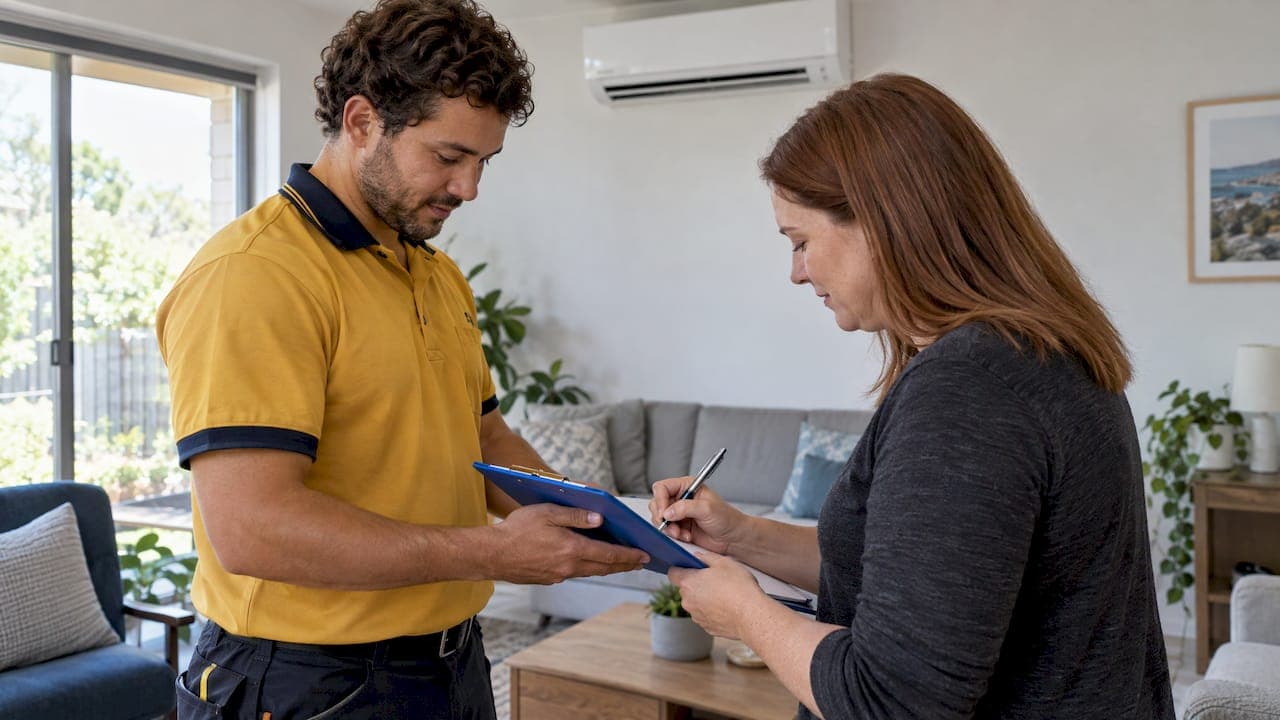
A photo consent form records that a customer agreed to a business taking, storing or publishing images of their property, and states what those images will be used for. For air-con cleaners, the images are usually before and after shots of indoor units, filters and coils. Consent is not always legally required for every photo, but a clear, optional, recorded opt-in is the safest practice, particularly when images are posted online or used in marketing.
TL;DR
- Consent for non-sensitive images is not legally mandated in every case, but the Office of the Australian Information Commissioner (OAIC) treats seeking it before publication as best practice.
- A good form names the business, the purpose, the planned uses, how long images are kept and how to withdraw.
- Marketing use should be a separate, optional tick box, not bundled into the service agreement.
- Record who agreed, what they were told, when and how, and stop using the images when consent is withdrawn.
- Address fields in the same booking form should be accurate, with autocomplete and a manual entry fallback.
Table of Contents
- Why air-con cleaners take photos in the first place
- Is a photo consent form required in Australia?
- What a customer photo consent form should say
- Recording consent so it can be proved
- Where photo consent fits in the booking process
- Capturing the service address accurately
- Our perspective on photo consent
- Keeping consent, photos and bookings in one system
- A simple consent wording structure
- FAQ
- Sources
Why air-con cleaners take photos in the first place
Photos serve three separate purposes in this trade. The first is job documentation: a before and after record shows what was found and what was done, which protects the operator if a customer later disputes the work. The second is customer communication: images attached to a report show a homeowner or property manager the condition of a unit. The third is marketing: the same images may appear on a website, a social media page or a quote.
Each purpose is a different use of the same file. A customer who accepts photos for the job record has not necessarily accepted publication on a public page. This is the reason consent forms are best written around purposes rather than around the photo itself. The MyAirCare guide to before and after photos for air-con cleaners covers how to capture the images; this article covers the permission side.
Images of units seldom show faces, but they can show more than expected: a living room, family photographs on a wall, a street number, a car in a driveway. These details can make a person identifiable, which matters under privacy law.
Is a photo consent form required in Australia?
The answer depends on what the image shows and who is taking it.
The OAIC states that photographs and videos are personal information where a person's identity is clear or can reasonably be worked out. Organisations covered by the Privacy Act may collect them only where reasonably necessary for their functions or activities. The OAIC also says that express consent is not legally mandated for collecting non-sensitive images, but that seeking it is best practice before publication, especially on the web, after the individual has been told the specific purpose and audience.
The same guidance says consent will probably be needed to use an image for something the person was not told about, unless they would reasonably expect that use. A customer who agreed to documentation photos would not ordinarily expect those photos to appear in an advertisement.
Does the Privacy Act apply to a small cleaning business?
The Privacy Act 1988 generally does not cover small businesses with annual turnover of $3 million or less. The OAIC lists exceptions, including health service providers, operators of residential tenancy databases and businesses that trade in personal information. Small businesses that are reporting entities under the Anti-Money Laundering and Counter-Terrorism Financing Act 2006 must also follow the Australian Privacy Principles for activities related to that Act.
Most sole-trader air-con cleaners therefore fall outside the Privacy Act. A consent form is still worth using. It sets expectations, reduces disputes, supports a professional image and prepares the business for growth: a business that later passes the turnover threshold, or takes on larger commercial clients with their own privacy requirements, already has the process in place. Commercial clients such as strata managers and facilities teams may also require evidence of how images of their sites are handled. Operators with questions about their own status can check the OAIC small business page or ask a privacy lawyer.

What a customer photo consent form should say
Australian legal guidance describes a good consent form as plain, specific and affirmative. Sprintlaw's guidance on privacy consent forms says the form should identify the business, the purpose, the planned uses, any disclosures, retention and the method of withdrawal, and that separate opt-ins should be used for distinct purposes.
The table below turns that into a working checklist for an air-con cleaning business.
| Element | What to include | Example wording direction |
|---|---|---|
| Who is asking | Trading name, ABN and contact details | The business name that appears on quotes and invoices |
| What is captured | Photos and video of units, filters, coils, the work area | Images of the air-conditioning equipment and surrounding work area |
| Purpose one | Job record and proof of work | Images are kept as a record of the condition and the work completed |
| Purpose two | Sharing with the customer or property manager | Images may be included in service reports |
| Purpose three | Marketing, with the channel named | Website, social media, printed material |
| Identifying details | What will be removed or cropped | Faces, street numbers, documents and personal items are excluded |
| Retention | How long the images are kept | A stated period, such as the warranty or records period the business follows |
| Withdrawal | How to withdraw and what happens | A phone number or email, and a promise to stop using the images |
| Optional status | Confirmation that refusing does not affect the service | The service proceeds whether or not marketing use is approved |
Keep marketing consent separate
The Australian Beauty Association advises separating media consent from general treatment or service consent to avoid bundled agreements. Marketing photography should be explicitly optional and should not influence the primary service. The advice is written for beauty businesses, but the principle transfers directly to any service business that photographs customers or their premises.
In practice, this means two tick boxes. The first covers documentation photos needed to do and prove the job. The second, unticked by default, covers marketing use. A customer who declines the second still receives the same booking, price and service.

Use plain wording
Short sentences work better than legal phrasing. A form that says "We may use photos of your air conditioner on our website and social media pages. You can say no, and you can change your mind later" is easier to understand, and therefore more likely to count as informed consent, than a long paragraph of clauses. Written consent covers a customer's own images; where a property has tenants or an owner who is not the person booking, the form should identify who is giving permission.
Recording consent so it can be proved
Consent that cannot be shown later has little value. Sprintlaw's guidance recommends an active opt-in, such as a checkbox or signed form, and a record of who consented, what they were told, when and how.
UK Information Commissioner's Office guidance, written for UK data protection law and used here only as general practice, describes the same audit trail: a dated, signed document or a timestamped digital record showing who consented, what information they received and when.
For an air-con cleaner, a workable record contains:
- The customer's name and booking reference.
- The version of the consent wording shown at the time.
- Which boxes were ticked: documentation, marketing, or both.
- The date and time, and whether consent was given on a booking page, on a mobile device on site or on paper.
- Any later change, including withdrawal.
Other service sectors have published detailed guidance on this. A guide to consent forms for Australian studios shows how verifiable records and evidence of what a person agreed to are handled in a related appointment-based trade. Messaging consent follows similar logic: guidance on opt-in rules and audit records explains why the exact consent text and the record of agreement should both be kept. Operators who send text reminders can also read the MyAirCare article on SMS marketing laws for Australian tradies.
Making withdrawal simple
The ICO guidance states that consent should be as easy to withdraw as it was to give, with an accessible process and a stop to processing based on consent as soon as possible after a request. For a small operator, that means a named contact, a reply within a stated time and a practical step: removing the image from the website and social pages, and noting the withdrawal on the customer record. Images already distributed in print cannot always be recalled, and the form can say so honestly.
Where photo consent fits in the booking process
The best moment to ask is before the visit, not at the door. A booking form or confirmation email can present the two tick boxes alongside the service details. The customer then has time to read and decide, and the record is created automatically. An on-site paper or tablet signature works as a fallback for phone bookings and walk-up jobs.
The customer intake form template for air-con cleaners shows where consent wording can sit next to access notes, unit details and contact preferences. The booking confirmation email guide covers how to repeat the key points once the booking is made. A link to a short privacy and photo statement in that email gives the customer a reference point.
Photo consent also connects to compliance paperwork. Documentation photos are often part of a service record, as described in the aircon service checklist for technicians, so the documentation purpose should be stated in terms that match the records the business already keeps.
Capturing the service address accurately
A consent form usually travels with other booking data, and the service address is the most error-prone field. A wrong unit number or a mistyped suburb means a wasted trip, a missed window and a frustrated customer.
Autocomplete
Address autocomplete suggests matching addresses as the customer types and fills the fields once one is selected. The Government of South Australia's forms platform advises collecting Australian addresses with a single-field autocomplete lookup and allowing manual entry when an address is not listed. The manual option matters for new subdivisions, rural properties and unusual unit numbering.
Addressfinder's widget guidance recommends displaying the selected address on one line and storing the individual address elements in hidden form fields. This reduces form size and limits the chance that users alter the parsed parts. The same guidance recommends testing with a range of addresses, including Australian unit, lot and PO Box addresses.
Validation
Autocomplete helps the customer choose an address; validation checks that the final value is complete and usable. Used together, the two reduce errors: autocomplete prevents most typing mistakes, and validation catches what remains, such as a missing unit number, a postcode that does not match the suburb or a state that does not match the postcode. A typical Australian address record holds street address, suburb, postcode and state or territory, with the country fixed as Australia. A published onboarding schema uses exactly that set, with an Australian postcode format and a state and territory list.
For an air-con cleaner, a third check applies: whether the address sits inside the service area and fits the day's travel time and capacity. Scheduling rules that reject out-of-area addresses at the booking stage save the call-back that would otherwise follow.
What customers should check before submitting
- The unit, apartment or lot number, and the street number.
- The suburb and postcode.
- Access notes, such as a gate code, a roof or ceiling access point, or parking.
- Whether the property is owned, rented or managed, since a tenant may need the owner's or agent's approval.
Address data is personal information too. The form should say that it is used to schedule and perform the service and is not published. The same statement can sit beside the photo consent boxes.
Our perspective on photo consent
Photos are the strongest proof an air-con cleaner has. A before and after image shows a result that words cannot, and it settles most disagreements about what was done. For that reason, we treat consent as part of the job process rather than a legal afterthought.
Our experience running an air-con cleaning business shaped this view. Customers rarely object to documentation photos when the reason is explained. They are more cautious about marketing use, and a separate optional box respects that. Operators who ask clearly, record the answer and honour a withdrawal build the kind of trust that produces repeat bookings and referrals.
MyAirCare is built around that sequence. Online booking pages, customer records, automated reminders and a mobile app with before and after documentation keep consent, photos and job details in one place, under the operator's own brand. Operators do not need a franchise to work this way, and without royalties the systems and the customer relationships stay with the business owner.
Lewis
Keeping consent, photos and bookings in one system
Operators who manage consent by paper forms, text messages and phone notes tend to lose track of what each customer agreed to. MyAirCare brings online booking, customer management, quotes, invoices, payments through Stripe and on-site job documentation together across web and mobile. The Free plan costs $0 per month, MyAirCare Pro is $199 per month and the AI phone agent is $29 per month, as published on the pricing page.

Operators starting out can see the full platform on the MyAirCare home page, including how branded booking pages and service-term customisation support a consistent customer experience from booking to follow-up. Other admin topics are covered in the guides on choosing booking software in Australia, taking deposits online and tax invoice requirements.
A simple consent wording structure
The structure below can be adapted by an operator and reviewed by a lawyer if needed. It is a layout, not legal advice.
- Heading: Photos of your air conditioner and work area.
- Job record (required for the service): We take photos before and after cleaning to record the condition of the equipment and the work done. These are kept with your customer record for a stated period.
- Sharing (optional): We may include these photos in your service report and share it with you, your property manager or your agent.
- Marketing (optional, unticked): We may use photos of the equipment on our website, social media and printed material. We do not show faces, street numbers or personal items.
- Your choice: You can decline marketing use and still receive the service. To withdraw consent at any time, contact us on the number or email shown. We will stop using the photos and remove them from our pages.
The business name, ABN and contact details sit at the top, and the date of consent is stored by the system or written beside the signature.
FAQ
Is a photo consent form legally required for air-con cleaners in Australia?
Not in every case. The OAIC says express consent is not legally mandated for collecting non-sensitive images, but it advises seeking consent before publication, especially online. Many small businesses fall outside the Privacy Act, yet a consent form remains good practice and helps resolve disputes.
Can photo consent be part of the service agreement?
Documentation photos needed for the job can be explained in the service terms. Marketing use should be a separate, optional opt-in so the customer is not pushed into agreeing. The Australian Beauty Association advises against bundling media consent with general service consent.
How long should customer photos be kept?
The form should state a retention period, and the period should match the business's own record keeping, such as the warranty period or the length of time job records are held. Photos used only for marketing should be removed when consent is withdrawn.
Does address autocomplete replace address validation?
No. Autocomplete helps the customer pick a correct address from suggestions, while validation checks that the submitted address is complete and consistent. A manual entry option should remain for addresses that do not appear in the suggestions.
Sources
- Posting photos and videos | OAIC
- Small business | OAIC
- When Would I Need A Privacy Consent Form? | Sprintlaw
- Taking and Sharing Client Photos and Videos | Australian Beauty Association
- How should we obtain, record and manage consent? | ICO
- Data dictionary | Government of South Australia
- Widget best practices | Addressfinder
- Client onboarding validation schema
- Spa consent forms for Australian studios
- WhatsApp opt-in rules and audit records