
SMS marketing is legal in Australia if you have the recipient's consent, include accurate sender identification and a working unsubscribe option, and, from 1 July 2026, register any branded sender IDs you use. The three priorities right now are simple: confirm your consent records are provable, register your sender IDs with your telco, and check your unsubscribe function actually works.
TL;DR:
- Sending branded SMS messages after July 2026 requires registration of each sender ID with your telco, or they will be labeled as unverified, impacting trust.
- Businesses must thoroughly record consent timestamps, sources, and specific wording to stay compliant and be able to prove valid opt-in if audited.
- Every marketing SMS needs clear sender identification and a functional, easy-to-use unsubscribe link like "Reply STOP" to fully meet legal requirements.
- Using third-party SMS providers does not transfer legal responsibility; businesses remain liable for consent, registration, and opt-out compliance.
- Auditing current records, updating templates, and registering sender IDs before July 1, 2026, are essential steps to avoid enforcement actions and penalties.
Table of Contents
- Sms marketing laws Australia: what the Spam Act 2003 requires
- Consent rules for SMS marketing: express, inferred and provable
- SMS Sender ID Register: registration and the 'Unverified' label
- What every marketing SMS must include
- Third‑party SMS providers: who carries the legal risk
- Enforcement and penalties under the Spam Act
- Compliance checklist: what to do before 1 July 2026
- Why this matters more for trades and booking-based businesses
- How MyAirCare keeps your SMS workflow compliant by default
- Sources
Sms marketing laws Australia: what the Spam Act 2003 requires
The Spam Act 2003 governs commercial electronic messages, and that definition covers SMS, MMS and instant messages that offer, advertise or promote a business, product or service. If part of a message promotes your business, even alongside a booking confirmation or job reminder, the whole message falls under the Act.
Three obligations sit at the centre of the law. Every business sending marketing text messages must have:
- The recipient's consent, either express or inferred
- Accurate sender identification so the recipient knows who is messaging them
- A functional, easy-to-use unsubscribe facility
Miss any one of these and the message breaches the Spam Act's promotional messaging rules, regardless of whether the commercial content was the main point of the text or a small add-on to an otherwise transactional message.
Consent rules for SMS marketing: express, inferred and provable
Consent comes in two forms. Express consent is when a customer actively opts in, ticking a box on a booking form, replying "yes" to a prompt, or signing up through your website. Inferred consent applies when there's an existing business relationship, such as a client who's booked your services before and would reasonably expect a follow-up message about a related service.
To stay audit-ready, record:
- The timestamp of when consent was given
- The source (booking form, quote follow-up, in-person conversation)
- The exact wording the customer agreed to
Store these records somewhere searchable, ideally attached to the customer's profile in your booking or CRM system, so you can retrieve them quickly if ACMA ever asks.
Never buy contact lists or use address-harvesting software. The Spam Act 2003 explicitly prohibits harvested address lists, and a purchased list gives you no defensible consent trail at all.
Pro Tip: Capture consent at the point of booking or quoting, not as a separate marketing sign-up step. A single checkbox at checkout does the job and creates a timestamped record automatically.
SMS Sender ID Register: registration and the 'Unverified' label
From 1 July 2026, any business sending branded text messages must register its branded sender IDs on the SMS Sender ID Register. This applies whether you send under your own business name, a trading name, or a franchise brand.
Key points to act on:
- Each branded sender ID needs its own registration, so a business using multiple trade names must register each one separately
- You apply through your telecommunications provider or messaging service, not directly through a government portal
- If you hold an ABN, your sender ID must align with your registered business name, company name, trademark, or domain
- Messages from unregistered branded IDs will be labelled 'Unverified' after the deadline, and grouped with other unverified messages
The Telecommunications (SMS Sender ID Register) Industry Standard 2025 sets out how participating carriers must handle this process, including notifying customers about registered versus unregistered status. ACMA has confirmed that texts will "look different" from that date, an intentional change designed to help customers spot impersonation scams. For a small trades business, an 'Unverified' label next to your booking reminder isn't just a compliance footnote. It's a trust problem that can cost you replies and repeat bookings.
What every marketing SMS must include
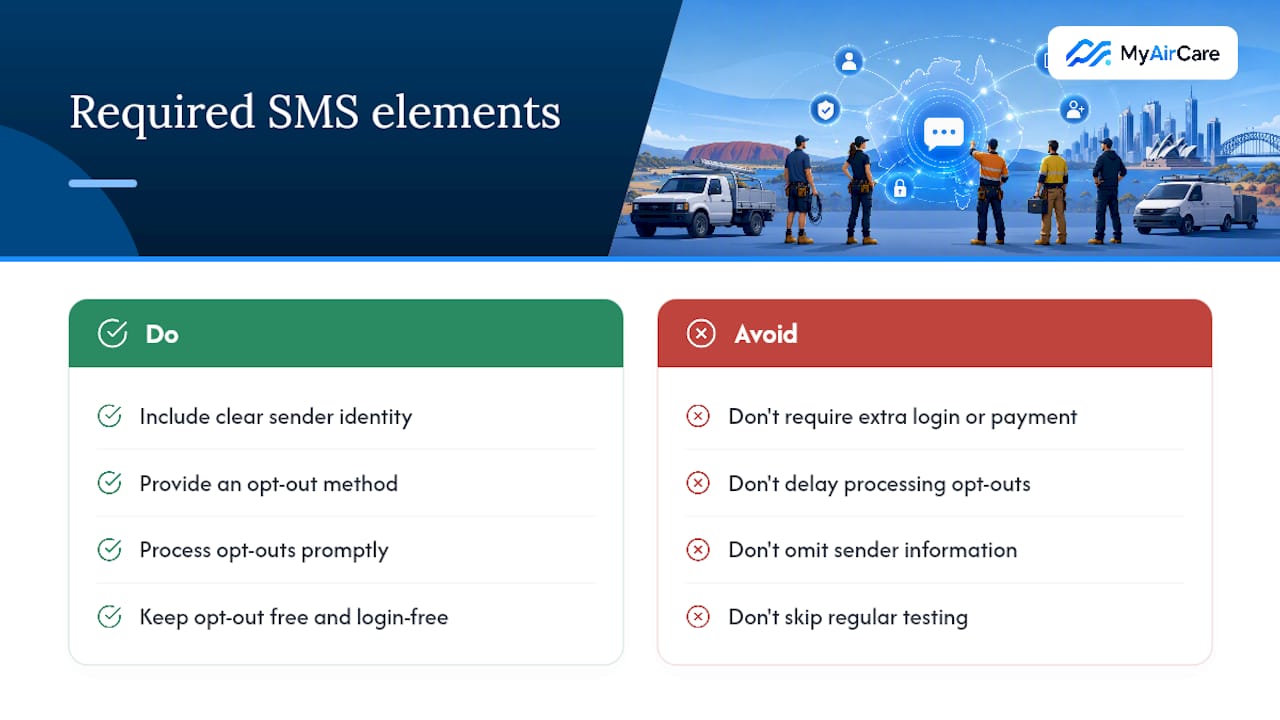
Every commercial text message needs two things: sender information the recipient can identify, and a working way to opt out.
The unsubscribe rules are specific. Under ACMA's fact sheet on email and SMS unsubscribe requirements, opt-out requests must be processed promptly, be free with no extra login or personal details required, and remain available for a reasonable period after the message was sent
A simple "Reply STOP to unsubscribe" line, paired with a short web link for more detail, satisfies both the sender identification and opt-out requirements in one line of text.
Pro Tip: Test your own unsubscribe function every few months by sending yourself a marketing message and actually replying STOP. If it doesn't process automatically, you're carrying legal risk you don't know about.
Third‑party SMS providers: who carries the legal risk
Using a booking platform or SMS provider to send your marketing messages doesn't shift legal responsibility away from your business. ACMA guidance is clear that the sending business remains liable for consent and unsubscribe compliance, even when a third party handles delivery.
Before signing with any provider, check for:
- Confirmation they operate as a participating telecommunications provider under the Sender ID Industry Standard
- Support for registering your branded sender IDs on your behalf
- Audit logs you can access to prove consent and delivery timing
- Clear data handling terms covering how customer numbers and consent records are stored
A platform like Modern DMS's CRM guidance for equipment dealers illustrates how field-service businesses generally structure record-keeping around customer consent and communication history, a useful reference point when assessing your own provider's audit capability.
Enforcement and penalties under the Spam Act
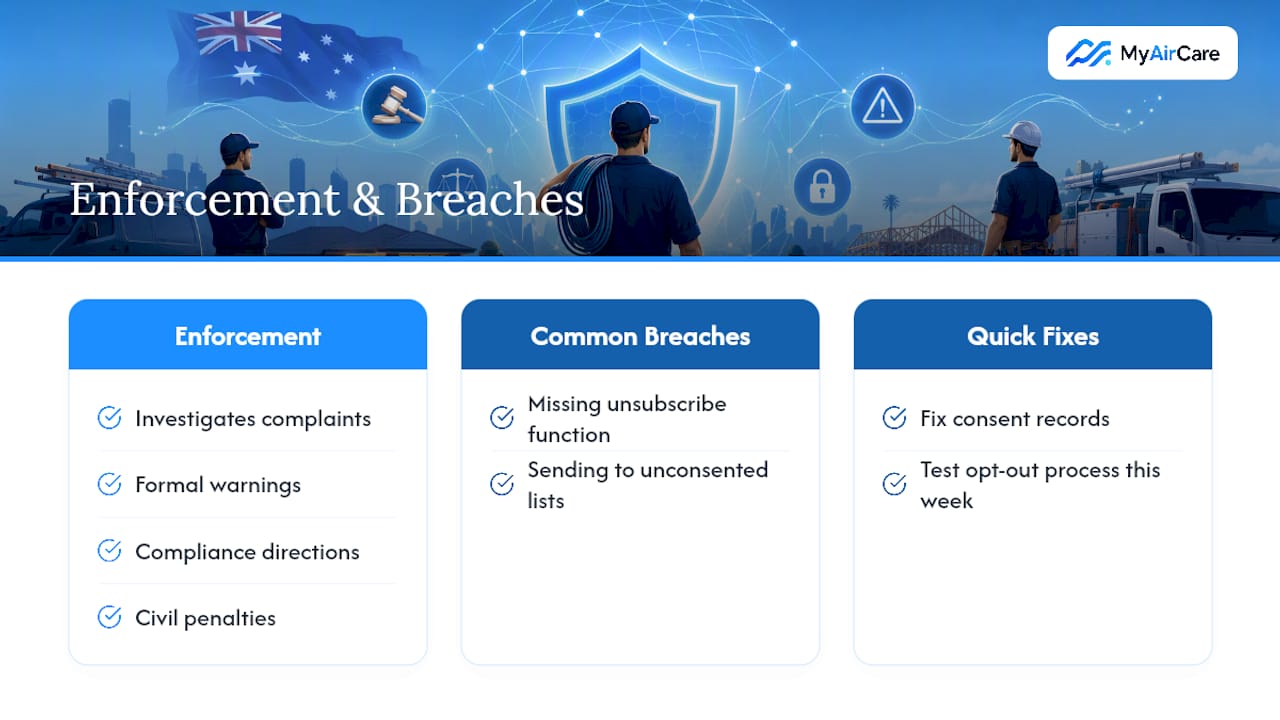
ACMA investigates complaints and can issue formal warnings, compliance directions, or civil penalties for breaches of the Spam Act. Common breaches include missing unsubscribe functions and sending to unconsented lists. Fixing consent records and testing your opt-out process this week removes the two most frequent triggers for a complaint.
Compliance checklist: what to do before 1 July 2026
Work through these steps in order:
- Audit existing consent records for every customer on your SMS list, checking for timestamp, source and wording
- Update message templates to include clear sender identification and a working opt-out line
- Contact your telco or messaging provider to register any branded sender IDs before the 1 July 2026 deadline
- Confirm your provider's obligations in writing, including audit log access and sender ID support
- Set a retention policy for consent records, keeping them for as long as you're actively messaging that customer, plus a reasonable buffer
Complete steps one to four before July if you send branded marketing texts. From 1 July 2026, any registration gap means your messages risk the 'Unverified' label the moment the Sender ID Register takes effect.
Why this matters more for trades and booking-based businesses
Air-con cleaning businesses run on booking confirmations, job reminders and repeat-service prompts, all of which can tip into "commercial message" territory the moment they mention an upsell or seasonal offer. Building consent capture into your booking confirmation and quote follow-up workflows, rather than treating it as a separate marketing task, is what actually keeps a small operation audit-ready without adding admin.
— Lewis
How MyAirCare keeps your SMS workflow compliant by default
There are practical alternatives to juggling spreadsheets, a separate SMS tool, and manual consent tracking across different systems. When booking, reminders and payments are run through a single platform, consent capture can happen automatically at the point a customer books, not as an afterthought.

The platform's automated booking confirmation SMS workflow ties each message to a timestamped booking record, giving you the exact audit trail ACMA guidance recommends without extra data entry. Job reminders and follow-ups may draw from the same consent record, avoiding the need for a separate list to manage or risk sending to the wrong contacts. If you're evaluating providers ahead of the 1 July 2026 sender ID deadline, check how MyAirCare's booking system structures customer records, then see the full platform at MyAirCare or review upcoming tender opportunities to get your booking and reminder workflow compliance-ready before the deadline lands.