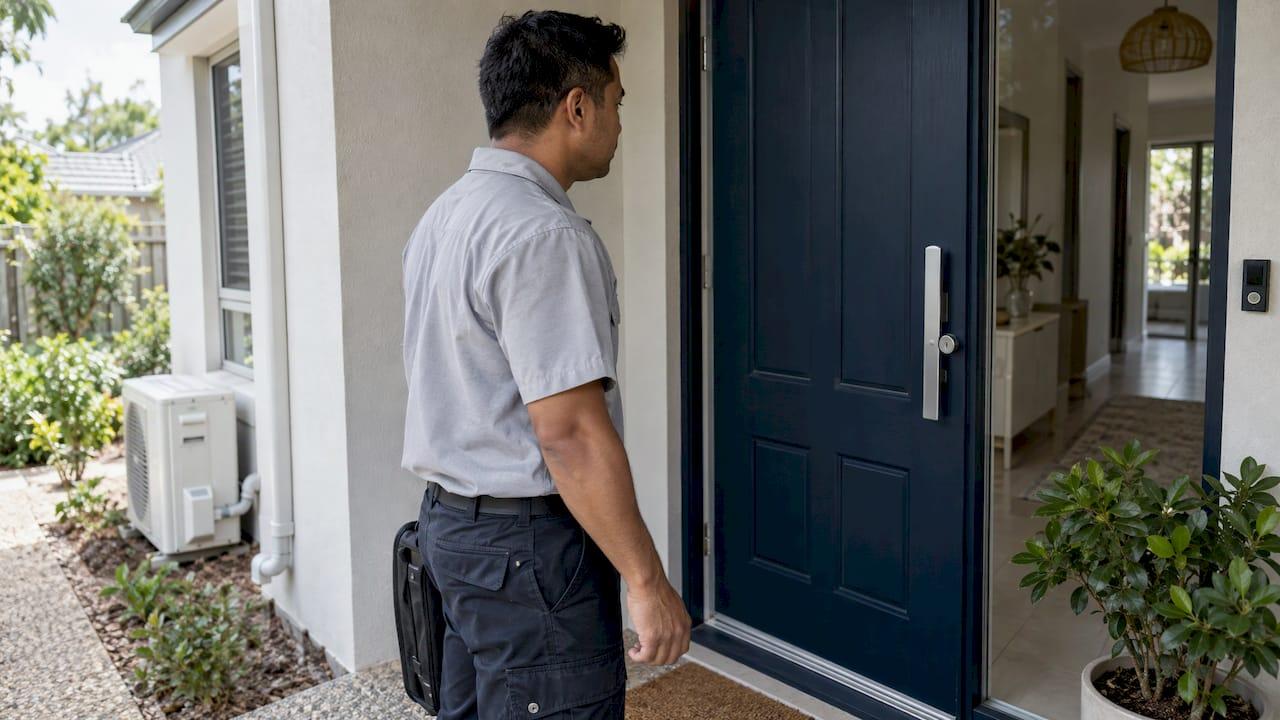
An air-con cleaning business has no reliable published no-show benchmark of its own. Most figures quoted online come from medical clinics, where appointment patterns differ from a two-hour home job. The useful benchmark for an operator is the business's own rate, counted the same way every month and tracked by job type, suburb and day of the week. Online booking, automated reminders and payment at booking give that rate a method for falling, and MyAirCare is built around those functions for Australian air-con cleaners.
TL;DR
- A no-show rate is no-shows divided by appointments that were still booked at their start time, multiplied by 100.
- Published benchmarks mostly describe healthcare. For an air-con cleaning business, the first month of clean data from its own jobs is the more reliable baseline.
- Cancellations with notice and rescheduled jobs stay out of the no-show count. Late cancellations are tracked as a separate figure.
- Each no-show costs a travel leg and an idle slot. Reminders, confirmed bookings and payment at booking address both.
- MyAirCare's Free plan includes online booking, and the Pro plan is $199 per month.
Table of Contents
- What a no-show rate measures
- Why a published benchmark is a weak yardstick
- Counting the edge cases consistently
- Setting a baseline from the business's own jobs
- What a no-show costs an air-con cleaner
- Levers that bring the rate down
- Reading the effect of reminders realistically
- Where the booking system fits
- MyAirCare for operators who want fewer missed jobs
- Perspective
- FAQ
- Sources
What a no-show rate measures
A no-show is a booked appointment where the customer neither attends nor cancels in time. For an air-con cleaner this usually means arriving at a property and finding nobody home, or a customer who cannot give access to the indoor unit or the outdoor condenser.
The rate expresses that as a share of the jobs scheduled. The formula is:
No-show rate = no-shows ÷ appointments still booked at their start time × 100
The denominator matters. Jobs cancelled with notice are not scheduled work at the start time, so they are removed from it. Metabase's metric definition for no-show rate uses the same logic: meetings marked no-show are divided by bookings less cancelled and rescheduled ones, and the page warns that counting a rescheduled booking and its replacement separately double-counts one intended meeting.
A worked example for a small operator:
- 120 jobs were on the calendar at the start of the month.
- 10 were cancelled with notice and 8 were moved to a new date.
- 102 jobs remained booked at their start time.
- 9 of those 102 were no-shows.
The no-show rate is 9 ÷ 102 × 100, which is 8.8%. The 8 rescheduled jobs are counted once, at the slot where they eventually happened or failed to happen.
Why a published benchmark is a weak yardstick
Search results for this topic are dominated by clinic and dental figures. Those industries book patients in short blocks, often weeks ahead, and have different patterns of non-attendance. A home-service job differs in several ways:
- The visit is booked at a customer's property, so access, pets and tenancy arrangements affect attendance.
- A job often runs 1 to 3 hours and fills a large part of a day, so one miss has a larger effect on daily revenue.
- Demand is seasonal. Booking lead times shorten in a hot spell and lengthen in the cooler months, and lead time influences how likely a customer is to forget.
- Many customers are landlords, property managers or tenants, and the person who booked is not always the person at the door.
For these reasons, quoting a single clinic percentage as a target for a cleaning business invites a misleading comparison. A more useful approach is to treat any outside figure as a rough range for context and rely on the business's own history for decisions.
Counting the edge cases consistently
The figure is only comparable from month to month if the counting rules stay fixed. Four decisions should be written down before the first count.
Cancellations with notice
A customer who cancels with enough notice to refill the slot is not a no-show. The notice window is set by the operator, commonly 24 hours, and should be stated in the booking terms so that both sides know it.
Late cancellations
A cancellation inside the notice window gives some warning, but not enough to refill the day. It is better tracked as a separate late-cancellation rate than blended into the no-show rate, because the two problems have different fixes. A no-show often points to a forgotten booking. A late cancellation often points to a change of plans or a quote that was never firmly accepted.
Rescheduled jobs
A rescheduled job should be recorded once. The original booking is kept for the record, the replacement is a new booking, and the two are linked so the customer is not counted twice. A reschedule that happens with notice is not a no-show.
Arrived but could not start
Some jobs fail at the door: nobody to give access, the unit is not reachable, or the customer is present but the job cannot proceed. These should be given their own label, such as no access, and the operator should decide in advance whether the label counts as a no-show. Either choice works as long as it is applied every month.
For operators with several technicians, measurement rules matter more because records are entered by different people. A guide on attendance dashboards for field no-shows covers how field teams can keep a live view of who was where, which is relevant when jobs are logged across a team.
MyAirCare's reschedule message guide sets out how to word a change of date so that the rescheduled job stays linked to the original booking.
Setting a baseline from the business's own jobs
A baseline needs a modest amount of data and a repeatable routine.
- Choose a period. Four to eight weeks of jobs is enough for a sole trader. A larger team can use a month.
- Pull the booked jobs. Take the jobs still booked at their start time, after removing cancellations with notice and rescheduled jobs.
- Mark the outcome. Each job is attended, no-show or late cancellation.
- Calculate three figures. These are the no-show rate, the late-cancellation rate and the share of bookings that were confirmed by the customer ahead of the visit.
- Split the results. Break them down by job type (split system, ducted, commercial), by suburb or service area, by day of the week and by new versus repeat customer.
The split is where the benchmark becomes useful. A business may find an overall rate that looks acceptable while new customers booking by phone for the following morning account for most of the misses. That is a specific problem with a specific fix, which an industry-wide figure can never show.
When a business operates across several areas, such as Brisbane's Southside, the Sunshine Coast or Townsville, the same split by service area shows whether one location behaves differently from the others.
What a no-show costs an air-con cleaner
The direct cost is the lost revenue of the slot plus the travel that produced nothing. Using a deliberately simple example with the operator's own numbers:
| Item | Example figure |
|---|---|
| Jobs booked per week | 20 |
| Average job value | $180 |
| No-show rate | 8% |
| Jobs lost per week | 1.6 |
| Revenue lost per week | $288 |
| Revenue lost per year (50 weeks) | $14,400 |
These are illustrative numbers rather than industry data, and the operator can replace them with their own. The calculation excludes fuel, vehicle time and the way a missed job pushes later jobs back or leaves a gap that cannot be filled at short notice.
The same logic explains why scheduling rules matter. Service-area scheduling, travel-time allowances and daily capacity limits, which MyAirCare includes in its scheduling, reduce the amount of driving built into a day and so lower the cost of any single miss.
Levers that bring the rate down
The published evidence on no-shows is strongest for reminders, and the mechanism is easy to apply to a trade. A reminder gives the customer a second chance to remember, to confirm or to cancel in time. The main levers are listed below.
Reminders at set intervals
An automated message the day before and a short one on the morning of the job covers most forgetting. MyAirCare's guide on starting with one SMS for service reminders describes setting up the first automated message, and the appointment reminder templates give wording that can be adapted. Timing also affects results, which is covered in the guide to the best time to send SMS reminders.
For customers who prefer the app, the guide to WhatsApp appointment reminders covers that channel.
A confirmation straight after booking
A confirmation sent immediately fixes the date, time, address and access details in the customer's phone. The guide to booking confirmation SMS for trade teams shows how a first version can be running within a week.
Payment at the time of booking
A customer who has paid or left a deposit has a stronger reason to attend or to cancel properly. MyAirCare processes payments through Stripe, and the article on integrating payments with bookings explains how payment at booking reduces missed jobs for Australian trades.
Clear terms
The notice window, any cancellation charge and the access requirements are best stated on the booking page before the customer confirms. MyAirCare's branded booking pages allow service terms to be customised, so the rules appear in the same place as the booking itself.
Capturing the booking in the first place
Some lost jobs are not no-shows but calls that were never answered. The guide on missed call text back covers returning a message to a caller the business could not reach. MyAirCare also lists an AI phone agent at $29 per month. Quotes that are never followed up are a related problem, addressed in the quote follow-up guide for air-con cleaning businesses.
For a wider overview, a 90-day plan for reducing no-shows outlines how an organisation can work through attendance problems in stages, and MyAirCare's own article on evidence-backed ways to reduce no-shows applies the evidence to trades.
Reading the effect of reminders realistically
The best-known evidence for reminders comes from healthcare, where baseline non-attendance is high. Systematic reviews of text reminders in clinics find better attendance than no reminder, and texts perform about as well as phone calls. The size of the improvement in an air-con cleaning business depends on its own starting rate. A business that already has a low rate has less to gain than one where a quarter of new bookings fail.
The practical conclusion is to measure before and after. Record the baseline rate for four to eight weeks, switch on automated reminders and confirmations, then count again over the same period with the same rules. The change in the operator's own figure is the result that matters.
Where the booking system fits
Counting no-shows by hand is possible, but it depends on notes being kept on every job. The work is easier when the booking, the reminder, the payment and the job outcome sit in one record.
MyAirCare brings scheduling, quotes, invoices, payments and customer communication together across web and mobile. Customers book online at any hour. Automated reminders go out without the operator sending them. The mobile app supports job tracking, rescheduling, on-site payments and before and after documentation. Because each job carries a status, the monthly counts described above come from the job list rather than from memory.
The same set-up addresses double bookings and unnecessary travel, two pressures that make a missed job more expensive. Scheduling rules follow service areas, travel time and daily capacity.

MyAirCare for operators who want fewer missed jobs
MyAirCare was built by an air-con cleaner for Australian air-con cleaning businesses. The software runs on a free plan, which is supported by booking fees, and a paid MyAirCare Pro plan at $199 per month that unlocks premium features. Full details are on the pricing page.

For those starting out, MyAirCare Training is a one-off $2990 and covers air conditioning hygiene. The Business in a Box package, at a one-off $24990, combines equipment, training, software, business setup and launch support, and lets the owner operate under their own brand without franchise royalties. The Business in a Box page lists what is included. Operators who already trade can look at the software overview.
Perspective
Missed jobs are the cost that owners tend to notice last. The day looks full on the calendar, and the loss only appears when the van is parked outside an empty house.
Our view is that a no-show rate should be treated as an operating figure, not a statistic to compare with other industries. Each operator has a different mix of customers, suburbs and job types, and the useful number is the one that comes from their own calendar, counted the same way each month.
MyAirCare was built by an air-con cleaner, and the booking, reminder and payment tools are designed around that daily reality. Online booking at any hour, automated reminders, payment through Stripe and scheduling that accounts for service areas and travel time all work on the same causes of missed jobs. A new operator who starts with a clear booking process, and records every job's outcome from the first week, builds a baseline that is a genuine asset.
That is the reasoning behind offering software, training and the Business in a Box package together: a business that starts with its systems in place has fewer gaps for jobs to fall through.
Lewis
FAQ
What is a good no-show rate for an air-con cleaning business?
No published benchmark exists for the trade, and the figures quoted online mostly describe clinics. A practical target is a steady downward trend against the business's own baseline, measured with fixed counting rules. Splitting the rate by job type, suburb and customer type shows where the gains are.
How is the no-show rate calculated?
The number of no-shows is divided by the number of appointments still booked at their start time, then multiplied by 100. Cancellations with notice and rescheduled jobs are removed from the count, and late cancellations are tracked as a separate rate. Nine no-shows out of 102 booked jobs gives 8.8%.
Should late cancellations count as no-shows?
They are better recorded separately. A late cancellation gives some notice, while a no-show gives none, and the fixes differ. Whichever rule is chosen, it should be written down and applied every month so the figures remain comparable.
Do automated reminders reduce no-shows?
The evidence from healthcare shows better attendance with text reminders than with none, and a text works about as well as a phone call. The size of the improvement for an air-con cleaning business depends on its starting rate, so the right test is to compare its own rate before and after reminders are switched on.
What does it cost to automate booking and reminders with MyAirCare?
MyAirCare has a Free plan at $0 per month, supported by booking fees, and a MyAirCare Pro plan at $199 per month. The AI phone agent is $29 per month. Current details are on the pricing page.
Sources
- No-Show Rate: Definition, Formula & SQL for Metabase
- Evidence Backed 90 Day Clinic Plan to Reduce No Shows
- Real Time Attendance Dashboards: Spot Field No Shows, Protect Privacy