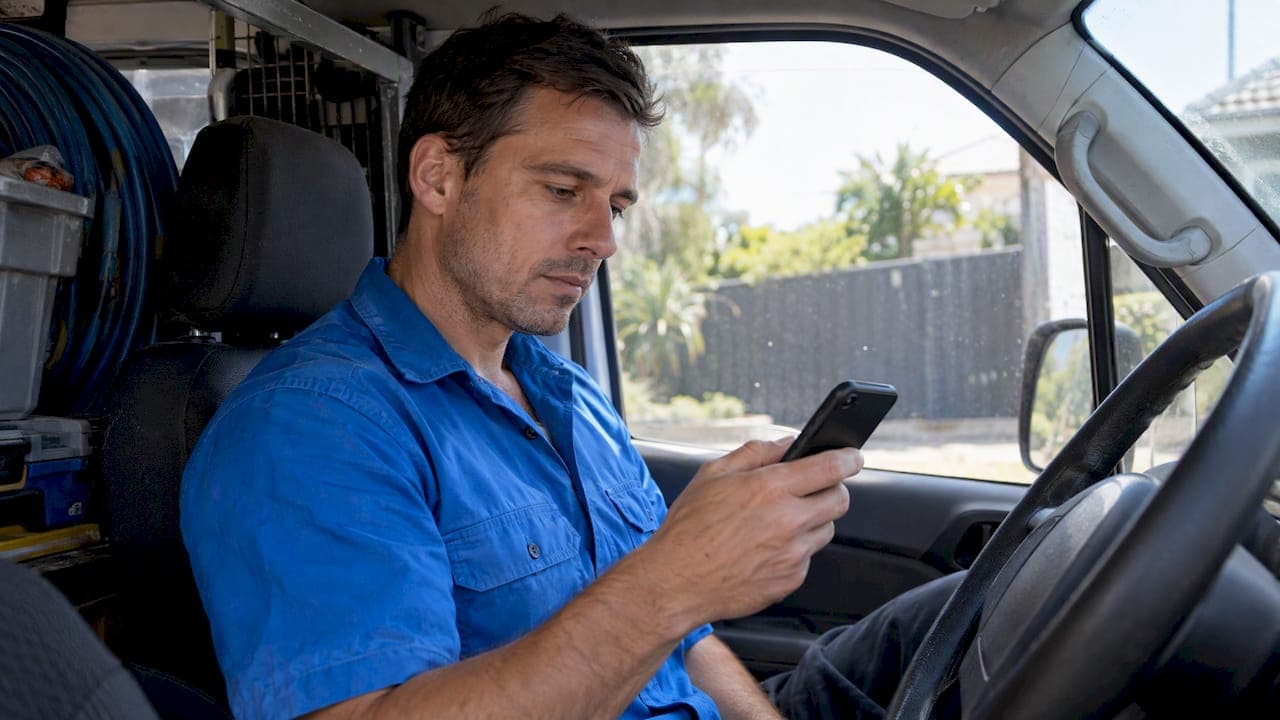
Missed call text back is an automatic SMS sent to a caller within seconds of a call that went unanswered. For an air-con cleaner on a roof or under a ceiling, it keeps the enquiry open until the phone can be picked up. This guide covers how the system works, how to set it up, what the message should say, which rules apply under Australia's Spam Act 2003, and where a text alone stops being enough.
TL;DR
- A missed call text back sends an SMS to unanswered callers, usually within 30 to 60 seconds, and invites them to reply, book online or wait for a call.
- Voicemail loses most enquiries: one Australian industry source reports that 67% of callers who reach voicemail hang up without leaving a message.
- The reply to a missed call is generally covered by inferred consent, but the message must identify the business and offer a working opt-out. Broader marketing texts need separate consent.
- The text should come from a real mobile-format number, not an alphanumeric sender name, so customers can reply.
- The best message gives the caller a next step that needs no phone call, such as an online booking link.
Table of Contents
- What missed call text back is
- Why unanswered calls cost trade businesses jobs
- How the system works, step by step
- Setting up missed call text back
- What the message should say
- Spam Act 2003: what applies to a text back
- Perspective: why the text is only the first step
- Where text back falls short
- Tracking whether it works
- Common mistakes
- Connecting text back to booking and reminders
- Booking pages and the MyAirCare plans
- FAQ
- Sources
What missed call text back is
A missed call text back (also called an auto reply to missed calls, or a missed call SMS reply) is a rule in a phone system or messaging tool. When a call is not answered, the system detects it and sends a pre-written text to the caller's number. The caller can reply, and the reply goes to the business owner or staff member.
The idea is simple. A person who rings a trade business usually has a specific job in mind and is often ringing several businesses. If the first business does not answer, the next one may. A text that arrives while the caller is still holding the phone keeps the business in the running.
One Australian guide describes the intended tone as a continuation of the conversation rather than a marketing blast. It says that using the business's actual phone number lets customers recognise who is messaging and reply directly.
Why unanswered calls cost trade businesses jobs
Trades work against the phone. The work happens away from the desk, on ladders, in roof cavities and in customers' homes, where answering is impractical or rude. Air-con cleaning adds one more factor: demand is seasonal, and the busiest weeks before summer produce the most calls at the time when the schedule is tightest.
The figures that circulate in the Australian market are worth reading with care, because most come from vendors of answering tools. With that caveat, they point in the same direction:
- One source states that up to 40% of calls to Australian trade businesses go unanswered during working hours, and that most callers who reach voicemail do not leave a message.
- The same source reports manual callbacks often take 24 to 48 hours, by which time a high-intent caller has often contacted a competitor.
- Another report cites research that prospects who receive a response within five minutes convert at around eight times the rate of those who wait an hour or more.
These are industry claims, not guarantees for any one business. The direction is consistent, though: speed of first response matters, and a sole trader on a job cannot supply it by phone.
A smaller case illustrates the pattern. A building materials business described losing an enquiry for $15,000 worth of material after one missed call: the caller left no voicemail and bought from a competitor that afternoon. The value of an air-con clean is far lower, but the mechanism is the same, and repeat customers on a service schedule multiply the value of each new customer.
How the system works, step by step
Most missed call text back tools follow the same sequence.
- A call arrives on the business number, or on a forwarding number that points to a mobile.
- The call goes unanswered, is rejected, or is busy. Some tools also trigger when the call is answered by voicemail.
- The system sends the SMS within seconds. Guides commonly quote 30 to 60 seconds as the target window.
- The caller replies or taps a link. The reply arrives as a notification on the owner's phone or in an inbox.
- The owner follows up by text or call, or the caller books without any further contact.
The third step is where setups differ. A text that arrives two hours later has lost most of its value. A text that arrives while the caller is still looking at the screen is the point of the exercise.
Setting up missed call text back
There are three common routes. Each suits a different size of business.
| Route | How it works | Suits |
|---|---|---|
| Phone-system feature | A VoIP or business phone service sends the SMS from the business number when a call is missed | Businesses already using a business phone service |
| Standalone text back service | A forwarding number sits in front of the mobile and sends the SMS on a missed call | Sole traders who want to keep their existing mobile |
| Customer platform with automation | Booking, reminders and messaging sit in one system with the text back as a rule | Businesses that want one customer record |
Whatever the route, the setup checklist is similar.
1. Choose the sending number
The text should come from a number the customer can reply to. Industry guidance warns that alphanumeric sender IDs, where a business name replaces a number, cannot receive replies. That prevents customers from replying STOP, which conflicts with the unsubscribe requirement discussed below. A standard mobile-format number avoids the problem.
2. Decide when the rule runs
Options include every missed call, only calls during working hours, or a different message after hours. Most air-con cleaners benefit from two messages: one for calls missed during a job and one for calls that arrive at night or on weekends.
3. Write the message
Keep it short, name the business and offer a next step that works without a call. Templates follow in the next section.
4. Connect the next step
A text that says "reply with your suburb" creates a manual task. A text that links to an online booking page lets the caller finish the job of booking alone. For this reason, a booking link is the strongest call to action for a service with standard job types, such as split system cleans.

5. Test it
Call the business number from another phone, let it ring out, and check the delay, the sender number, the wording and what happens when the test phone replies. Test the opt-out by replying STOP.
6. Check the call path
A text back is only as reliable as the connection behind the number. Poor internet at a home office or depot can cause dropped calls and delays in cloud phone systems. A guide on NBN business versus residential plans for small businesses covers the trade-offs for operators who depend on internet-based phone or messaging tools.
What the message should say
A good text back does four things: identifies the business, acknowledges the missed call, explains why, and offers one or two ways forward. It should be readable in a notification preview.
Templates for an air-con cleaning business, adjusted to suit each operator:
During a job
Hi, thanks for calling [Business Name]. We are on a job and cannot answer right now. Book a clean online here: [link]. Or reply with your suburb and the type of unit and we will text back today. Reply STOP to opt out.
After hours
Hi, you have reached [Business Name] after hours. Book a time online here: [link], or reply and we will respond when we open at 7:30am. Reply STOP to opt out.
Seasonal rush
Thanks for calling [Business Name]. Bookings are busy this week. Check the earliest available times here: [link]. Reply STOP to opt out.
Existing customer due for a service
Hi, [Business Name] here. Sorry we missed your call. Reply with a good time to call, or rebook your service here: [link]. Reply STOP to opt out.
Points that apply to every version:
- One link only. Several links look like spam and lower the response.
- No price lists in the first text. Prices vary by unit type, access and number of units.
- No claims that cannot be kept, such as "we will call in five minutes".
- A named person reads as more natural than a company name alone, but only when a real person will follow up.
Spam Act 2003: what applies to a text back
Australian businesses sending commercial text messages are covered by the Spam Act 2003, enforced by the Australian Communications and Media Authority (ACMA). The ACMA guidance on avoiding spam sets out the core requirements: consent from the recipient, identification of the sender with contact details, and an easy way to unsubscribe.
The unsubscribe requirements are specific. According to ACMA, the facility must be clearly presented, honoured within five working days, free of charge, no more costly than a standard text, and functional for at least 30 days after the message is sent.
For a missed call text, three practical points follow.
Consent. A customer who called the business has given inferred consent to a direct response to that call. Industry commentary notes this does not extend to ongoing marketing. Separate, express consent is needed for future promotional campaigns, and a record of how and when consent was given should be kept.
Identification. The message should state the business name. A text that arrives with no indication of who sent it fails the identification requirement and may confuse the customer.
Unsubscribe. Including "Reply STOP to opt out" is the common approach. It depends on the sender number being able to receive replies, which is another reason to avoid alphanumeric sender IDs.
Penalties can be substantial. One compliance summary notes that a major gambling company was recently penalised $4 million for contraventions. A small trade business is unlikely to face a penalty on that scale, but the rules apply to businesses of every size. A broader overview of the Spam Act's scope for SMS, email and instant messages is available for those who want the legislative detail.
MyAirCare has also published a guide to SMS marketing laws for Australian tradies. Operators with doubts about a specific message or list should check ACMA's guidance directly or ask a lawyer, because this article is general information and not legal advice.

Perspective: why the text is only the first step
We build booking software for air-con cleaners, and our view comes from how those businesses run day to day. A missed call text back solves one problem: the caller is not left in silence. It does not solve the next problem, which is what happens after the caller replies.
In many small businesses the reply starts a manual exchange: the owner finishes a job, reads the text, asks for a suburb, offers two times, waits for an answer and then writes the booking in a diary. Each step is a chance for the customer to drift away or for a double booking to occur. The faster path is for the text to lead directly to a page where the customer chooses a time, confirms the details and pays a deposit if the business requires one.
For that reason, the best use of a text back is as a doorway to an online booking page. The call is missed, the text goes out, and the customer books without a conversation. The owner then sees the job in the calendar, and reminders go out automatically. That sequence also supports repeat business, because the same customer record triggers a service reminder when the next clean is due.
A text back should also be honest. It should not pretend to be a person, and it should not promise an immediate call when the owner is on a roof. Customers in the trade accept "on a job, here is how to book" far more readily than a vague promise that is not kept.
— Lewis
Where text back falls short
A text back is a stopgap, and several situations call for more.
- Customers who prefer to speak to someone. Some callers, particularly older homeowners, will not tap a link. A voice-based option, such as an answering service or an AI phone agent, covers them. Guides on AI receptionists versus voicemail compare costs, which vary widely by provider.
- Complex enquiries. Ducted systems, commercial sites or body corporate work usually need a conversation and a site detail check. A text back can set up the call but cannot replace it.
- After-hours volume. Evening enquiries need a process as well as a message. MyAirCare's guide to handling after-hours bookings covers how to respond in a short window while keeping customer privacy in mind.
- Wrong numbers and spam calls. An automatic text goes to every missed number, including robocalls and wrong numbers. Rules that exclude known numbers, or that wait a short period for a voicemail, reduce the noise.
It is also worth noting what automation is meant to do. One Australian guide to trade automations describes missed call text back as the first of several, alongside quote follow-ups and appointment reminders. The same source estimates that such automation can save tradies 12 to 21 hours a week. That figure is an estimate from a vendor, not a measured result, and actual savings depend on call volume and current habits.
Tracking whether it works
A text back should be measured like any other lead source. A simple monthly record is enough for a sole trader.
| Measure | What it shows |
|---|---|
| Missed calls | How many enquiries reached the phone but not a person |
| Texts sent | Whether the rule is triggering as intended |
| Replies or link taps | How many callers engaged |
| Bookings from text back | The jobs that would otherwise have been lost |
| Opt-outs | Whether the wording or timing causes irritation |
Two cautions apply. First, a booking that came from a text back may also have come from a callback that would have happened anyway, so the figure is an upper estimate. Second, the number of missed calls is a useful signal in itself. If it is high every week, the business may need an additional answering option or a different booking flow, not only a better message.
Common mistakes
- Using a sender name that cannot receive replies. This blocks two-way conversation and the opt-out.
- Sending the text hours later. The value drops quickly as the caller moves on to another business.
- Using the missed call as consent for marketing. The inferred consent covers a direct response, not a promotional campaign.
- No next step. A text that says only "sorry we missed you" adds a task for the owner without moving the customer forward.
- A long message. Anything that does not fit on the notification preview is less likely to be read.
- Never testing. Rules fail silently after a phone plan change or a number port.
Connecting text back to booking and reminders
The text back is the first message in a customer relationship that, for air-con cleaning, can run for years. Filters and coils need regular cleaning, so a first job is often the start of a repeat schedule. The messages that follow include a booking confirmation, a reminder before the visit, and a service reminder when the next clean is due.
MyAirCare has published practical guides on each stage: booking confirmation SMS, appointment reminder templates, service reminder automation and quote follow-up for air-con cleaning businesses. Used together, they replace a string of manual tasks with a sequence that runs from the first missed call to the next scheduled clean.
Booking pages and the MyAirCare plans
MyAirCare is booking and management software built for Australian air-con cleaning businesses. It provides branded online booking pages, automated reminders, customer management, quotes and invoices, a calendar with team collaboration, and a mobile app for job tracking, rescheduling and on-site payments. Online payments are processed through Stripe.
For a business using a text back, the booking page is the destination the message links to. A caller who misses the owner can choose a time online, and the job lands in the calendar without a phone call. An AI phone agent add-on is also listed for businesses that want calls answered by voice. Pricing for that add-on is not published.
The plans, as published on the MyAirCare pricing page:
- Free: $0 per month. A booking fee applies to online bookings. The fee amount is not published on the pricing page.
- MyAirCare Pro: $199 per month, unlocking the premium features.
The platform is designed for GST, ABN and service area requirements, and contracts have no lock-in. The MyAirCare homepage describes the full feature set, and a sample booking page shows how a customer sees the booking flow.
FAQ
How do I text back when I missed a call?
Send a short message from the business number that names the business, acknowledges the missed call and offers a next step, such as a booking link or a promise to reply. Include an opt-out instruction such as "Reply STOP to opt out". Sending promptly, ideally within a minute or two, gives the best chance of keeping the enquiry.
Is a missed call text back legal in Australia?
Yes, when the message complies with the Spam Act 2003. According to ACMA, commercial messages need consent, must identify the sender and must include a working unsubscribe option. A caller's own call is generally treated as inferred consent for a direct reply, but not for ongoing marketing. Operators unsure about a particular message should seek legal advice.
Why am I getting text messages about missed calls?
A business has probably set up an automatic reply that triggers when it cannot answer. The text usually arrives after a call to that business, a wrong number or a call from a number that was returned. If the messages are unwanted, reply STOP. If they continue after five working days, the sender may be breaching the Spam Act, and a complaint can be made to ACMA.
Should the text come from a business name or a number?
A mobile-format number is the safer choice. Sender names cannot receive replies, so customers cannot opt out or continue the conversation, and that conflicts with the unsubscribe requirement that applies under the Spam Act.
Does text back replace an answering service?
No. It keeps the caller engaged, but some callers want to speak to a person or need advice on a complex job. Many businesses use a text back for simple enquiries and a voice option, such as an AI agent or a receptionist, for the rest.
Sources
- ACMA: Avoid sending spam
- Business SMS: Text From Your Business Number, Not the Ute
- AI Receptionist vs Voicemail Australia 2026
- How Australian Tradies Are Using AI to Win More Jobs in 2026
- 7 Automations Every Tradie Needs to Stop Losing Jobs
- $15K lost in 15 minutes
- GoHighLevel Missed Call Text Back: Setup and ROI (2026)
- Spam Act Australia: Email, SMS and Text Marketing Rules Explained