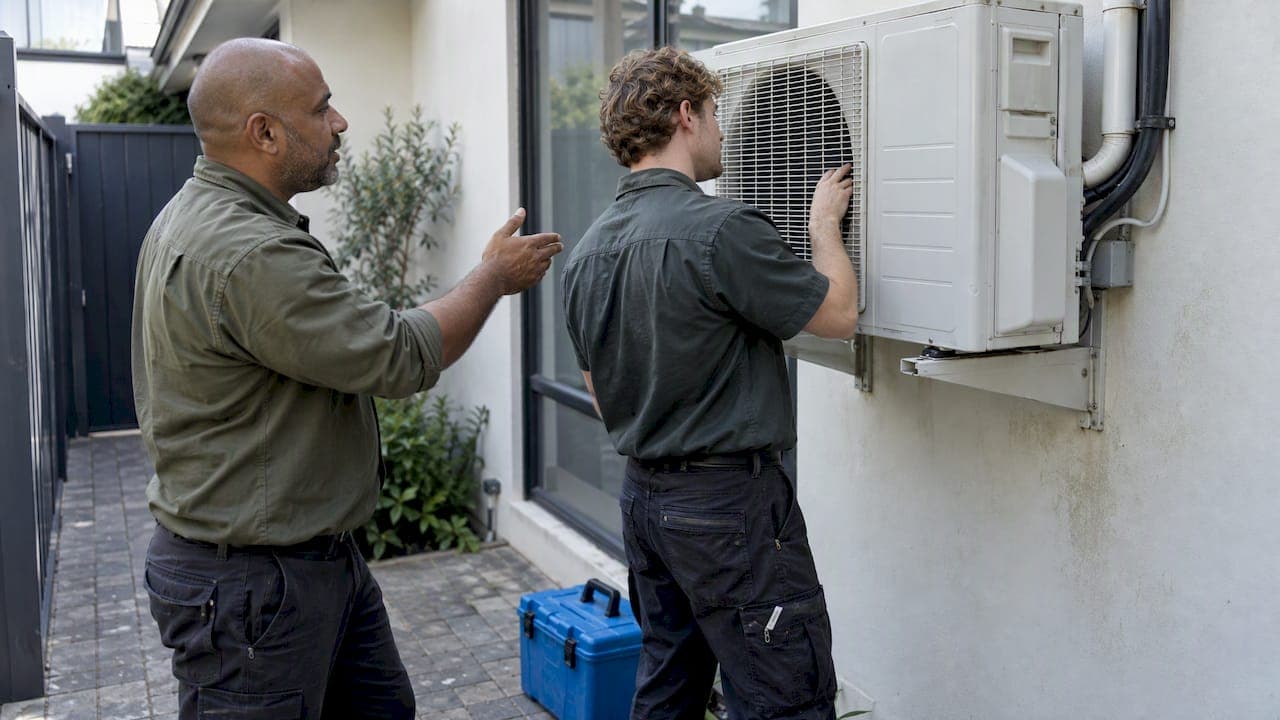
A job handover checklist lists everything an incoming person needs to carry on someone else's work: open jobs and their status, recurring customers, contacts, access arrangements, equipment and the reasons behind pending decisions. In an air conditioning cleaning business, the handover happens when a technician leaves, when a job moves between crews, when an owner takes leave, or when work passes to a new hire. This guide sets out the checklist, a reusable template, a technician daily checklist and the record-keeping points that apply in Australia.
TL;DR
- A handover needs a conversation and a written document. Neither works well alone.
- Each open job should record its status, next action, owner, due date and supporting record.
- Passwords are not written into the document. Access is arranged through the business's own management process.
- Field technicians also need a before, during and after checklist for each job, plus a short daily routine.
- The test of a good handover: a competent newcomer could run the role for a month using only the document and the people named in it.
Table of Contents
- What a job handover should include
- The job handover checklist
- Job handover template
- Handing over a job between technicians
- Technician daily checklist
- Safety and record-keeping in Australia
- Confirming the handover is complete
- Our perspective
- Keeping handovers simple with MyAirCare
- FAQ
- Sources
What a job handover should include
A handover covers the day-to-day responsibilities of the role, the software and processes used, important documents, useful contacts and ongoing projects with their status, deadlines and issues. Reed's guidance on writing a handover lists these same areas, and BrightHR Australia adds team roles, key responsibilities and sensitive information as items the documentation should address.
The Australian Charities and Not-for-profits Commission describes a handover as both a conversation, held face to face or virtually, and a written document. The conversation allows questions. The document remains after the conversation is forgotten.
For an air conditioning cleaning business, the content translates into specific items:
- booked jobs, with dates, addresses, unit types and access notes
- quotes sent and awaiting a reply
- invoices unpaid and payments pending
- customers due for a repeat service
- warranty or complaint follow-ups
- equipment, chemicals and stock held in each vehicle
- supplier, strata manager and property manager contacts
- the booking and scheduling system and who administers it
Start early
A handover is best started weeks before a departure rather than in the final days, so that critical knowledge is captured while the person is still available. Aideveloper makes this point for staff leaving a business. For planned leave, the same applies on a smaller scale: a handover started a week ahead catches gaps that a handover written the afternoon before does not.
Include the unwritten duties
Responsibilities that are not in the job description but have become part of the role often carry the most risk if they are not handed over. Employment Hero's work handover checklist highlights this. In a cleaning business, examples include a regular customer who only accepts Tuesday mornings, a building whose car park needs a booking, or a supplier who gives a better price when called directly. None of these appear in a system unless someone writes them down.

The job handover checklist
The checklist below is grouped by what the incoming person needs to do first. Live commitments come first, recurring work second and background context last. This order follows the prioritisation suggested by Australian Small Business Guide.
1. Live commitments
- List every booked job for the next four weeks, with date, time, address, service type and number of units.
- List quotes awaiting a response and the date each was sent.
- List jobs started but not finished, including what remains.
- List any customer promise made verbally, such as a call-back or a price held.
- List payments and invoices outstanding.
2. Recurring work
- Identify customers on a regular service cycle and the date each is next due.
- Note any standing instructions, for example pets, keys, building access hours or unit locations.
- Note which reminders are automated and which are manual.
3. Access and systems
- Name each system used for booking, quoting, invoicing and payments.
- Record who owns each account and who can grant the incoming person access.
- Do not write passwords in the document. Sensitive credentials should not be included in handover documents, and access should be arranged through established IT or management procedures, as Australian Small Business Guide advises.
4. Contacts
- Customers with special requirements, including commercial clients and strata managers.
- Suppliers of chemicals, filters and replacement parts.
- Other trades the business refers work to or receives work from.
- The person to call when something goes wrong on site.
5. Equipment and stock
- Equipment assigned to the departing person, with its condition and any pending repairs.
- Chemicals and consumables on hand, with safety data sheets available. The guide on how to read an SDS explains what to look for on each sheet.
- Vehicle, uniforms, keys, cards and any other company property to be returned or reassigned.
6. Context and reasons
A handover should explain why the next action is appropriate, so that the incoming person understands the context and does not simply repeat a step. FaultPilot makes this point for maintenance handovers, and it applies equally to a cleaning job. A note such as "customer asked for a quote before the service because the previous clean was disputed" changes how the next call is made.
Job handover template
The template below can be copied into a spreadsheet, a document or a job management system. Each open item has the same fields, so nothing depends on memory. For each open item, the record should show the next action, owner, due date and supporting record, a structure also used in PM Daily's portfolio handover checklist.
| Field | What to record | Example |
|---|---|---|
| Customer and site | Name, address, contact number | Strata manager, 12-unit block, Brisbane Southside |
| Job or item | What it is | Split system clean, six units |
| Current status | Where it stands today | Quote accepted, booking not confirmed |
| Next action | The single next step | Confirm access with building manager |
| Owner | Who is responsible after handover | Incoming technician |
| Due date | When the next action must be done | Written date, not "soon" |
| Supporting record | Where the proof sits | Quote number, photos, job notes |
| Risks or blockers | Impact, workaround, owner, deadline | Access only after 9 am; book the lift in advance |
| Background | Why this approach was chosen | Customer disputed the last clean |
For open tasks and projects, documentation should specify the current status, next required action, assigned owner and agreed deadline. The blockers row follows the same logic: unresolved issues should be recorded with their impact, workaround, owner and deadline, as Worktinue's handover checklist recommends.
A second table can be kept for the role itself, separate from individual jobs:
| Area | What to record |
|---|---|
| Daily routine | Order of work, start and finish times, travel patterns |
| Weekly tasks | Stock orders, vehicle checks, invoicing runs |
| Monthly tasks | Follow-ups with repeat customers, equipment servicing |
| Decisions the role can make | Discounts, rescheduling, refunds, who approves them |
| Escalation | Who to call and when |
Handing over a job between technicians
When a single job moves between technicians, a short version of the template is enough, provided it is complete. A before, during and after structure works well. Kiolo's field service visit checklist describes this pattern for service visits.
Before the job
- Confirm the scope, the unit or asset, and the records from earlier visits.
- Confirm site access, tools, parts and approved safety controls.
During the job
- Confirm the scope on site, record conditions and the work done, and verify the result.
After the job
- Complete the record, attach parts and time used, and give every open action an owner and a due date.
For air conditioning cleaning, the record is strongest when it includes before and after photos and short job notes. The three line job notes template gives a format that a second technician can read in under a minute. The service report template guide covers the longer report a customer may expect, and the aircon service checklist covers compliance and proof of work.
A paper note left in a vehicle is easy to lose. Where jobs are tracked in a shared system, the incoming technician sees the same history the outgoing one did, including photos, notes and payment status. The staff job assignment workflow sets out how field managers can assign and reassign jobs on mobile without losing detail.
Technician daily checklist
A daily checklist is separate from a handover. It keeps the handover from being needed in an emergency, because records are current every day. A practical daily routine for an air conditioning technician has three parts.
Start of day
- Review the day's bookings, addresses and access notes.
- Check that tools, hoses, pumps, drop sheets, chemicals and personal protective equipment are in the vehicle and in working order.
- Confirm that safety data sheets for the chemicals carried are accessible.
- Check the order of jobs against travel time and daily capacity.
During the day
- Take before and after photos for each unit.
- Write job notes straight after each job, not at the end of the day.
- Record any fault found, any recommendation made and any quote promised.
- Take payment on site where agreed, and record it.
End of day
- Close each job in the system and attach photos and notes.
- Flag open actions with an owner and due date.
- Restock the vehicle and note any equipment that needs repair.
- Check the next day's schedule and flag any conflict.
Admin done at the end of each job is much shorter than admin saved for the weekend. The guide on reducing admin time covers practical ways to do this, and the comparison of a work order and a job card explains which document supports billing at which stage.
Safety and record-keeping in Australia
Record-keeping requirements differ by state and territory, and by the type of work. For plant and equipment, the Safe Work Australia model code of practice for managing risks of plant sets out that records of tests, inspections, maintenance and alterations should be kept for as long as the control is in use. Each state and territory adopts or varies the model code through its own work health and safety laws, so a business should check the regulator in the state where it operates.
Technicians who handle refrigerants or electrical work are covered by separate licensing and handling rules in each jurisdiction. A cleaning business should confirm with its state regulator which work requires a licence before assigning a task to an incoming worker. A handover does not transfer a licence: the incoming person must hold the authorisation needed for the tasks handed to them.
A handover should therefore record:
- inspection and maintenance records for equipment, and where they are stored
- any pending maintenance that needs follow-up
- licences and tickets held by each worker, and their expiry dates
- incident or near-miss reports still open
An owner who is unsure about a specific obligation should contact the work health and safety regulator in their state or territory.
Confirming the handover is complete
A document does not prove that the handover worked. Confirmation takes a short, structured meeting.
- Walk through the work together. The outgoing and incoming person go through each open item. Key work is walked through together, and unanswered questions are given an owner and a due date, as the Worktinue checklist recommends.
- Confirm access without sharing logins. The incoming person confirms they can open the records and systems they need through their own account.
- Have the recipient state first actions. The incoming person says what they will do first on each live item, and the accepted responsibilities are recorded. PM Daily describes this approach.
- Introduce key contacts. Where the relationship matters, the outgoing person calls or emails the customer or supplier to introduce the successor.
- Apply the one month test. A useful test is whether someone competent but new could run the role for a month using only the document and the people listed in it, as Aideveloper puts it. If the answer is no, the document has gaps.
- Sign off. Both people and the owner or manager date the document. A copy is stored where the business can find it.
Our perspective
We ran an air conditioning cleaning business before building MyAirCare, and the handover problems we saw were rarely dramatic. They were small and constant: a booking that lived in one person's phone, a note on a paper job card, a customer who expected a call that nobody knew had been promised.
Three habits make the biggest difference in a small cleaning operation.
- Write the job note at the job. A three line note and a few photos take two minutes on site. Reconstructing them later from memory takes far longer and is less accurate.
- Keep one schedule. Double bookings and missed calls usually come from two or three calendars that do not match. One shared schedule that respects service areas, travel time and daily capacity removes most handover confusion before it starts.
- Let reminders carry repeat work. When the next service date is stored against the customer and a reminder goes out automatically, a change of technician does not break the cycle. The appointment reminder templates show what to send.
A handover document is useful, but a business whose records are current every day needs far less of it at the end.
— Lewis
Keeping handovers simple with MyAirCare
MyAirCare is a business management platform built for Australian air conditioning cleaners. It brings online booking, scheduling, quotes, invoices, payments and customer communication together, with a mobile app for job tracking, rescheduling, on-site payments and before and after service documentation. Because the history of each job sits in one place, a new technician or a covering team member sees the same record as the person who did the last visit.

The Free plan costs $0 per month and is supported by booking fees. MyAirCare Pro costs $199 per month. Full details of both plans, the booking fee and the AI phone agent add-on are on the MyAirCare pricing page, and an overview of the platform is on the MyAirCare home page.
FAQ
What is the difference between a handover checklist and a handover template?
A checklist lists the topics to cover, such as live jobs, access, contacts and equipment. A template is the form used to record the detail for each item, with fields for status, next action, owner and due date. Most businesses use both: the checklist ensures nothing is missed, and the template holds the information.
How long before someone leaves should a handover start?
As early as possible, ideally weeks before the departure. Starting in the final days leaves little time to capture knowledge or answer follow-up questions. For short planned leave, a week is usually enough for a small team.
Should passwords be included in a handover document?
No. Credentials should not be written into the document. Access should be arranged through the business's established process, so that the incoming person uses their own account and the owner can remove the departing person's access.
What should a technician checklist cover for each job?
Before the job: scope, the unit, past records, site access, tools, parts and safety controls. During the job: confirming scope, recording conditions and work, and verifying the result. After the job: completing the record, attaching parts and time, and giving every open action an owner and due date.
Who is responsible for confirming that a handover worked?
Both people share it, with the owner or manager signing off. The incoming person states what they will do first on each live item, and the outgoing person corrects any misunderstanding before leaving.
Sources
- How to write a handover | Reed
- Small Charities Library: Handovers | ACNC
- Handover Document: Capture What Staff Know | Aideveloper
- How to write a handover document | BrightHR Australia
- The Ultimate Work Handover Checklist | Employment Hero
- Structured vs verbal handovers | FaultPilot
- Create a useful handover when an employee is leaving | Australian Small Business Guide
- A clearer portfolio handover | PM Daily
- Employee handover checklist | Worktinue
- Field Service Visit Checklist | Kiolo
- Model Code of Practice: Managing risks of plant in the workplace | Safe Work Australia