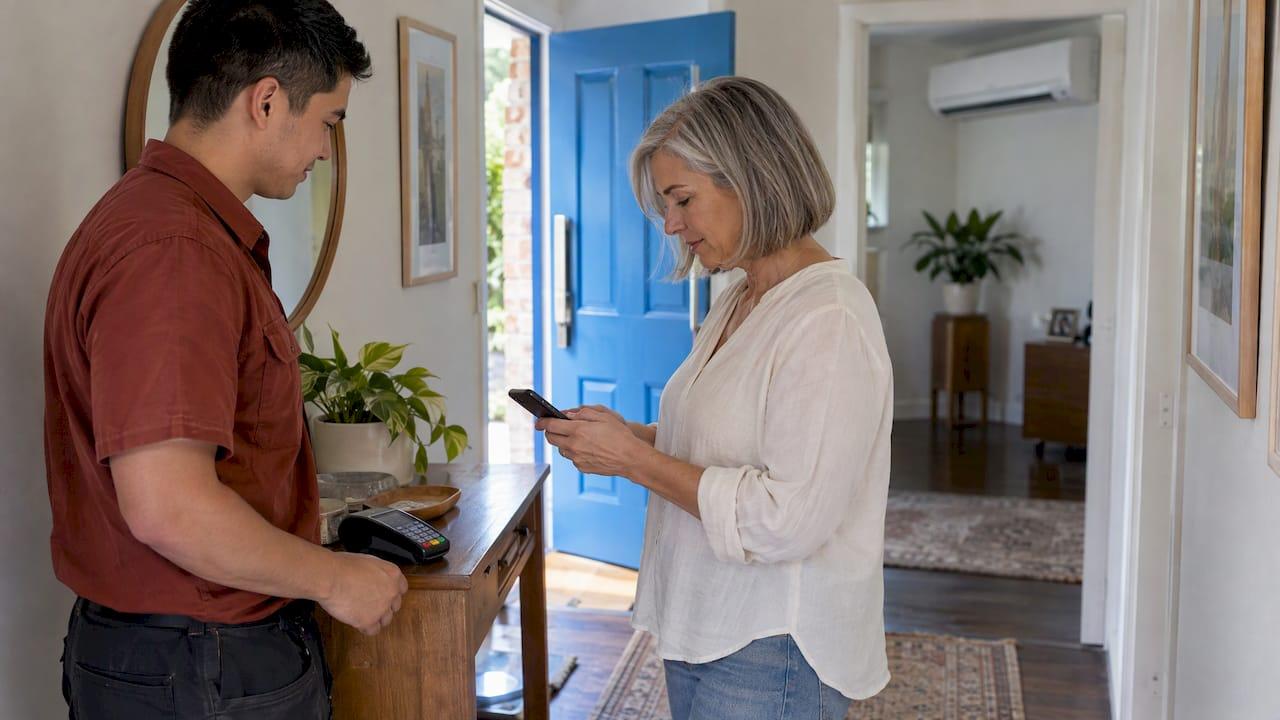
For most air-con cleaning jobs booked by households, card payments are the more practical option. They are taken at booking or on site, are matched to the job automatically and settle in one to three business days. Bank transfers, including EFT, PayID and Osko, suit larger invoices to property managers and commercial clients, where lower processing cost matters more than convenience. Most operators use both, and the choice depends on the customer type, the job value and how payment is tied to the booking.
TL;DR
- A bank transfer moves money directly between two bank accounts. A card payment runs through a card network or the EFTPOS network, and credit cards draw on a line of credit.
- Card payments authorise instantly and usually settle in 1 to 3 business days. PayID and Osko transfers can clear in seconds, at any time of day.
- Card fees are often quoted at roughly 1.5% to 3.5%, and bank transfers usually cost less. Since 1 October 2026, businesses can no longer pass card surcharges on to customers.
- Cards carry chargeback rights and automatic records. Bank transfers generally cannot be reversed once received and need manual reconciliation unless a reference system is in place.
- Residential bookings generally suit cards taken online. Commercial and high-value invoices generally suit bank transfer or PayID.
Table of Contents
- What the terms mean in Australia
- Speed and when the money arrives
- Fees and the end of card surcharging
- Security, disputes and reversals
- Reconciliation and record keeping
- Which method suits which job
- Offering both without extra admin
- Perspective
- Taking card payments with MyAirCare
- FAQ
- Sources
What the terms mean in Australia
The vocabulary around electronic payments overlaps, which causes most of the confusion in this comparison.
EFT (electronic funds transfer) is a general term. According to Stripe's Australian EFT guide, it covers any electronic transfer, and an eftpos card purchase is one type of EFT, alongside BPAY bill payments and PayID transfers. So "EFT vs credit card" really compares two groups of methods: direct account-to-account transfers, and payments made with a card.
A bank transfer is the account-to-account version. The customer sends money from their account to the business's BSB and account number, or to a PayID such as a phone number, email address or ABN. No card is involved.
A card payment is made with a debit or credit card. business.gov.au explains that credit cards let customers pay by creating a debt with a credit card provider, while debit cards deduct the amount from the customer's bank account. Both can be processed online or on a physical EFTPOS terminal.
The EFTPOS option on a terminal adds a further layer. NAB's merchant guide describes three account choices at checkout: Cheque (CHQ), Savings (SAV) and Credit (CR). CHQ and SAV link directly to the customer's bank account through the EFTPOS network, while CR routes through a credit card network such as Visa or Mastercard.
Speed and when the money arrives
Speed has two parts: when the payment is approved, and when the money reaches the business account.
| Method | Approval | Funds available |
|---|---|---|
| Card (online or on site) | Real time | Usually 1 to 3 business days |
| EFTPOS terminal | Real time | Typically 1 to 2 business days, with same-day options at some banks |
| PayID / Osko (NPP) | Seconds | Seconds, 24/7 |
| PayTo | Near real time after setup | Near real time |
| BECS direct debit | Batch | Usually 1 to 3 business days |
| BPAY | Batch | Same or next business day in many cases |
The figures come from Stripe's payment processing guide, which states that card authorisation is real time and settlement usually takes 1 to 3 business days, while NPP payments such as PayID, Osko and PayTo can clear in seconds, even on weekends. NAB states that EFTPOS funds typically settle within one or two business days, with same-day settlement available when settling to a NAB business account before 9:30pm AEST. A 2026 guide from WealthWorks tabulates the BECS and BPAY timings above.
In practice, an instant PayID transfer gives the fastest access to funds. A card payment gives the fastest certainty: the booking can be confirmed at the moment the customer pays, because authorisation happens immediately. Traditional bank transfers sent by a customer from a slower channel are less predictable. Stripe's bank transfer guide notes that funds might arrive in hours or in several days.
For an air-con cleaner, this matters most when a job is booked for the following morning. A booking that is paid by card at the time of booking is secured immediately. A booking waiting on a manual transfer may sit as "pending" until someone checks the account.
Fees and the end of card surcharging
Cost is the main reason some operators prefer bank transfers. Stripe's guide notes that card processing fees are often around 1.5% to 3.5%, which means a $10,000 invoice would carry $150 to $350 in fees, while bank transfers usually cost less. For NPP transfers, Stripe notes that banks usually do not charge customers, but a business might pay a flat fee per transfer.

On a typical residential clean, the fee difference is small in dollar terms. A card fee of a few percent on a job of a few hundred dollars is a modest amount, and it buys instant confirmation, automatic records and refund tools. On a $10,000 commercial contract, the same percentage becomes a larger figure, which is why large invoices often go by transfer.
For the true cost picture, WealthWorks cautions that a comparison should cover the whole process, not just the headline fee. Cards may deliver higher conversion, mature refunds and chargeback rights, while account-to-account pricing can include minimum commitments and integration fees.
The surcharge rule from 1 October 2026
The Reserve Bank of Australia finalised its card payment reforms on 31 March 2026. According to the RBA's summary, card surcharging on both debit and credit cards ended on 1 October 2026, covering eftpos, Mastercard and Visa. The same page reports that 76.0% of consumers wanted surcharging to stop, and that the interchange cap on foreign cards and some transparency changes start on 1 April 2027.
The practical effect is that a card fee can no longer be added as a separate line on the customer's bill. Greenhalgh Pickard reports that acquirers were directed to remove surcharging functionality entirely, whether the business charged a flat or a percentage-based amount. Merchant fees remain a deductible business expense. The firm also notes that some businesses are using the change to review how they accept payments, and that for B2B businesses direct bank transfers remain practical for high-value invoices, while PayID can reduce complexity for B2C businesses.
For operators, the fee is now part of the price of the service. Pricing the service with the fee in mind is simpler than relying on a surcharge. A MyAirCare guide to the surcharge rules covers the details, and a separate explainer on Stripe fees in Australia sets out what processing costs in 2026.
Security, disputes and reversals
The two methods handle mistakes and fraud in different ways.
Card payments can be reversed through chargebacks. Stripe explains that this gives the customer a route to dispute a charge, while for businesses it means keeping records of the job. Businesses that handle card payments are responsible for PCI DSS compliance, and many use fraud prevention such as 3D Secure, according to Stripe's payment processing guide. Using a payment provider that handles card data on the business's behalf keeps this simple.
Bank transfers generally cannot be reversed. Stripe notes that once the money lands, it stays there unless the business sends it back. On the other hand, a transfer requires the customer to log in to their bank or pre-authorise the payment, which makes fraud with a stolen number more difficult.
Consumer protections still apply to electronic payments. The ASIC ePayments Code sets out the rules for unauthorised transactions and mistaken internet payments. Under the Code, where a user reports a mistaken internet payment within 10 business days and the sending bank is satisfied it occurred, the receiving bank must return the funds within 5 business days if practicable, up to a maximum of 10 business days, according to the ASIC ePayments Code. ASIC's Report 718 clarifies that the Code's unauthorised transaction protections are separate from card scheme chargebacks, which generally run to around 120 days.
The Code has limits. Commonwealth Bank's terms state that it does not apply to any transaction performed using a business account, which is relevant when a commercial client pays by transfer.
One scam point applies to businesses that take transfers. WealthWorks recommends a two-person process for changes to bank details on supplier payments above a set threshold such as $5,000, and warns that the speed of an NPP payment can narrow the recovery window. A call from someone claiming to be a bank's fraud team should never lead to moving money.

Reconciliation and record keeping
Bank transfers arrive with limited information. Stripe notes that they come without built-in metadata, which leads to messy reconciliation, and that customers sometimes type the wrong amount or apply an unauthorised discount. The reference field is often the only link between a payment and a job.
There are ways to reduce the effort. Stripe's EFT guide notes that EFT automatically generates digital records and that NPP messages can carry detailed invoice references, which minimise manual matching. Using the invoice number as the payment reference, and a PayID tied to the business, helps.
Card payments taken through a booking system avoid most of this. The payment is attached to the booking, the customer and the invoice at the moment it is made, so there is nothing to match later. This is the main operational argument for cards on residential work.
Which method suits which job
| Situation | Suits | Reason |
|---|---|---|
| Household split clean booked online | Card at booking or on site | Instant confirmation, automatic record, refund tools |
| Deposit to hold a time slot | Card | Payment is secured before the visit |
| Annual or repeat service | Card on file | Reminder and payment can be automated |
| Property manager or strata invoice | Bank transfer or PayID | Lower cost, usual practice for B2B |
| Large commercial contract | Bank transfer | Percentage fees grow with invoice value |
| Customer without a card to hand | PayID or QR payment | Fast and no terminal needed |
NAB's guide notes that bank transfers are suitable for B2B but not ideal for in-person retail, while EFTPOS suits businesses that are on the go. business.gov.au states that electronic credit and debit cards are the most common payment method and that most in-store card transactions now use contactless payment.
One coverage point is specific to field work. The same business.gov.au page notes that EFTPOS and other electronic systems need electricity and an internet connection, so the location of the job matters. In areas with weak reception, a second option, such as a transfer or a payment link sent later, keeps the job payable.
Operators who want to go deeper on particular methods can look at guides on taking deposits online, card on file payments, QR code payments and Tap to Pay on iPhone.
Offering both without extra admin
A practical setup for an air-con cleaning business has three parts.
- Cards as the default for residential bookings. The customer pays online when booking or on site after the job.
- PayID or bank transfer for commercial invoices. The invoice carries the PayID and a unique reference.
- A process for unpaid invoices. Payment links and reminders reduce chasing. A guide on failed payment recovery covers this for air-con cleaners.
Tying payment to the booking also reduces no-shows, as covered in a guide to integrating payments with bookings.
Perspective
MyAirCare was built by someone who has run an air-con cleaning business, and the payment question comes up in almost every conversation with new operators. The usual starting point is the fee. The more useful starting point is how much time each payment takes to collect, match and confirm.
Our view is that cards, taken through the booking, remove the most admin for residential work. The customer pays when booking, the slot is held, the receipt and invoice are generated, and the payment is recorded against the right job. Secure processing through Stripe is built into the platform for this reason.
Now that card surcharging has ended, the fee is simply a cost of doing business, and the sensible response is to price jobs with it included. We do not see this as a reason to avoid cards. A paid booking is worth more than an unpaid one, and the platform's online booking, reminders and on-site payments are designed to get more bookings paid.
Bank transfers still have a place for commercial clients, and invoices with a PayID or reference are straightforward to send from the same system.
Lewis
Taking card payments with MyAirCare
MyAirCare brings online booking, quotes, invoices and Stripe payments together for Australian air-con cleaners. Customers can book and pay at any hour through a branded booking page, and the mobile app supports on-site payments and before and after documentation.

The Free plan costs $0 per month and is supported by booking fees. MyAirCare Pro is $199 per month, and the AI phone agent is $29 per month. Full details are on the MyAirCare pricing page, and an overview of the platform is on the MyAirCare homepage.
FAQ
Is a bank transfer cheaper than a credit card payment?
Usually yes. Card processing fees are often quoted at around 1.5% to 3.5%, while bank transfers typically cost less, and NPP transfers may carry a flat fee for the business. The difference is most noticeable on high-value invoices. On smaller residential jobs, the fee is modest relative to the convenience.
Can a business still add a surcharge for card payments?
No. From 1 October 2026, surcharging on eftpos, Mastercard and Visa cards ended under the Reserve Bank of Australia's reforms. Businesses now need to include payment costs in their prices instead of adding a separate line.
Is EFT the same as a bank transfer?
EFT is the broader term. It includes bank transfers, PayID and Osko payments, BPAY and eftpos card purchases. In everyday use, "EFT" often means a direct transfer from one account to another.
Can a bank transfer be reversed like a card payment?
Generally not. Card payments can be disputed through chargebacks, while a received bank transfer stays in the account unless the business returns it. A mistaken internet payment reported within 10 business days can be returned under the ASIC ePayments Code, but this applies to genuine mistakes and is not a general refund route.
Which is better for a recurring service?
Cards stored on file, or a PayTo agreement, suit repeat billing. Stripe notes that PayTo allows a business to collect funds with the customer's prior digital consent. Card on file is the more widely used option for household customers.
Sources
- Stripe: Electronic funds transfer (EFT) payments in Australia
- business.gov.au: Choose payment methods
- NAB: Learn more about EFTPOS
- Stripe: Payment Processing in Australia
- WealthWorks: Account-to-Account Payments in Australia, 2026 Guide
- Stripe: Accepting Bank Transfers for Business Payments
- RBA: Merchant Card Payment Costs and Surcharging, In Brief
- Greenhalgh Pickard: Are card surcharges being banned in Australia?
- ASIC: ePayments Code
- ASIC: Report 718
- Commonwealth Bank: Electronic Banking Terms and Conditions