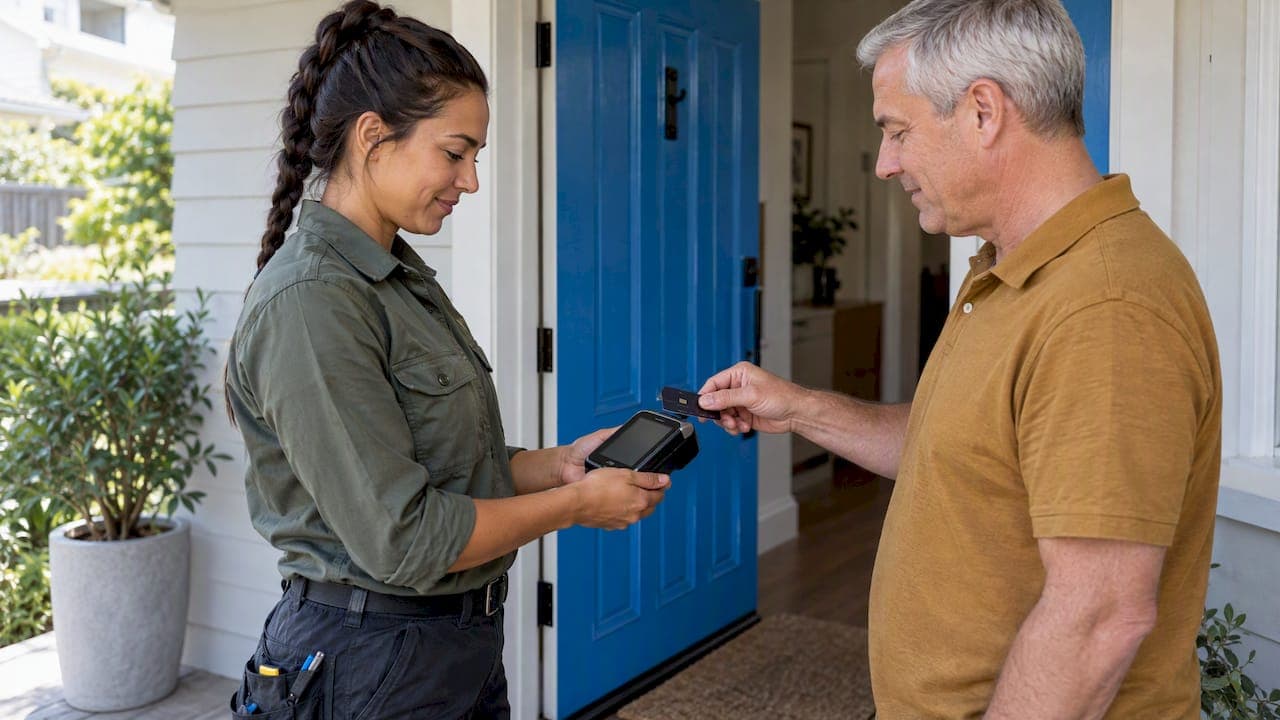
Businesses in Australia can no longer add a surcharge to card payments. From 1 October 2026, the ACCC states that a surcharge cannot be added for payments made with Visa, Mastercard, American Express and eftpos cards. This covers credit, debit and prepaid versions. Fees that do not depend on how the customer pays, such as a public holiday loading or a travel fee, remain allowed if they are disclosed clearly. This guide explains what changed, why, what stays legal and how service businesses such as air-con cleaners can recover card costs without breaking the rules.
TL;DR
- Card payment surcharges on Visa, Mastercard, eftpos and American Express cards are no longer allowed from 1 October 2026, online, in person and through mobile wallets.
- Relabelling a card surcharge as a booking or service fee is treated as misleading conduct by the ACCC.
- Fees unrelated to the payment method, such as public holiday, travel or same-day fees, remain legal when shown up front.
- Businesses can lawfully raise their general prices to cover card costs, provided the total price is displayed honestly.
- Payment providers, including Stripe, have disabled surcharging support in Australia, so any surcharge logic in checkouts or invoices needs to be removed.
Table of Contents
- What changed on 1 October 2026
- Why surcharging was removed
- The rules before the ban
- What the ban covers and what it does not
- Pricing after the ban
- Fees that remain legal
- Checklist for service businesses
- Perspective: what the ban means for air-con cleaners
- How MyAirCare handles pricing and payments
- Common mistakes after the ban
- FAQ
- Sources
What changed on 1 October 2026
The Reserve Bank of Australia (RBA) concluded that it is in the public interest to remove surcharging for the designated card networks: eftpos, Mastercard and Visa. The RBA's FAQ sets 1 October 2026 as the start date. American Express is not regulated by the RBA in the same way, but the ACCC notes that it also decided to follow the same date.
The ban applies to all in-store, online and digital transactions, including those made with mobile wallets. A business that previously added a percentage at the terminal, on an invoice or on a website checkout must now remove it for these card types.

Business.gov.au advises businesses that charged card surcharges to review their pricing strategy, payment methods and payment providers. The practical effect is that the cost of card acceptance moves from a separate line item into the business's ordinary pricing.
Why surcharging was removed
Surcharging was introduced to encourage customers to choose cheaper payment methods. The RBA found in its March 2026 review that it was no longer achieving that purpose. It had become harder for consumers to understand, and disclosure was often poor for both consumers and businesses.
The Australian Payments Network describes the goal as simplifying the payments landscape and improving price transparency at the point of sale. The federal government has estimated that consumers will no longer pay $1.6 billion a year in surcharges, and that small businesses will save $910 million, according to the figures reported in its announcement on ending card surcharges summarised in search results. Those figures are government estimates and have not been independently verified here.
The rules before the ban
Until the ban, card surcharges were permitted under the Australian Consumer Law, with limits. Under section 55B of the Competition and Consumer Act 2010, a corporation must not charge a payment surcharge that is excessive. The object of that Part is to ensure surcharges are not excessive and reflect the cost of using the payment method.
The WA Consumer Protection Commissioner's blog explained the same principle in plain terms: a card surcharge could only reflect what the card actually cost the business. That is why many businesses used flat figures such as 1.5% or 3%, and why questions such as whether a 2% or 3% surcharge was legal depended on the business's real acceptance costs.

That cost-recovery test is now largely irrelevant for the main card types. The network rules prohibit the surcharge itself, whatever the amount.
What the ban covers and what it does not
| Item | Status from 1 October 2026 |
|---|---|
| Surcharge on Visa, Mastercard, eftpos or American Express credit cards | Not allowed |
| Surcharge on debit or prepaid cards from those networks | Not allowed |
| Surcharge on mobile wallet payments (card-based) | Not allowed |
| Public holiday or weekend loading unrelated to payment method | Allowed, if disclosed |
| Travel, call-out or same-day fees unrelated to payment method | Allowed, if disclosed |
| Higher general prices that absorb card costs | Allowed, if not misleading |
| Card surcharge relabelled as a booking or service fee | Treated as misleading |
The RBA FAQ confirms that the ban is specific to card payment surcharges and does not stop independent booking and service fees. The condition is that those fees must be unrelated to the method of payment.
Why relabelling does not work
Some owners may assume a card surcharge can continue under a different name. The ACCC explicitly warns that this is misleading conduct and will be monitored. A test that regulators are likely to apply is simple: if the fee only appears when a customer pays by card, or varies with the card amount, it is a card surcharge in substance.
A genuine separate fee applies to every customer regardless of how they pay. A travel fee of $20 for a job beyond a set distance, for example, is charged on distance, not on the payment method.
Pricing after the ban
The ACCC confirms that businesses may adjust their overall prices to recover costs previously offset by card surcharges. Two conditions apply. Customers must not be misled about the reason for a price change or about the total price payable. And any mandatory fee that can be calculated at the time of display must be included in a single total price.
For a small service business there are several lawful approaches.
- Raise base prices modestly. A small increase across services absorbs card costs from all payment types. This is the simplest option and the easiest to explain.
- Offer a genuine discount for another payment method. Some businesses publish a standard price and a lower price for bank transfer. This should be checked against current ACCC guidance before use, because a discount that works as a disguised card surcharge may attract scrutiny.
- Require a deposit or card on file. A deposit reduces no-shows and also moves payment earlier. The card on file guide covers how this works for Australian businesses.
- Review the payment provider. Processing fees differ by provider and by in-person versus online payment. A breakdown is in the Stripe fees guide for Australia.
The cost of accepting cards is also a wider question than the fee percentage. A comparison of what accepting crypto costs versus cards shows the items businesses weigh when deciding which payment methods to offer and how to build those costs into prices.
A worked example
A cleaner charges $180 for a split-system service and previously added a 1.5% surcharge for cards, or $2.70. Under the new rules the $2.70 line cannot appear. If processing costs average a similar amount across all jobs, the business may set the price at $183 for every customer. The listed price must be the price payable, with no card-only addition at checkout. These figures are illustrative only and are not taken from any provider's pricing.
Fees that remain legal
Several common trade fees stay allowed because they are not tied to payment method. Each must still be disclosed before the customer commits, a point the WA Commissioner's blog makes for surcharges generally.
- Public holiday loadings. The ACCC specifically mentions weekend and public holiday surcharges as still permitted. A guide to setting and automating public holiday surcharges is available.
- Travel fees. Charged by distance or service area. See the travel fee example.
- Same-day or add-on pricing. Priced as a service option. See same-day service add-on pricing.
- Call-out and minimum charges. A minimum charge applies to the job, not to the payment method. The call-out fee policy guide explains what customers owe if they decline.
The rule for each is the same. The fee must apply whichever way the customer pays, and it must appear in the price shown before payment. The booking page pricing guide sets out how to display every fee before payment.
Checklist for service businesses
- Remove any card surcharge line from invoices, quotes, booking pages and terminals.
- Check payment provider settings. Stripe has stated that it disabled surcharging support for Australian card payments, and that surcharge logic calculated in a checkout or third-party system must be removed.
- Update terms and conditions, website text and signage that mention card fees.
- Decide whether base prices need a small increase and apply it to every customer.
- Confirm that any other fee is disclosed up front, is payment-method neutral and is included in the displayed total where it can be calculated.
- Keep a record of the price change date and reasoning in case of a customer or regulator query.
The RBA FAQ also notes that further requirements are scheduled for early 2027, when large acquirers must publish fee flow-through data. Regulators are expected to keep watching merchant costs after the ban.
Perspective: what the ban means for air-con cleaners
We built MyAirCare from operating experience in the air-con cleaning trade, and the ban affects this trade in a specific way. Jobs are small, often between $150 and $400, and a large share of customers pay by card on the day. A sole trader who relied on a surcharge to cover fees now has to absorb that cost somewhere else.
Our view is that the cleanest response is to remove card fees from the conversation entirely. Prices should be set once, shown in full on the booking page and applied to every customer. Customers then see one total, and there is no argument at the door about extra charges.
We also see a bigger loss in most small businesses than card fees: unpaid jobs, no-shows and last-minute cancellations. Taking payment or a card on file when the booking is made, and sending automated reminders, tends to protect more income than a surcharge ever did. Where a customer cancels late or declines at the door, a clear call-out or minimum charge policy, applied to everyone, is lawful and easier to defend than any card-based fee.
We do not publish a price for our booking fee on the pricing page, so operators should check the current pricing page for how it applies. Under the ACCC guidance, a booking fee has to stay independent of the payment method, and the same principle applies to anything an operator adds on top.
— Lewis
How MyAirCare handles pricing and payments
MyAirCare is booking and management software for Australian air-con cleaners. Customers book online through a branded booking page, pay securely through Stripe, and receive automated reminders. Operators manage quotes, invoices, calendars and jobs from a mobile app, including on-site payments and before and after service documentation.
There is a Free plan at $0 per month, supported by booking fees, and MyAirCare Pro at $199 per month. An AI phone agent add-on is also listed on the pricing page, without a published price. A cost comparison between the subscription and per-transaction fees is available in the aircon software cost guide. Taking payment at booking is covered in the guide to integrating payments with bookings.
Operators who want to see a live example can view the MyAirCare homepage for the full feature list.
Common mistakes after the ban
- Leaving surcharge settings switched on. Old invoice templates, website plugins and booking forms may still add a percentage. Each should be checked individually.
- Charging a fee only to card customers. Any fee that depends on payment method falls inside the ban in substance, whatever the label.
- Hiding fees until checkout. Mandatory fees that can be calculated should appear in the displayed total.
- Treating a price rise as a secret. A rise is allowed, but explanations to customers must be accurate.
- Assuming every payment type is covered. The ban applies to the listed card networks. Businesses with questions about other payment types or specific circumstances should check the ACCC's guidance or contact the ACCC directly.
FAQ
Is it legal to charge a 3% card fee in Australia?
Not on Visa, Mastercard, eftpos or American Express cards from 1 October 2026. Before that date, a surcharge was legal only if it did not exceed the business's cost of acceptance, under the Competition and Consumer Act 2010. Since the ban, the amount is not relevant because the surcharge itself is not permitted.
Can a business call a card surcharge a booking fee?
No, not if the fee works as a card surcharge. The ACCC warns that relabelling a card surcharge as another fee is misleading conduct and will be monitored. A booking fee is acceptable only when it applies to all customers regardless of payment method.
Who pays the cost of card acceptance now?
The business pays the processing fee to its payment provider and recovers it through its general prices. The RBA and ACCC allow businesses to adjust overall prices, provided customers are not misled about the reason for a change or the total price payable.
Are public holiday and travel fees still allowed?
Yes. The ACCC confirms that fees unrelated to how the customer pays, including weekend and public holiday surcharges, are still permitted. They must be clearly disclosed before the customer pays and should be part of the displayed total where the amount is known.
Does the ban apply to online and mobile wallet payments?
Yes. The ban covers in-store, online and digital card transactions, including mobile wallets. Payment providers such as Stripe have removed surcharging support in Australia, so checkout tools no longer add the fee.
Sources
- Card surcharges, ACCC
- Card surcharges (business guidance), ACCC
- Frequently Asked Questions: Removal of Card Payment Surcharges, RBA
- In Brief: Merchant Card Payment Costs and Surcharging, RBA
- New card payment surcharge rules now apply, business.gov.au
- What consumers and businesses need to know about new card surcharge rules, Australian Payments Network
- Commissioner's Blog: Paying extra? What to know about surcharges, WA Government
- Competition and Consumer Act 2010, Part IVB, legislation.gov.au
- Competition and Consumer Act 2010, section 55B, AustLII
- Australia is removing card surcharges: what Stripe users need to know, Stripe Support