
Calculate your true cost per kilometre and per minute, then apply it through either a per-kilometre charge or a flat fee paired with a free travel radius. Add a margin and put the terms in writing before the first job. As a temporary benchmark, many Australian service businesses charge somewhere between a modest flat fee for local jobs and a small per-kilometre rate beyond a set radius. The ATO and tools like Sole's travel cost calculator can help you confirm the number is defensible.
TL;DR:
- Setting a clear travel fee involves calculating a defensible cost per kilometre that accounts for vehicle, fuel, labor, overheads, and a margin, tailored to your specific business costs.
- Flat fees are most effective when most jobs fall within a predictable distance, while per-kilometre or per-minute charges suit businesses with widely varying job locations.
- Implementing the travel fee as a written, itemized line on invoices, with terms established upfront, minimizes disputes and simplifies enforcement.
- Rechecking your rates after 10 to 20 jobs helps refine your radius and fee to reflect actual driving patterns and costs.
- Automating travel fee application through booking platforms and integrated invoicing systems ensures consistent, accurate billing without manual recalculations.
Table of Contents
- Quick rules of thumb and common rates
- How to calculate your true travel cost (step-by-step)
- Pricing models: per kilometre, flat fee, or something else
- How to present, invoice, and enforce travel fees with clients
- Worked example and quick calculator guidance
- Tax and recordkeeping basics
- Handling client objections and scripts you can use
- A practical view on running fees in a small service business
- Automating travel fees once you've set them
- Sources
Quick rules of thumb and common rates
Most service businesses settle on one of two starting points. Industry benchmarks compiled from travel-fee surveys show flat travel fees clustering around a modest midpoint for standard local jobs, with per-unit charges applied beyond that for anything further out. Converted to kilometres, this usually looks like:
- A free radius from your base, covering most regular customers.
- A per-kilometre rate beyond that radius, set to at least cover fuel and running costs.
- A flat fee for jobs inside a defined zone, useful when route variation is small and clients expect price certainty.
Pro Tip: If you serve a tight metro area with predictable travel times, a flat fee usually beats per-kilometre pricing. Clients understand it faster, and you avoid disputes over whether the GPS route was the shortest one.
One warning worth repeating: don't lift a per-mile rate from a US guide and use it as-is. Miles and kilometres aren't interchangeable, and US fuel, insurance, and vehicle costs don't map onto Australian conditions. Convert first, then check the number against your own running costs.
How to calculate your true travel cost (step-by-step)
Guessing a travel rate is how businesses end up subsidising their own callouts. A proper cost breakdown takes five inputs and produces one defensible number per kilometre.
- Annualise your vehicle costs. Add registration, insurance, servicing, tyres, and depreciation for the year, then divide by your annual kilometres travelled for work.
- Add fuel cost per kilometre. Divide your vehicle's litres-per-100km rating by 100, then multiply by the current fuel price.
- Convert your labour rate to a per-minute figure. Take your hourly rate, divide by 60, then multiply by average travel minutes per kilometre in your service area.
- Add overhead allocation. Insurance, phone, admin time and software costs should carry a small per-job loading, not just a flat business expense.
- Apply a margin. A contingency of 10 to 30% covers detours, client delays, and fuel price swings without forcing you to adjust rates every few months, a practice several fee-setting guides recommend as standard.
The most common pitfall is underestimating depreciation. A vehicle doing heavy daily kilometres wears out faster than the standard depreciation schedule assumes, and tradies who ignore this end up recovering less than the real cost of keeping the vehicle on the road. Idle time in traffic is the second blind spot. If you're paid hourly for the job but not for the drive, that time still needs to be priced somewhere.
Rather than build this in a spreadsheet from scratch, Sole's travel cost calculator does the arithmetic for you. It's built specifically for Australian sole traders and converts fuel, vehicle running costs, and overheads into a single per-kilometre figure, which is exactly the number you need for the next step.
Pricing models: per kilometre, flat fee, or something else
Once you have a true cost per kilometre, the model you choose depends on how predictable your jobs are.
- Per-kilometre and per-minute charges suit businesses where job distances vary widely. Take your calculated cost per kilometre, add your margin, and that's your retail rate. It's transparent, and clients who query it can be shown the logic.
- Flat travel fees work best when most jobs sit within a similar distance band. Size the flat fee by taking your average job distance and multiplying by your per-kilometre retail rate, then round to a clean number.
- A free-travel radius removes friction for your closest, most frequent customers. Choose the radius based on where your customer density drops off, then charge per kilometre only beyond it.
- Hourly or minimum-callout fees suit labour-heavy services where the job itself, not the drive, is the main cost driver. Fold a small travel allowance into the hourly minimum instead of itemising it separately.
- A planning deposit or credit model works well for jobs that need a quote visit or consultation before booking. Charge a small non-refundable deposit for that visit, then credit it against the final invoice if the client proceeds. This protects unpaid time on the research and quoting stage and filters out low-intent enquiries before you've spent a morning driving to a site that was never going to book.
How to present, invoice, and enforce travel fees with clients
A travel fee only holds up if it's written down before the job starts. Once it's part of your standard terms, enforcing it becomes routine rather than a negotiation.
- Put it in your service agreement. State what the travel fee covers, what triggers it (distance, zone, or minimum callout), and how it interacts with your cancellation policy if the client cancels after you've already left.
- List it as its own invoice line. Don't bury travel inside the labour cost. Naming it "Travel fee" or "Travel and callout charge" makes the tax invoice clearer and easier to justify if a client asks.
- Decide when it's charged. For quote visits, take the deposit at booking. For confirmed jobs, either add the travel line at booking or fold it into the final invoice, whichever matches how the rest of your pricing works.
- Automate collection where you can. Card-on-file systems and Stripe-based invoicing reduce the awkward step of chasing payment after the drive is already done, and services that cover taking deposits online make this far less manual.
Worked example and quick calculator guidance
Here's a simple version you can run with your own numbers. Say your vehicle costs work out to $0.35 per kilometre once fuel, servicing, and depreciation are annualised, and your labour rate on the road works out to roughly $0.60 per kilometre once average speed is factored in. Your raw cost per kilometre sits around $0.95.
If your average job is 15 kilometres from base, that same math gives you a flat fee of around $18, which you might round to $20 for a clean, client-facing number.
- Round retail rates to the nearest dollar. Clients don't want a quote with three decimal places.
- Keep your raw cost figure private. Show clients the final rate, not the build-up.
- Use Sole's calculator whenever fuel prices shift meaningfully, rather than recalculating from scratch each time.
- Log distance per job as you go. Field-service apps that automate distance logging and travel zones cut down on disputes about what was actually driven.
A short checklist for your quote template: cost per km, margin percentage, free radius (if any), retail rate, and the invoice line description. Five fields, filled in once, reused on every quote.
Tax and recordkeeping basics
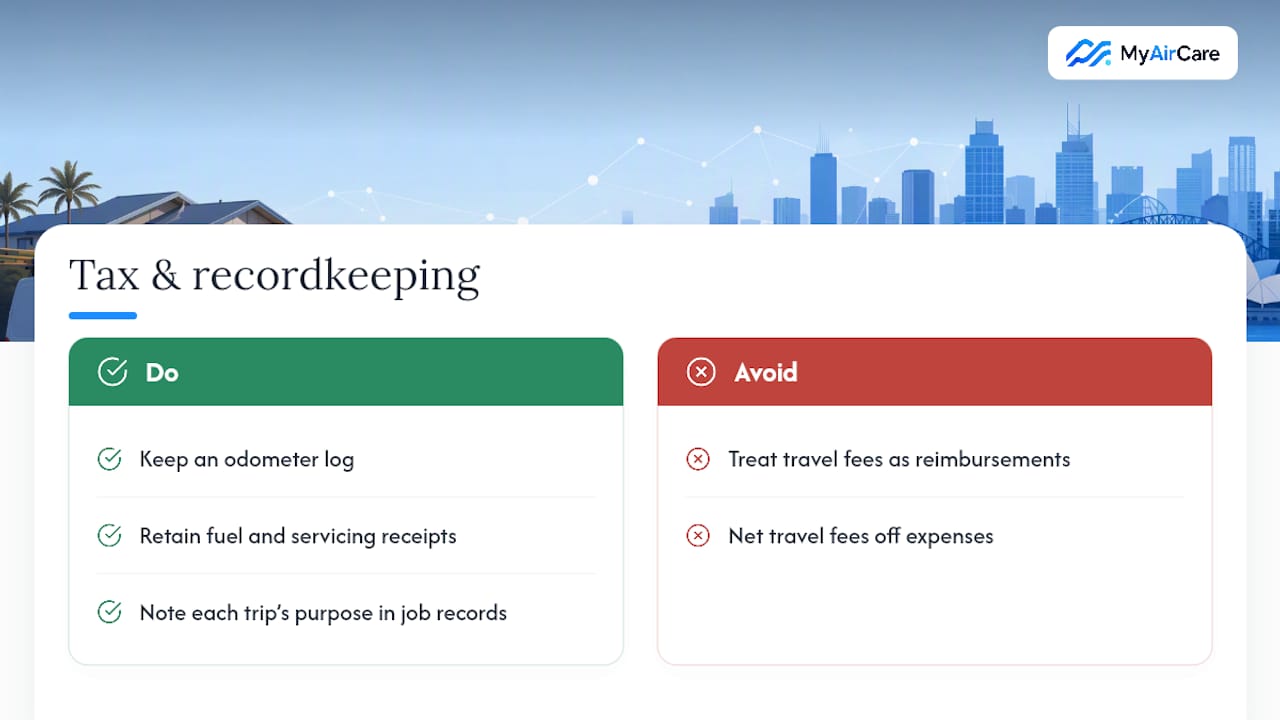
Travel costs may be deductible for your business depending on the purpose and nature of the trip, and the ATO expects accurate records to support any claim. Keep an odometer log, retain fuel and servicing receipts, and note the purpose of each trip in your job records. On the other side of the ledger, travel fees you charge clients are revenue, not a reimbursement, and should be recorded as part of your income, not netted off against expenses.
Handling client objections and scripts you can use
Most objections come down to clients not understanding what the fee covers, not genuine price resistance.
- "Why should I pay for you to drive?" Explain that the fee covers vehicle wear, fuel, and the time you're not earning elsewhere, not just petrol.
- "Your competitor doesn't charge this." Note that an itemised travel fee often means a lower base rate than a competitor who's quietly built travel into their hourly price.
- New client script: "Our quote includes a travel fee that covers the cost of getting to your site. It's itemised on your invoice so you can see exactly what you're paying for."
- Existing client script (moving to fees): "We're introducing a standard travel fee across all bookings from [date] to keep our pricing consistent and sustainable. It won't affect the quality or timing of your service."
- When to waive it: Reserve exceptions for genuine long-term clients or bundled multi-job bookings, and say so explicitly, so it reads as a one-off gesture rather than a new baseline.
A practical view on running fees in a small service business
Most small operators avoid setting a travel fee for months because it feels like an awkward conversation to introduce. It isn't. The businesses that struggle are the ones that absorb travel costs indefinitely and then wonder why margins shrink as their service area grows. A clear, written fee removes the awkwardness because it's no longer a negotiation, it's a line item.
Pro Tip: Recheck your travel fee after your first 10 to 20 bookings under the new structure. That's usually enough data to see whether your radius, rate, or flat fee actually matches how far you're really driving.
— Lewis
Automating travel fees once you've set them
Working out the right number is only half the job. Applying it consistently, invoice after invoice, is where most small operators lose time or accuracy. The platform is built for air-con cleaning businesses that already know their travel fee and want it enforced automatically rather than recalculated by hand on every booking.

The platform lets you set travel zones against your booking pages, so a job outside your free radius automatically carries the right charge without you doing the maths on-site. Payments run through Stripe, including card-on-file for travel-fee deposits, and every charge lands on the invoice as its own line item, matching the presentation approach covered earlier in this guide. It's not a pricing tool. It's the operational layer that stops your correctly calculated fee from getting lost between the quote and the final invoice. If your rates are already set, you can see how the booking and billing side works on the MyAirCare platform and check current pricing for your business size.
Sources
- ATO — travel expenses
- Travel Cost Calculator for Small Businesses and Sole Traders — Sole
- Charging your clients travel fees — Check Cherry
- The Travel Institute — the importance of service fees