
For Australian service businesses comparing field service management (FSM) software in 2026, the shortlist comes down to four options that consistently deliver on mobile usability, local integrations, and practical pricing: MyAirCare for air-con cleaning operators needing a purpose-built Australian platform, ServiceM8 for small trade teams wanting mobile-first job management, simPRO for multi-van contractors needing depth in job costing and inventory, and AroFlo for maintenance teams with asset and compliance requirements.
- MyAirCare — Air-con cleaning businesses: branded booking pages, Stripe payments, GST-ready invoicing, and automated reminders built for Australian operators.
- ServiceM8 — Solo contractors and small trade teams: strong mobile UX, offline support, and integrated quoting and invoicing.
- simPRO — Mid-market and multi-van teams: detailed job costing, inventory management, and Xero/MYOB integrations.
- AroFlo — Maintenance contractors and PM-heavy teams: asset tracking, compliance workflows, and mobile forms.
- Tradify — Trades businesses wanting simple job costing with transparent pricing and fast onboarding.
- Fergus — Small to growing trade teams: straightforward quote-to-invoice flow and clear onboarding.
- ServiceTitan — Large home-service companies and multi-location HVAC or plumbing operators needing deep dispatch and marketing tools.
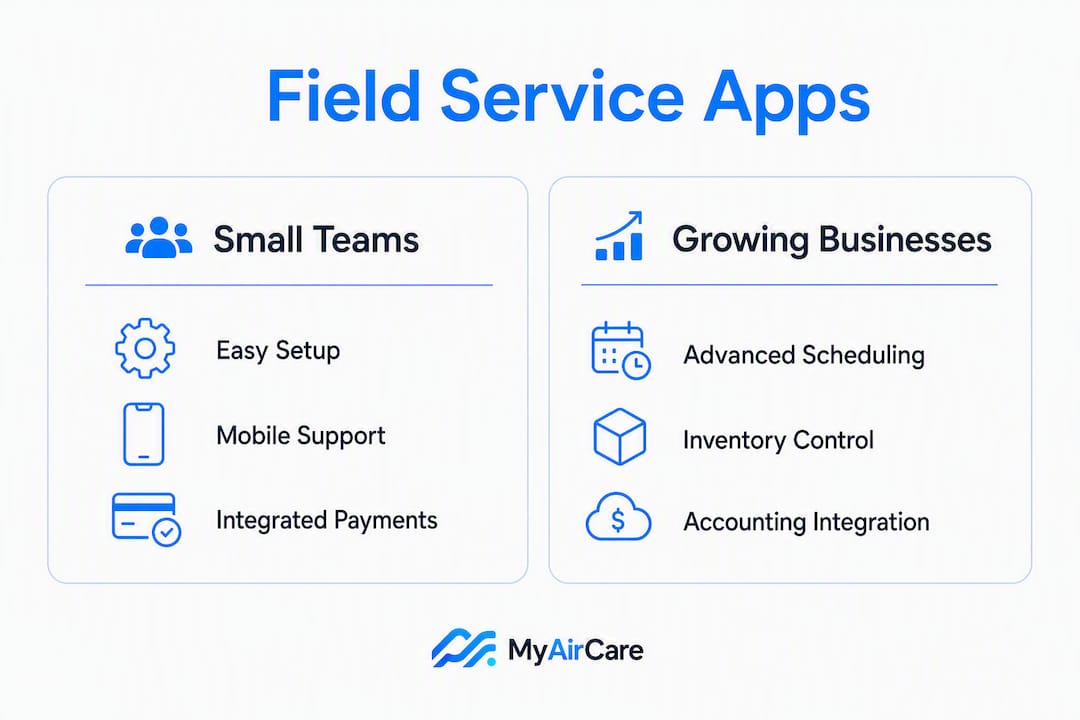
Solo operators typically need scheduling, quoting, and payments in one mobile app. Teams of 2–10 technicians benefit most from offline support, Xero integration, and dispatch features. Mid-sized teams typically require job costing, inventory, and reporting. Multi-site enterprises need advanced scheduling, asset management, and ERP-level integrations.
Table of Contents
- How these apps were selected
- Quick comparison: which app fits your situation?
- Detailed profiles: what each app does best
- How to choose the right field service app for your Australian business
- Australian-specific considerations: payments, accounting, and offline work
- Final recommendation: which app to pick by business type
- Key takeaways
- The case for purpose-built over generic
- MyAirCare is built for Australian air-con cleaning businesses
- Useful sources and further reading
How these apps were selected
The shortlist was built against six primary criteria: ease of use, mobile and offline support, payments and accounting integrations, scheduling and dispatch capability, inventory and asset management, and quality of customer support. G2 roundups consistently identify ease of use and support quality as the top adoption drivers for small teams, which shaped the weighting applied here.
Each app was assessed using vendor documentation, demo testing, G2 and Gartner Peer Insights data, and MyAirCare's direct operational experience in the Australian air-con cleaning sector. Apps were excluded if they lacked an active Australian presence, had no Xero or MYOB integration path, or did not support payment methods compatible with Australian merchants (Stripe or Tyro). Enterprise platforms without a realistic SMB entry point were retained in the comparison for reference but are not recommended as primary picks for teams under 50 technicians.
Australian availability was confirmed by checking for local reseller or onboarding partners, GST-compliant invoicing, and compatibility with Xero, MYOB, Stripe, and Tyro. Tools that are US-only or lack local support were noted accordingly.
Quick comparison: which app fits your situation?
| App | Best for | Pricing snapshot | Mobile & offline | Scheduling & dispatch | Quoting / invoicing & payments | Accounting integrations | Inventory / assets | Ease of use & Aussie support |
|---|---|---|---|---|---|---|---|---|
| MyAirCare | Air-con cleaning operators | Free plan + paid tier; Stripe fees apply | Mobile app; job tracking & photos | Calendar & team scheduling | GST invoicing, Stripe payments | Xero-compatible | — | Purpose-built for AU; local support |
| ServiceM8 | Small trade teams, solo contractors | From ~$29/month; free trial | Excellent mobile UX; offline support | Job scheduling & dispatch | Quoting, invoicing, card payments | Xero, MYOB | Basic | Strong AU user base |
| Tradify | Trades needing simple job costing | From ~$35/user/month; free trial | Good mobile app | Job scheduling | Quoting & invoicing | Xero, MYOB | Basic | AU-focused; good support |
| simPRO | Mid-market, multi-van teams | Custom pricing; demo available | Solid mobile; offline sync | Advanced dispatch & scheduling | Full quoting, invoicing, payments | Xero, MYOB | Full inventory | AU offices; strong support |
| AroFlo | Maintenance & PM contractors | Custom pricing; demo available | Mobile forms; offline support | Scheduling & PM workflows | Quoting & invoicing | Xero, MYOB | Asset tracking | AU-based; compliance focus |
| Fergus | Small to growing trade teams | From ~$49/month; free trial | Good mobile app | Job scheduling | Quote-to-invoice | Xero, MYOB | Basic | NZ/AU market; good onboarding |
| Jobber | Solo operators, micro teams | From ~$49/month; free trial | Clean mobile UX | Scheduling | Quoting, invoicing, card payments | Xero, QuickBooks | — | Strong support; US-origin |
| ServiceTitan | Large home-service companies | Custom; enterprise pricing | Full mobile suite | Advanced dispatch | Full billing & marketing | Xero, QuickBooks | Inventory | US-origin; AU availability varies |
| Housecall Pro | Home service contractors | From ~$49/month; free trial | Good mobile app | Scheduling | Customer-facing payments | QuickBooks | — | US-origin |
| SafetyCulture / SHEQSY | Safety & compliance teams | Free tier + paid plans | Mobile checklists; offline | — | — | — | — | AU-based; strong compliance |
| Enterprise FSM (ServiceMax, ServiceNow, MS Dynamics 365, Salesforce, Oracle, SAP, IFS) | Large enterprises | Custom; significant investment | Full mobile suites | Enterprise dispatch & AI scheduling | Full billing suites | ERP-level | Full asset management | Dedicated implementation required |
Free trials are available for ServiceM8, Tradify, Fergus, Jobber, and Housecall Pro. simPRO and AroFlo offer demos rather than self-serve trials. Enterprise platforms (ServiceMax, ServiceNow, Microsoft Dynamics 365 Field Service, Salesforce Field Service, Oracle Field Service, SAP Field Service Management, IFS) require vendor-led implementation and are not self-serve.
Detailed profiles: what each app does best
Independent testing consistently shows that the right choice depends on business size and workflow, not on feature count alone. The profiles below reflect that finding.
MyAirCare
MyAirCare is built specifically for Australian air-con cleaning businesses. It handles online appointment scheduling, automated reminders, Stripe payments, GST-ready invoicing, customer management, and mobile job tracking in a single platform. The branded booking pages allow operators to present a professional customer-facing experience without custom development.
Key features: Branded booking pages, Stripe payment processing, GST-compliant invoicing, automated SMS and email reminders, mobile app for job tracking and before/after documentation, calendar and team scheduling, quote generation.
Pricing: Free plan (supported by booking fees) and a paid subscription tier. See MyAirCare pricing for current plan details.
Pros: Purpose-built for Australian air-con cleaners; Stripe and GST-ready out of the box; automated reminders reduce no-shows; fast onboarding for small teams.
Cons: Scope is specific to air-con cleaning, not general trades; not suited to multi-trade or enterprise operations.
ServiceM8
ServiceM8 is a mobile-first job management platform with a strong following among Australian trade businesses. Its mobile app handles quoting, scheduling, dispatch, invoicing, and card payments, with reliable offline support. Xero and MYOB integrations are native. The platform suits solo contractors and teams up to around 20 staff.

Pricing: Starting on an entry-level paid plan with a free trial available.
Pros: Excellent mobile UX; strong offline support; native Xero and MYOB integration; well-established AU user base.
Cons: Limited inventory management; can become costly as team size grows.
Tradify
Tradify focuses on the core job management cycle: quoting, scheduling, time tracking, and invoicing. Pricing is transparent and per-user, which makes budgeting straightforward for small teams. Xero and MYOB integrations are included. It suits trades businesses that want a clean, focused tool without enterprise complexity.

Pricing: Charged on a per-user basis with a free trial available.
Pros: Trade-focused workflows; transparent pricing; fast onboarding; Xero/MYOB native.
Cons: Limited asset management; fewer dispatch features than simPRO.
simPRO
simPRO is a comprehensive operations platform for trade and mechanical/electrical service companies. It covers job costing, inventory, multi-stage quoting, scheduling, dispatch, and detailed reporting. It has Australian offices and a local support team. The platform suits mid-market contractors with 10 or more technicians and complex job costing needs.
Pricing: Custom pricing; demo required.
Pros: Deep job costing and inventory; strong Xero/MYOB integration; AU-based support; scales to multi-van operations.
Cons: Steeper learning curve; higher cost than entry-level tools; onboarding takes time.
AroFlo
AroFlo combines field service management with asset tracking and compliance workflows. Mobile forms, preventive maintenance scheduling, and safety checklists are core features. It suits maintenance contractors and facility managers who need documented compliance alongside job management.
Pricing: Custom pricing; demo available.
Pros: Asset tracking and PM scheduling; compliance-ready mobile forms; Xero/MYOB integration; AU-based.
Cons: Interface can feel complex for simple job management; pricing is not self-serve.
Fergus
Fergus offers a clear quote-to-invoice workflow with straightforward onboarding. It targets small to growing trade teams in Australia and New Zealand. Xero and MYOB integrations are standard. The pricing model is simple and the setup process is faster than simPRO or AroFlo.
Pricing: Starting on an entry-level paid plan with a free trial available.
Pros: Simple onboarding; clean quote-to-invoice flow; Xero/MYOB native; good for growing teams.
Cons: Less depth in inventory and asset management than simPRO.
Loc8
Loc8 is a cloud-based job and asset management platform for SMB maintenance and service contractors. It covers work order management, asset tracking, and dispatch. Xero integration is available. It suits businesses that need asset management without the complexity of an enterprise platform.
Coast
Coast is a mobile-first platform combining team communication with work order management. Real-time chat is tied directly to work orders, which suits facility management teams where coordination between staff is as important as job tracking. It is less suited to trade businesses needing deep quoting and invoicing.
Jobber
Jobber is a clean, well-supported scheduling and invoicing tool for solo operators and micro teams. Its onboarding is fast and the mobile app is straightforward. Xero and QuickBooks integrations are available. It is US-origin but widely used in Australia.
Pricing: Starting on an entry-level paid plan with a free trial available.
Pros: Fast onboarding; clean UX; good customer support; card payments built in.
Cons: QuickBooks-first for accounting; Xero integration available but not as deep as AU-native tools.
Housecall Pro
Housecall Pro is an all-in-one platform for home service professionals, with customer-facing booking and payment flows as its standout feature. It suits solo contractors and small teams in HVAC, plumbing, and cleaning. US-origin; Australian availability and local support should be confirmed before committing.
Kickserv
Kickserv is a simple job management tool for small service teams. It covers scheduling, quoting, and basic invoicing. It suits very small teams that need a low-cost starting point. Australian support and local integrations are limited compared to AU-native tools.
Workiz
Workiz bundles FSM features with marketing tools, including call tracking and online booking. It suits trade businesses that want job management and customer acquisition in one platform. US-origin; verify AU availability before trialling.
Service Fusion
Service Fusion covers dispatch, invoicing, and billing for small to mid-sized service providers. It is US-origin and best suited to businesses already operating in the US market. Australian merchants should confirm Stripe compatibility and GST invoicing before adopting it.
SafetyCulture (formerly iAuditor) and SHEQSY by SafetyCulture
SafetyCulture is an Australian-founded platform focused on inspections, checklists, and audit trails. SHEQSY by SafetyCulture extends this to lone worker safety and field compliance. Both are well-suited to safety and compliance-driven teams. They are not general-purpose FSM tools but are strong additions for businesses with documented safety obligations.
Fieldpoint
Fieldpoint targets mid-market service organisations with service contracts, scheduling, and mobile dispatch. It suits companies managing recurring service agreements rather than one-off jobs.
Freshdesk (with FSM capabilities)
Freshdesk is primarily a helpdesk platform. Its FSM capabilities suit organisations that need a tight helpdesk-to-field ticketing flow, where customer support tickets translate directly into field dispatch. It is not a standalone FSM tool.
Comarch FSM
Comarch FSM is an enterprise scheduling and SLA management platform. It suits large service providers with complex SLA obligations and multi-tier scheduling requirements.
Infor
Infor provides ERP and field service capabilities for larger organisations. It suits companies that need ERP-level integration across finance, supply chain, and field operations. Not suited to SMBs.
Syncron
Syncron focuses on service parts optimisation and aftermarket revenue management. It is relevant for organisations where parts availability and aftermarket workflows are the primary business concern, not general field dispatch.
OnthegO
OnthegO is a lightweight, mobile-centric FSM tool for small on-demand teams. It suits businesses that need simple job workflows without the overhead of a full FSM platform.
Odoo (Field service app)
Odoo's field service module is part of its broader modular ERP. It suits teams already using Odoo for accounting or inventory who want to extend into field service without adopting a separate platform.
ServiceTitan
ServiceTitan is built for larger home-service companies, particularly HVAC, plumbing, and electrical operators with multiple locations. It includes deep dispatch, pricing, and marketing tools. It is US-origin and enterprise-priced; Australian availability and local support should be confirmed directly with the vendor.
Intuit Field Service Management
Intuit Field Service Management integrates with QuickBooks and suits small businesses already in the Intuit ecosystem. It is US-origin and best suited to businesses using QuickBooks as their accounting platform.
Skedulo
Skedulo is a workforce scheduling and optimisation platform for organisations with complex scheduling requirements, including healthcare and field services. It has an Australian presence and suits larger teams with dynamic scheduling needs.
Zuper
Zuper is a flexible FSM platform covering scheduling, invoicing, and mobile team management. It offers custom workflows and a capable mobile app. It suits SMBs that need extensible FSM without committing to an enterprise platform.
Enterprise FSM platforms
ServiceMax suits large enterprises with complex asset lifecycle management. ServiceNow Field Service suits organisations that need integrated IT service management and field operations in one platform. Microsoft Dynamics 365 Field Service suits enterprises already on the Microsoft stack, with deep ecosystem integrations and AI-enabled scheduling. Salesforce Field Service suits organisations using Salesforce CRM, with CRM alignment and advanced scheduling as its core strengths. Oracle Field Service suits enterprises with complex, high-volume dispatch needs and predictive scheduling requirements. SAP Field Service Management suits large enterprises using SAP back-office systems. IFS Field Service Management Software, IFS Cloud, and IFS Mobile Workforce Management together form a comprehensive enterprise FSM suite for asset-intensive organisations with extensive workforce planning needs. Gartner Peer Insights covers user reviews for most of these platforms and is a useful reference for enterprise buyers conducting due diligence.
All enterprise platforms require vendor-led implementation, custom pricing, and dedicated administration. They are not practical for teams under 50 technicians.
Pro Tip: When evaluating any FSM app, run a live pilot against your two most common job types before committing. Test the full cycle: booking, dispatch, on-site quoting, payment collection, and Xero reconciliation. A tool that handles your real workflows in a 30-minute demo is worth more than one with a longer feature list.
How to choose the right field service app for your Australian business
The right app depends on team size, job complexity, and the integrations your business already relies on.
-
Solo operators and micro teams (1–3 people): Prioritise ease of use, fast onboarding, and mobile payments. ServiceM8, Jobber, and Tradify are the practical starting points. MyAirCare is the right choice if the business is specifically air-con cleaning.
-
Small teams (2–10 technicians): Offline mobile support becomes critical. Confirm that the app caches job data and queues actions when connectivity drops. ServiceM8 and Tradify handle this well. simPRO and AroFlo suit teams with more complex job costing or asset needs.
-
Mid-sized teams (10–50 technicians): Scheduling depth, inventory management, and reporting matter at this scale. simPRO and AroFlo are the primary candidates. Evaluate whether the platform supports multi-stage quoting and purchase orders.
-
Facilities and maintenance teams: Asset management and preventive maintenance scheduling are the deciding factors. AroFlo and Loc8 are built for this. SafetyCulture/SHEQSY adds compliance documentation on top.
-
Enterprise operations: ServiceMax, ServiceNow, Microsoft Dynamics 365 Field Service, Salesforce Field Service, Oracle Field Service, SAP Field Service Management, and IFS are the relevant tier. Budget for implementation, training, and ongoing administration.
Questions to ask vendors during demos:
- Can data be exported in a standard format (CSV, API) if the business switches platforms?
- What exactly is cached offline, and how does the app handle failed sync attempts?
- Does the platform support Stripe or Tyro for card-on-site payments?
- How does the Xero or MYOB integration handle GST line items and payment reconciliation?
- Is there a local Australian onboarding partner or support team?
Red flags to watch for: hidden setup or data migration fees, no true offline mode (read-only is not sufficient), poor mobile UX that technicians will avoid using, and accounting integrations that require manual CSV exports rather than live sync.
A realistic switching timeline for a team of 5–15 technicians is 4–8 weeks: two weeks for data migration and configuration, two weeks for parallel running, and two to four weeks for full adoption. Budget for training time, not just software costs.
Pro Tip: During the demo, ask the vendor to show you what happens when a technician loses mobile signal mid-job. The answer reveals more about real-world reliability than any feature list.
Australian-specific considerations: payments, accounting, and offline work
Australian service businesses have specific requirements that not all FSM platforms address out of the box.
GST invoicing: Every invoice must correctly apply and display GST. Confirm the platform generates Tax Invoices compliant with Australian Taxation Office requirements, not generic invoices that require manual adjustment.
Accounting integrations: Xero and MYOB are the dominant accounting platforms for Australian SMBs. A live, two-way integration that syncs invoices, payments, and contacts without manual exports is the standard to expect. Platforms that offer only one-way or CSV-based sync add reconciliation time.
Payments: Stripe and Tyro are the most common card payment options for Australian service businesses. Stripe supports card-on-site via mobile, which is the standard for technicians collecting payment at the end of a job. Confirm the platform's payment integration handles GST correctly in the transaction record.
Offline mobile support: Rural and suburban service work frequently involves low or no mobile coverage. The app must cache job data, allow technicians to complete forms and capture photos offline, and queue all actions for automatic sync when connectivity is restored. When testing offline support, check which specific fields are cached, how photo attachments are handled, and whether failed operations retry automatically.
Automated customer communications: SMS "on my way" notifications, booking confirmations, and post-service reminders are the most effective single feature for reducing no-shows and cutting admin time. Booking confirmation templates and automated follow-ups should be configurable without developer involvement.
Ease of use and quality of customer support are better predictors of long-term adoption for small-to-mid-sized service businesses than a long list of advanced features. A platform that technicians actually use consistently delivers more value than one with more capabilities that gets avoided in the field.
- Xero and Stripe integrations are high-value for Australian SMBs: they reduce reconciliation time and improve cashflow visibility.
- MYOB remains common in Australian trade businesses and should be confirmed as a supported integration before committing.
- Tyro is a practical alternative to Stripe for businesses that prefer a local payment provider.
Pro Tip: When testing offline support, ask the vendor to demonstrate what happens to a photo attachment captured offline. Some platforms cache text fields but drop attachments, which creates gaps in job documentation for compliance purposes.
Final recommendation: which app to pick by business type
- Solo air-con cleaning operators: MyAirCare. Purpose-built for Australian air-con cleaners, with Stripe payments, GST invoicing, and automated reminders ready from day one.
- Solo trades and micro teams (non-cleaning): ServiceM8. The strongest mobile UX and offline support in the entry-level tier, with native Xero and MYOB integration.
- Small trade teams (2–10 technicians): Tradify or Fergus. Both offer transparent pricing, fast onboarding, and clean quote-to-invoice workflows. Tradify suits teams that prioritise job costing; Fergus suits teams that want the simplest possible onboarding.
- Mid-sized teams (10–50 technicians): simPRO. The depth of job costing, inventory management, and reporting justifies the higher cost and longer onboarding at this scale.
- Maintenance and PM-heavy contractors: AroFlo. Asset tracking, compliance workflows, and preventive maintenance scheduling in one platform.
- Facilities and safety-compliance teams: SafetyCulture / SHEQSY. Audit trails, checklists, and lone worker safety features that general FSM tools do not match.
- Large home-service companies (multi-location HVAC/plumbing): ServiceTitan. Deep dispatch, pricing, and marketing tools for operators at scale. Confirm AU availability before committing.
- Enterprise operations: Microsoft Dynamics 365 Field Service, Salesforce Field Service, ServiceMax, Oracle Field Service, SAP Field Service Management, or IFS, depending on the existing technology stack.
Key takeaways
The most effective field service app for an Australian SMB is the one that covers GST invoicing, Xero or MYOB integration, offline mobile support, and a payment method compatible with Australian merchants, at a price and complexity level the team will actually adopt.
| Point | Details |
|---|---|
| Match app to team size | Solo operators need mobile payments and fast onboarding; teams of 10+ need job costing and inventory. |
| Prioritise local integrations | Xero, MYOB, Stripe, and Tyro compatibility reduces reconciliation time for Australian businesses. |
| Test offline support specifically | Confirm that photos, forms, and job data are all cached and queued for sync, not just text fields. |
| Ease of use predicts adoption | A simpler, well-supported tool used consistently outperforms a feature-heavy platform that technicians avoid. |
| MyAirCare for air-con cleaning | MyAirCare is the purpose-built option for Australian air-con cleaning operators, with Stripe payments and GST invoicing included. |
The case for purpose-built over generic
The most common mistake in FSM software selection is choosing a platform based on feature count rather than fit. Enterprise platforms like ServiceNow, SAP Field Service Management, and Microsoft Dynamics 365 Field Service are genuinely capable, but they require dedicated administrators, multi-week implementations, and ongoing configuration. A sole trader or a team of five technicians does not need that overhead.
The more useful question is: does this platform handle the two or three workflows that consume most of the business's admin time? For most Australian trade businesses, those workflows are booking, quoting, invoicing, and payment collection. For air-con cleaning businesses specifically, automated reminders and before/after documentation are equally critical because they directly affect repeat bookings and compliance records.
Generic FSM tools often treat these as secondary features. Purpose-built platforms treat them as the core product. That distinction shows up in onboarding time, technician adoption rates, and the number of support calls a business needs in the first three months.
The shift toward AI-enabled route planning and parts optimisation is real, and it will matter more as teams grow. For businesses under 20 technicians, though, the practical gains from AI scheduling are marginal compared to the gains from simply having a reliable mobile app that works offline and sends an automated reminder the day before a job.
MyAirCare is built for Australian air-con cleaning businesses
Most field service platforms are built for general trades. MyAirCare is built specifically for air-con cleaning operators in Australia, which means the features that matter most to that business type are not add-ons or workarounds — they are the core product.

Branded booking pages let customers schedule appointments directly, reducing missed calls and double bookings. Stripe payments handle card-on-site and online transactions with GST applied correctly. Automated reminders go out before each job, cutting no-shows without manual follow-up. The mobile app covers job tracking, rescheduling, on-site payments, and before/after photo documentation.
For small teams and sole traders, the free plan provides a practical starting point. The paid subscription tier unlocks the full feature set, including team scheduling and advanced reporting. See the MyAirCare pricing page for current plan details, or explore available tenders and commercial work if the business is looking to grow its client base.
Useful sources and further reading
- G2: Best Field Service Management Software 2026 — Buyer guides and ranked roundups covering ease of use and support quality across leading FSM platforms.
- Inc.: We tested the best field service software tools — Independent testing of Jobber, ServiceTitan, and others against simulated small business workflows.
- Gartner Peer Insights: Field Service Management — User reviews and ratings for enterprise and mid-market FSM platforms including IFS, Praxedo, Salesforce Field Service, and Microsoft Dynamics 365.