
Choose fixed price for well-scoped, repeatable projects with clear deliverables. Choose hourly, also called time and materials, for discovery work, open-ended support and anything where the requirements will shift once you start. That's the whole decision in one sentence, but the projects rarely sort themselves that cleanly, so here's how to place your next job in the right column.
Three quick examples show the split in practice:
- A logo and brand kit with a fixed deliverable list suits fixed price.
- An ongoing IT support contract with unpredictable ticket volume suits hourly.
- A kitchen renovation where the client keeps changing tile choices suits hourly, or a fixed price with a locked scope document signed before work starts.
If you're still unsure after reading those three, run a short paid discovery phase on an hourly basis first. Use that to scope the job properly, then convert to a fixed quote once you know what you're actually building.
TL;DR:
- Fixed price contracts are ideal for well-defined, repeatable projects with clear deliverables, while hourly billing suits discovery, ongoing support, or evolving scope.
- Adding a certainty premium of 15 to 30 percent on your hour estimate helps protect margins when setting fixed fees, especially with unknowns.
- Use a simple change-order process with clear scope and explicit exclusions to prevent scope creep and protect your profit margins.
- Set clear travel billing terms with specified zones, flat fees, or mileage rates to avoid disputes and ensure transparency.
- Tracking tools like automated logging of time, expenses, and travel reduce admin overhead and support smoother transitions between pricing models.
Table of Contents
- Hourly vs fixed pricing: weighing the pros and cons
- When should you use fixed price versus hourly?
- How to calculate an hourly charge-out rate and a fixed fee
- Managing scope creep and formalising change orders
- Billing travel, expenses and non-billable time
- Hybrid pricing and moving safely from hourly to fixed
- Contract terms and negotiation checklist
- What the evidence says about pricing risk and travel billing
- Why I stopped hourly billing for scoped jobs
- Less admin, whichever pricing model you choose
- Key Takeaways
- Sources
Hourly vs fixed pricing: weighing the pros and cons
The two models split project risk in opposite directions. In a fixed-price contract, you absorb the cost if the job runs over your estimate. In an hourly or time-and-materials arrangement, the client absorbs that risk, because every extra hour lands on their invoice. That single fact drives almost every other trade-off between the two.
Fixed pricing rewards speed. If you finish a $3,000 fixed-fee job in 15 hours instead of the 20 you quoted, you just earned $200 an hour instead of $150. Hourly billing does the opposite: get faster at your craft and your revenue per project actually falls unless you keep raising your rate. This is sometimes called the efficiency trap, and it's one of the more counterintuitive problems in service pricing. The better you get at your job, the less you're paid for it, until you switch models or raise prices to compensate.
Clients have their own preferences here too. Most prefer the budgeting certainty of fixed pricing because it lets them plan cash flow without worrying about scope drift inflating a final bill. Hourly work demands more of the client's attention: regular check-ins, time-log reviews, and enough trust to sign off on hours logged rather than a fixed number agreed up front.
The trade-offs, summarised:
- Risk holder: fixed price puts estimation risk on you; hourly puts it on the client.
- Efficiency incentive: fixed price rewards speed; hourly can quietly punish it.
- Admin load: hourly needs time tracking and itemised invoices; fixed price needs tighter scoping up front.
- Client comfort: fixed price wins on budget certainty; hourly wins on flexibility for evolving work.
Neither model is objectively better. They're tools for different risk profiles, and picking the wrong one for the job is where most pricing disputes start.
When should you use fixed price versus hourly?
Match the model to what you actually know about the job before you start, not what you hope will happen once it's underway.
- Choose fixed price when the deliverables are clearly defined. A website with five fixed pages, a set of engineering drawings, or a bathroom retile with a locked material list all have known endpoints you can estimate confidently.
- Choose fixed price for short, well-understood windows. Jobs you've delivered a dozen times before carry low estimation risk, which is exactly when a fixed number protects your margin instead of threatening it.
- Choose hourly when you're in discovery mode. Early-stage strategy work, UX research, or diagnosing a fault before you know the fix all involve genuine unknowns that make a fixed number a guess dressed up as a quote.
- Choose hourly for open-ended or ongoing engagements. Retained IT support, legal advice on an as-needed basis, and long-term maintenance contracts don't have a natural finish line, which makes hourly billing the honest option.
- Use a phased hybrid when the signals conflict. Many software and iterative projects run a fixed-fee discovery phase first, then move to hourly or capped-hourly for the build once the scope is actually known.
The phased approach deserves more attention than it gets. It lets you charge properly for the uncertainty at the start of a project, then quote fixed once you've done the work of removing that uncertainty. Clients tend to accept this readily, because it reads as prudent rather than evasive.
How to calculate an hourly charge-out rate and a fixed fee
Your charge-out rate is the number everything else gets built from, and most freelancers set it by guesswork instead of arithmetic. The formula:
(Desired annual income + business overheads + tax provision) ÷ billable hours per year = baseline hourly rate.
Say you want $90,000 in personal income, your overheads (software, insurance, vehicle, admin) run $18,000, and you set aside $20,000 for tax. That's $128,000 needed. If you bill 1,100 hours a year (most sole operators bill fewer hours than they work, once admin, sales and non-billable time are stripped out), your baseline rate is roughly $116 an hour. Add a margin for profit and market positioning, and you land somewhere in the $130 to $150 range depending on your trade or field.
Turning that rate into a fixed fee is the next step. Estimate the hours honestly, then add a buffer. Practitioner guidance on negotiating fixed-price contracts commonly discusses a 15 to 30% "certainty premium" on top of your raw hour estimate, sized to how many unknowns remain: unfamiliar integrations, slow client feedback, or third-party dependencies all push you toward the higher end of that range.
Pro Tip: Break payment into milestones tied to deliverables rather than dates. A deposit, a mid-project payment on approval of a draft, and a final payment on sign-off protects your cash flow and gives the client natural checkpoints to review progress.

Managing scope creep and formalising change orders
Scope creep kills margin on fixed-price work faster than almost anything else, and it happens because most quotes never define what's out of scope, only what's in.
- Write a scoping checklist before you sign. List deliverables, revision rounds, file formats, and explicit exclusions, so "just one small thing" has a clear line to cross.
- Build a simple change-order clause into every quote. State that any request outside the agreed scope gets a written estimate and requires sign-off before work continues.
- For hourly projects, add governance instead of a scope lock. Regular demos, a visible backlog, and short steering check ins keep hourly work honest, because without that oversight, time-and-materials projects commonly drift well past the original estimate.
Pro Tip: Keep your change-order template to one page. A client who has to read three paragraphs of legal language to approve a $200 add on will just avoid asking, then blame you later for the thing they never mentioned.
Billing travel, expenses and non-billable time
Travel billing causes more quiet resentment than almost any other line item, mostly because it's rarely spelled out in advance. There are four common approaches, and each suits a different situation:
- Full hourly rate when travel time is genuinely productive (you're on the phone, prepping materials, or the drive itself is the billable job).
- Reduced rate, often around 50% of your normal rate, for idle transit time where you're just driving.
- Flat per-trip fee for predictable, repeat visits within a set radius.
- Mileage reimbursement, useful when distance varies job to job and you want a simple, defensible number.
Set a free travel radius or zone in your contract, then state the trigger clearly: anything beyond, say, 30 kilometres attracts a flat fee or mileage rate. Keep a simple travel log and retain fuel or toll receipts. That habit alone prevents most billing disputes before they start.
Hybrid pricing and moving safely from hourly to fixed
Most experienced providers eventually land somewhere between the two extremes. Common hybrid patterns include:
- A fixed core scope with hourly extras for anything beyond the agreed deliverables.
- A monthly retainer with hourly overage billing once you exceed the included hours.
- Fixed mini-scopes inside a longer hourly engagement, useful for well-understood sub-tasks within an otherwise open-ended contract.
If you're used to hourly billing and want to shift toward fixed pricing, don't leap straight in. Run several projects on hourly first to build a real dataset of how long similar jobs actually take. Once you trust your own numbers, pilot fixed pricing on a small, low-risk project with a tightly limited scope before offering it as your default.
Contract terms and negotiation checklist
A short, clear contract prevents most pricing disputes before they happen. Cover these points every time:
- Scope and acceptance criteria — define exactly what "done" looks like, in writing.
- Payment schedule — deposit, milestones, and final payment terms, with dates or triggers attached.
- Change-order terms — how extra work gets quoted, approved and invoiced.
- Travel and expense rules — rate, radius, and reimbursement method, stated plainly.
- Termination and liability terms — what happens if either party wants out early, and any cap on your liability.
When you present a fixed fee that includes a certainty premium, say so plainly rather than burying it. Most clients respond better to a transparent buffer than a padded number they suspect but can't see. Frame it as "this figure includes contingency for X and Y," not as a mystery markup, and you'll get fewer pushback conversations at invoice time.
What the evidence says about pricing risk and travel billing
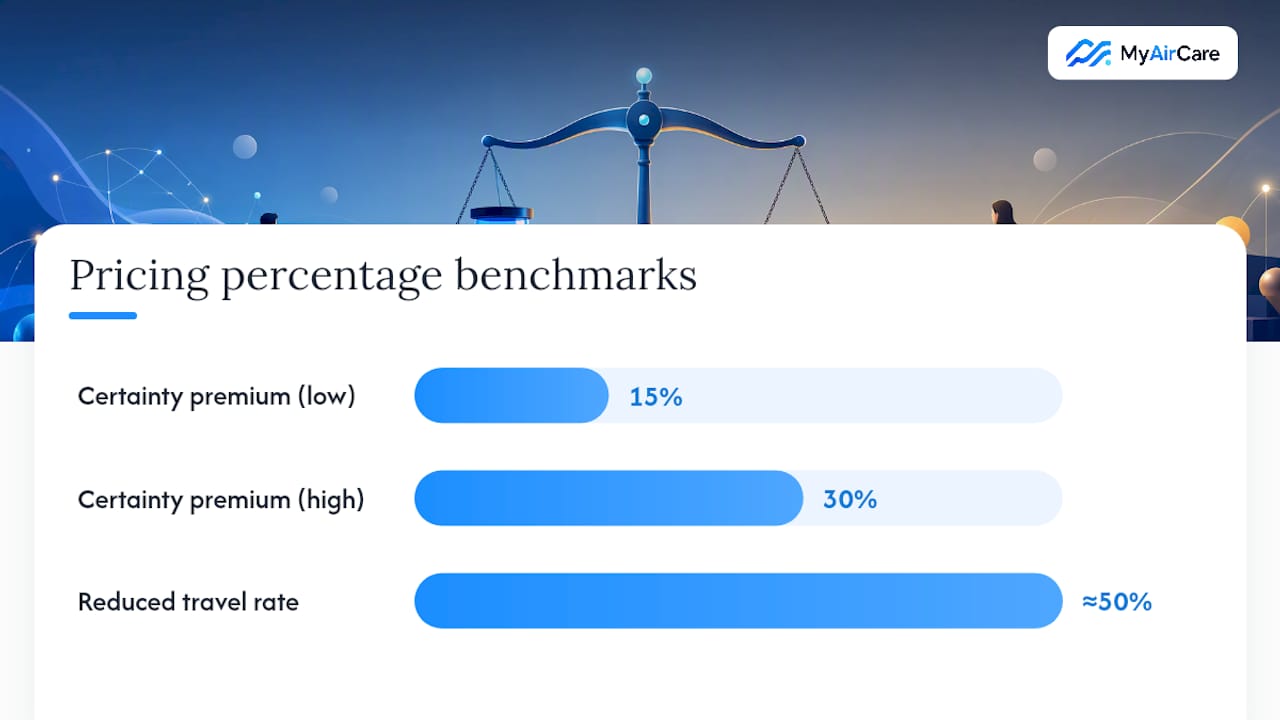
The core research consensus is straightforward: fixed price shifts estimation risk to you, hourly shifts it to the client, and the right choice depends entirely on how well-defined the work is before you start.
A worked example ties the formula together. At a $130 baseline hourly rate with a 25-hour estimate, a typical certainty premium turns a raw hour estimate into a fixed quote, with the premium reflecting the unknowns involved. On travel, the pattern across practitioner guidance is consistent: charge full rate for productive transit, a reduced rate for idle travel, and state your method in writing.
| Pricing element | Typical guidance |
|---|---|
| Certainty premium range | 15 to 30% above raw hour estimate |
| Reduced travel rate | Roughly 50% of standard hourly rate |
| Fixed price best suited to | Clear, well-defined, low-ambiguity scope |
| Hourly best suited to | Discovery, evolving or ongoing work |
Why I stopped hourly billing for scoped jobs
I used to quote everything hourly because it felt safer, less chance of underquoting and eating the loss myself. What actually happened was the opposite: clients grew wary of open-ended invoices, and I was penalised every time I got faster at the work.
Switching well-scoped jobs to fixed price, with a genuine buffer built in, changed both the client conversations and the margin. The one rule I hold to now: never quote a fixed fee for something I haven't scoped in writing first. If the scope isn't nailed down, it stays hourly until it is.
— Lewis
Less admin, whichever pricing model you choose
Whichever model you land on, the paperwork around it, time logs, travel records, invoices, payment chasing, is where most small operators lose hours they never bill for. MyAirCare was built specifically for air-con cleaning businesses to remove that friction: it captures job time, tracks travel and on-site visits, and takes payment on the spot through Stripe, so nothing gets forgotten between the ute and the invoice.

If you're moving between pricing models, a platform that logs every job automatically makes that transition far less risky, because you've actually got the delivery data to back up your next fixed quote instead of a guess. MyAirCare's tender and booking management tools handle the scheduling and payment capture side, while automated reminders keep repeat clients coming back without extra admin on your end. Check the pricing plans to see which tier fits your business, and get your booking page live before your next quote goes out.
Key Takeaways
Fixed price works best for clearly scoped, repeatable jobs, while hourly billing suits discovery, evolving or ongoing work where the requirements aren't locked down yet.
| Point | Details |
|---|---|
| Match model to scope clarity | Use fixed price when deliverables are defined; use hourly for discovery or evolving work. |
| Build a certainty premium | Add roughly 15 to 30% to your raw hour estimate when quoting fixed fees. |
| Formalise change orders | Put a one-page change-order clause in every quote to protect margin against scope creep. |
| State travel terms upfront | Set a free travel radius, then specify a flat fee, mileage, or reduced hourly rate beyond it. |
| Track jobs to ease admin | MyAirCare automates time tracking, payment capture and travel records for air-con cleaning businesses moving between pricing models. |
Sources
- Fixed-price contracts explained: essential guide for Australian businesses — Sprintlaw
- Hourly vs. Fixed-Rate Projects: What’s right for your next hire — Upwork
- Flat rate vs hourly — Toggl blog
- How to bill for travel time as a contractor — LegalClarity
- Fixed price vs time & materials: selection framework — Coderio