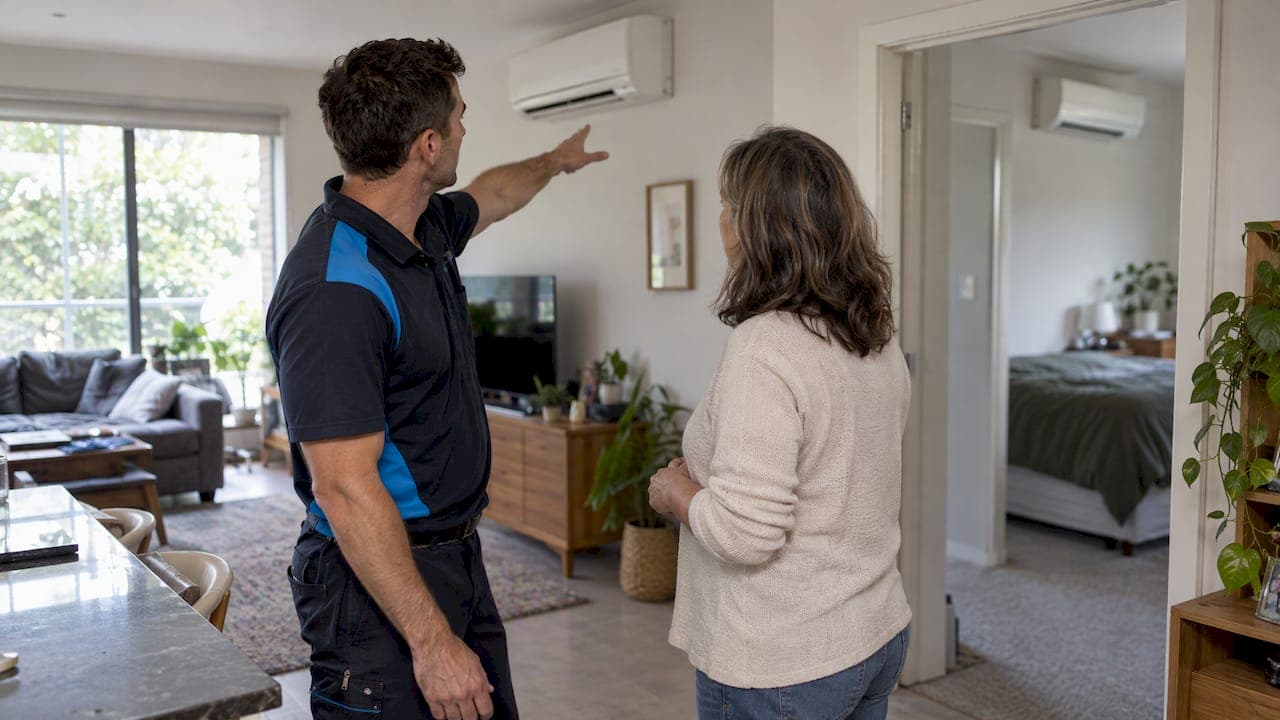
A service package bundle combines two or more services into one bookable item with a single price. For an air-con cleaning business, that usually means grouping a split system clean with a drain flush, a second unit at a reduced rate, or a yearly maintenance plan. Done well, bundles raise the average job value, simplify the choice for the customer and fill the calendar with repeat work. Done poorly, they give away margin and create booking confusion. This guide covers how bundles are structured, how they are priced, and what the booking system needs to handle.
TL;DR
- A bundle packages related services into one offering with one price. Its purpose is a higher average transaction value and simpler fulfilment, not a blanket discount.
- Three tiers (good, better, best) let customers self-select without a hard sell, according to Inside Small Business.
- The most common bundle types in the trade are multi-unit packages, clean-plus-inspection packages and annual maintenance memberships.
- Automatic renewals on memberships must be clearly disclosed and easy to cancel under Australian Consumer Law.
- Bundles only work if the booking system can show them as a single item, take payment and send the reminder for the next visit.
Table of Contents
- What a service bundle is
- Why bundles suit air-con cleaning
- Common bundle types in the trade
- Building a bundle that earns its place
- Memberships and Australian Consumer Law
- What the booking system has to handle
- Selling bundles on site
- Perspective: bundles are an operations decision first
- Setting up bundles in MyAirCare
- A simple starting plan
- FAQ
- Sources
What a service bundle is
Service bundling is the practice of packaging related services into a single, coordinated offering. Simon-Kucher describes the aim as simplifying the purchase for the customer, increasing average transaction value and making fulfilment more efficient for the provider. The same source notes that bundling lets a business capture different levels of willingness to pay by matching packages to different customer needs, instead of offering one option to everyone.
The idea is not limited to trades. Telecommunications and streaming providers use it heavily, and salon software treats a bundle as a single bookable item with its own price. In air-con cleaning, the same logic applies at a smaller scale: the customer wants the job done, the cleaner wants fewer, larger and more predictable jobs.
Why bundles suit air-con cleaning
Several features of the trade make bundling a natural fit.
- Travel time is a fixed cost. A cleaner who attends a property to service one unit spends the same travel time as one who services three. Multi-unit bundles spread that cost across more billable work.
- Households usually have more than one unit. Bedrooms, living areas and sometimes a ducted system often sit on the same property.
- Demand is seasonal. Cleaning work tends to bunch before summer. Annual plans and pre-booked visits move some of that work into quieter months.
- Customers forget. A cleaning that is due every 6 to 12 months depends on a reminder. A bundle that includes the next visit builds the reminder into the product.
The practical outcome is a steadier calendar. For sole traders and small teams, predictability often matters as much as total revenue.
Common bundle types in the trade
Multi-unit packages
The customer pays a lower per-unit rate when more units are cleaned on the same visit. Published examples from Australian operators show the pattern: one cleaning business lists a reduced per-unit price for three or more split system units compared with the single-unit price. The saving for the customer is modest, while the saving for the operator is the avoided second trip.
Clean plus inspection or add-on packages
A basic clean is combined with services that have a higher margin or a lower time cost, such as a drain flush, a sanitising treatment or an outdoor unit check. The add-ons raise the job value without a large increase in time on site.

Annual maintenance memberships
A yearly plan commits the customer to a recurring visit. According to the research gathered for this article, maintenance memberships are increasingly used in the Australian trades to secure recurring revenue. One South West operator publishes an annual plan from $220 that includes a clean and service, waived call-out fees during business hours, priority fault attendance and half-price servicing for additional units at the same property, run as a 12-month rolling subscription. Those figures belong to that operator and indicate what a plan can contain. They are not a benchmark that every business should match.

Good, better, best tiers
Three clear options with obvious differences let customers choose by budget. Inside Small Business reports that average spend rises under this structure without hard selling. An example for a split system:
| Tier | Typical contents | Purpose |
|---|---|---|
| Basic | Filter clean, cover wipe-down, operation check | Entry price, easy to say yes to |
| Standard | Basic plus drain flush and sanitising of surfaces | Most customers, best margin per hour |
| Premium | Standard plus deeper strip clean or priority rebooking | Customers who want the full service |
The contents above are an illustration of structure, not a recommended price list.
Building a bundle that earns its place
Audit services by margin and time
Before grouping anything, the services need to be ranked. Prospa suggests listing every service, ranking by profit margin rather than revenue, noting the time each takes, and flagging those that take the most time for the least profit. Those services can then be repriced, bundled with a stronger item or dropped. The same guidance from Inside Small Business warns against using discounts as a reaction to slow demand.
For an air-con cleaner, a typical finding is that a single-unit visit in a distant suburb has the lowest return per hour, while a multi-unit visit close to other jobs has the highest.
Sort services into leaders, fillers and killers
Simon-Kucher offers a simple classification. Leaders are high-value, highly wanted items. Fillers are nice-to-have additions. Killers are low-value items that reduce the appeal of the bundle. A successful bundle leans on leaders to drive uptake of fillers and avoids killers.
In practice:
- Leader: a full split system clean, the reason most customers call.
- Fillers: drain flush, sanitising treatment, a second unit at a reduced rate.
- Killers: low-margin extras that take time on site but that customers do not value, or that complicate the quote.
Price against the whole job, not the discount
A bundle price should be calculated from time, travel and input costs, and then checked against what the customer would pay for the items separately. The research also warns that many owners under-price by ignoring their own time and that adjustments should target the services hit hardest by cost increases rather than applying a flat percentage across the board. A bundle discount is a reasonable trade for a larger job. It is not a substitute for a price that covers costs.
Keep the number of options small
Three packages and one membership are easier to explain, quote and book than ten. Each extra option adds a decision for the customer and an exception for the operator.
Review proactively
Academic work on hybrid offerings, published in a management journal article, found that businesses that adopt combined product and service strategies proactively achieve better financial performance than those that do so only in response to customer pressure. For a cleaner, that points to designing packages before the busy season rather than improvising discounts during a slow month.
Memberships and Australian Consumer Law
An annual plan that renews automatically carries legal obligations. The ACCC has taken action over bundled packages where the monthly fee and 12-month minimum term were not adequately disclosed. Clayton Utz has summarised how automatic renewal clauses can be treated as unfair contract terms.
The practical points drawn from those sources:
- State the term, the price and the renewal clearly at sign-up.
- Give reasonable notice before a renewal takes effect.
- Provide a simple way to cancel, without penalty charges that are out of proportion.
- Keep the terms in plain language.
These points are general. A business drafting membership terms should obtain advice from a lawyer, or review a guide such as Sprintlaw's overview of subscription agreements, before publishing them.
What the booking system has to handle
A bundle that is easy to design can still be awkward to run. The system behind it needs to do the following:
- Show the bundle as one bookable item. The customer selects "two units plus drain flush" and sees one price and one time slot, not three separate bookings.
- Allocate the right amount of time. A three-unit job needs a longer slot than a one-unit job. Without this, double bookings and late arrivals follow.
- Collect payment at booking or on site. Deposits and card payments reduce no-shows and unpaid invoices.
- Produce a GST-compliant quote or invoice. Bundles should show the price including GST in the way Australian customers expect.
- Send the follow-up reminder. The next clean, or the membership renewal, should be triggered automatically.
- Record the job. Before and after photos support the value of the package and reduce disputes.
Where the tools fall short, the usual result is manual work: phone calls to confirm what the package includes, spreadsheets for membership renewals and missed follow-ups. More background on assessing tools is available in the MyAirCare guides on choosing booking software in Australia and cleaning business software for small teams.
Selling bundles on site
The point at which a customer is most likely to accept an upgrade is when the technician is already at the property. A photo of a dirty filter or coil is more persuasive than a price list. Maintenance plans offered at that moment convert at a higher rate than those promoted online, and the MyAirCare article on selling maintenance plans with on-site enrolments covers the approach in detail.
A few practices support this:
- Present the standard package first and the premium tier second.
- Offer the second-unit rate before leaving the first unit, not after.
- Enrol the customer for the next visit on the spot and confirm by message.
- Record the plan terms in the customer's profile so that the renewal reminder is accurate.
Perspective: bundles are an operations decision first
We built MyAirCare around the way air-con cleaning businesses actually run: missed calls, double bookings, customers who do not pay and a calendar that empties in the cooler months. Our view is that a bundle is first an operations decision and only second a marketing one.
Three observations come from that work. First, a bundle that cannot be booked cleanly online will generate phone calls, and phone calls are where jobs are lost while the cleaner is up a ladder. Second, the value of a package is mostly in the next booking. A reminder that arrives when the unit is due for cleaning is the cheapest form of repeat business available to a sole trader. Third, simple beats clever. A small set of packages that customers understand will outsell a long menu.
We also favour honest terms. Bundles and memberships should be easy to understand and easy to leave, which is also what Australian Consumer Law expects. That is the reason we do not use lock-in contracts for our own plans.
— Lewis
Setting up bundles in MyAirCare
MyAirCare is booking and management software for Australian air-con cleaners. Service terms can be customised, branded booking pages show what each package includes, and payments run through Stripe. Quotes and invoices, a shared calendar for teams, automated reminders and a mobile app for job tracking, rescheduling, on-site payments and before and after documentation sit in the same system.
The Free plan costs $0 per month and is supported by a booking fee. MyAirCare Pro costs $199 per month. An AI phone agent add-on is also listed. Current details are on the MyAirCare pricing page, and a comparison of the two cost models is in the article on aircon software costs for Aussie cleaners.
A simple starting plan
For a business with no bundles today, a measured first step could look like this:
- List all services and rank them by margin and time on site.
- Identify the single most requested service as the leader.
- Create one multi-unit package with a modest per-unit reduction.
- Create one clean-plus-add-on package using a high-margin filler.
- Draft a yearly plan with clear renewal and cancellation terms.
- Load the packages into the booking page and review results after a full season.
Reviewing booking data after a season shows which packages are chosen, which are ignored and which lose money. Packages that do not sell can be removed without disruption.
FAQ
What is a service package bundle?
A service package bundle groups two or more services into one offering with a single price. In air-con cleaning, examples include a multi-unit clean, a clean with a drain flush, or a yearly maintenance plan. The customer makes one decision and the operator schedules one job.
Should a bundle always be cheaper than buying services separately?
A bundle usually carries a modest saving, because the customer is committing to a larger job. The saving should come from costs the business avoids, such as a second trip, and not from cutting below the cost of time and inputs. Sources on small business pricing advise against using discounts as a reaction to slow demand.
How many packages should a cleaning business offer?
Three tiers plus one annual plan is a sensible limit. Good, better and best options allow customers to self-select, and a small menu is easier to quote, book and explain. More options can be added later if booking data shows a need.
Can a maintenance plan renew automatically?
Yes, but the terms must be disclosed clearly at sign-up, with reasonable notice before renewal and a straightforward way to cancel. The ACCC has acted against poorly disclosed renewal terms. A lawyer should review membership terms before they are published.
Sources
- Simon-Kucher: packaging steps for system providers
- Inside Small Business: stop discounting, start pricing
- Prospa: 9 ways to protect your margins
- Nixon: annual air-con maintenance package
- Air-con cleaning packages with multi-unit pricing
- ACCC: Sensis undertaking and amended contract terms
- Clayton Utz: automatic renewal clauses
- Sprintlaw: subscription agreements explained
- Hybrid offering strategies and financial performance
- Tresslyn: what is a service bundle