
Sell maintenance plans at the job and enrol the customer on-site. That single change, paired with a simple tiered menu and a technician trained to recommend rather than pitch, lifts conversion far above delayed follow-up calls. Expect a meaningful jump in sign-up rates within weeks and stronger renewal numbers once auto-pay and reminder sequences are running.
TL;DR:
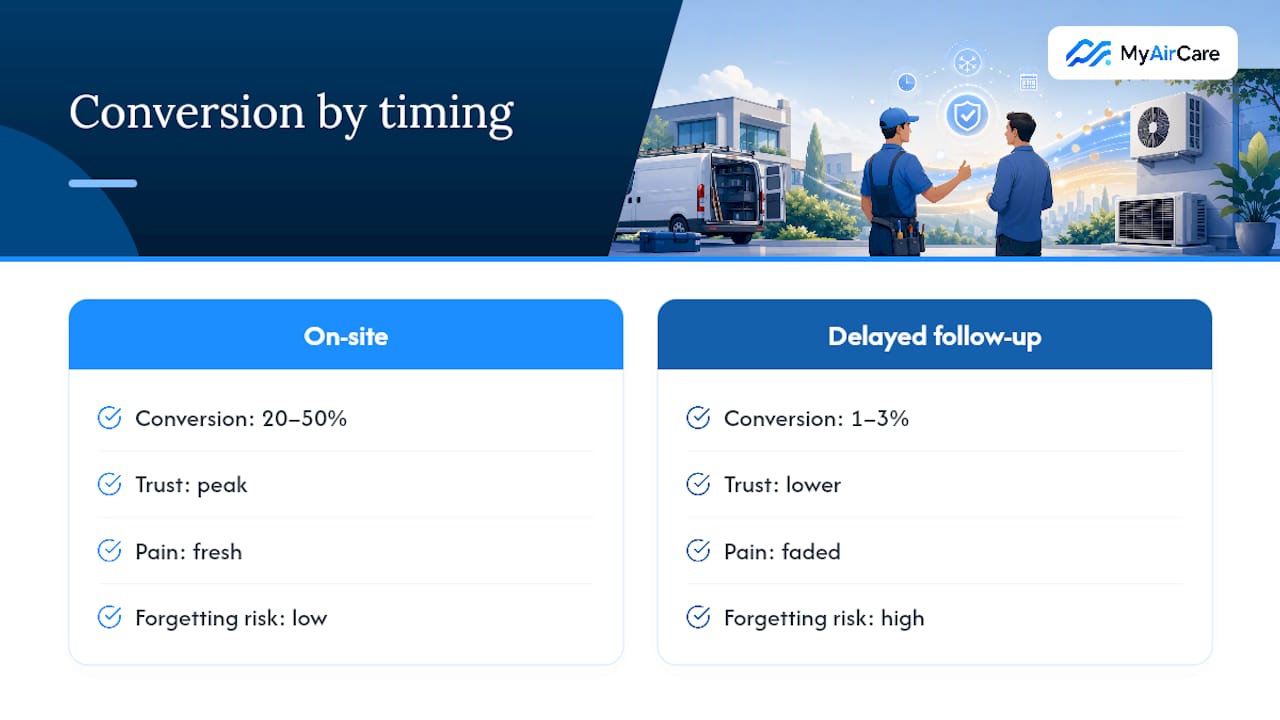
- Selling maintenance plans immediately after service completion yields the highest on-site conversion rates, often between 20 and 50 percent, compared to 1 to 3 percent for delayed follow-ups.
- Using a simple three-tier menu with clear, plain-language descriptions ensures customers can easily understand and choose the appropriate plan, with most opting for the mid-tier option.
- Technicians should deliver a two-sentence, benefit-led pitch tied to the specific problem just fixed, and enroll customers on-site within three minutes using mobile payment tools.
- Auto-pay and annual prepayment significantly improve renewal rates by 10 to 15 percentage points, while tracking technician performance helps boost overall plan sales.
- Testimonials, case studies, and targeted segmentation based on recent service history and equipment age increase trust and improve the success of on-site maintenance plan sales.
Table of Contents
- How to sell maintenance plans on the job, not after it
- Design a simple tiered plan menu that customers understand
- When to pitch: timing and the highest-converting moments
- Scripts and benefit-led messaging technicians can use
- On-site enrolment: build the three-minute workflow
- Pricing and billing cadence: practical anchors
- Turn technicians into reliable sellers
- Retention and renewals: the automation sequence
- Common objections and short, evidence-based responses
- How MyAirCare maps to the on-site enrolment and retention workflow
- Using testimonials and case studies to build trust
- Finding the customers most likely to say yes
- Cross-selling and upselling to existing plan customers
- Legal and compliance considerations when selling maintenance plans
- Training non-sales staff to sell without feeling like salespeople
- What separates elite programs from average ones
- Put the on-site workflow into practice with MyAirCare
- Sources
- FAQ
How to sell maintenance plans on the job, not after it
Selling a maintenance plan while the technician is still at the property beats every other timing option. On-site offers routinely convert in the 20 to 50% range, compared with 1 to 3% for delayed office follow-up. The gap exists because the customer has just watched a problem get fixed. Trust is at its peak, the pain point is fresh, and there's no gap in which the offer gets forgotten or a competitor's letterbox drop wins the decision instead.
This is the core reframe for anyone still relying on quote follow-ups or email campaigns to promote maintenance contracts: the highest-converting moment is the one you're already standing in. Everything else in this article, from tier design to scripts to the enrolment workflow, exists to make that on-site moment as frictionless as possible.
Design a simple tiered plan menu that customers understand
A three-tier structure (Good, Better, Best) is the standard format across the service agreement industry, and for good reason: three options are easy to compare, and most buyers settle on the middle one when it's positioned as the sensible default.
Keep tier names plain. "Basic," "Preferred," and "Premium" work better than clever branding no one remembers a year later. Each tier should answer three questions in plain language: what the customer gets, what it costs, and what's excluded, a framing Simpro's contractor guide treats as the baseline test for whether a plan description is clear enough to sell.
- Basic: one annual visit, standard scheduling, no priority queue
- Preferred: two visits per year, 10 to 15% discount on repairs, priority booking
- Premium: two to four visits, biggest repair discount, free consumables, same-day priority dispatch
If a customer can't repeat the plan back to you in one sentence, the tier description needs simplifying, not the customer.
When to pitch: timing and the highest-converting moments
The primary opportunity is the moment a repair or install finishes and the equipment is running well. Secondary moments (inbound calls booking a one-off service, or a technician spotting an ageing unit during an unrelated job) still convert, just at a lower rate.
- Finish the job and demonstrate the fix is working before saying anything about a plan.
- Frame the plan around the specific issue just resolved, not generic upkeep.
- Offer the mobile enrolment on the spot, before the invoice is settled.
- Log the outcome (sold, declined, follow-up requested) so the moment isn't wasted data.
Making this repeatable matters more than making it perfect. A technician who pitches on every job, even clumsily, will out-sell one who waits for the "right" opportunity.
Scripts and benefit-led messaging technicians can use
Technicians don't need a sales course. They need two sentences that connect the job just finished to the outcome the customer cares about, which is peace of mind, avoided emergency costs, and getting seen first when something breaks, not the checklist of tasks itself.
- "This will stop the same issue coming back. Want to lock in two visits a year so it's caught early next time?"
- "You just paid for an emergency callout. Our plan customers get this same visit for free and jump the queue."
- "The unit's ageing, so small issues show up faster. This plan catches them before they become an emergency bill."
Objection: "I'll think about it." Rebuttal: "No problem. Most people who sign up do it right after a repair like this. Want me to hold the price for a week?"
Pro Tip: Tie the pitch to the exact fault just repaired. "This prevents the same drain clog we fixed today" outperforms any generic prevention line, because it's specific and the customer just lived it.
On-site enrolment: build the three-minute workflow
A workflow that takes longer than three minutes to complete loses customers to hesitation, distraction, or a ringing phone. The playbook benchmark for high-converting teams is a sub-3-minute enrolment from pitch to signed, paid contract, and manual office handoffs are the single biggest reason that number blows out.
- Mobile contract creation the technician fills in on a phone or tablet, no paperwork
- Card capture through a secure processor like Stripe, so the customer pays and activates immediately
- Instant receipt and plan confirmation sent to the customer's inbox or phone
Track conversion rate by technician, average time-to-enrol, and failed or abandoned attempts. If one tech's enrolments consistently take twice as long as the team average, that's a training gap, not a personality issue. The most common failure mode is a payment step that requires switching apps or re-entering details, which is exactly where customers change their mind.
Pricing and billing cadence: practical anchors
Price the plan against loaded delivery cost, not against what a competitor charges. Undercutting on price without knowing your true cost to deliver each visit creates a contract you lose money honouring.
Residential single-system plans commonly land between roughly $150 and $350 per year, with premium tiers justified by extra visits, discounts, and priority dispatch.
- Entry tier: near cost price, positioned as the easy "yes"
- Mid-tier: the anchor, priced for healthy margin and the option most customers choose
- Premium tier: highest margin, sold on speed and priority rather than volume of visits
Auto-pay and card-on-file arrangements lift renewal rates by roughly 10 to 15 percentage points compared with plans requiring manual renewal payment.
Monthly billing tends to win more initial sign-ups because the number feels smaller. Annual prepay, often with a small discount attached, improves retention because the customer has already committed for the year. Offer both, and let the customer self-select.
Turn technicians into reliable sellers
Complicated commission structures confuse technicians and slow them down. Small, immediate incentives work better.
- Pay a modest, fixed spiff per signed plan rather than a percentage that requires a calculator.
- Post a simple leaderboard so technicians see how their conversion compares to the team, which creates healthy competition and flags who needs coaching.
- Review conversion rate per technician monthly, not annually, so struggling reps get help before a bad quarter becomes a bad year.
- Run short roleplay sessions, ten minutes, focused on one objection at a time, rather than a full sales training day nobody retains.
Consistency beats charisma here. A technician who uses the same two-sentence script on every job will out-perform a naturally gifted talker who only remembers to pitch half the time.
Retention and renewals: the automation sequence
Winning the sale is half the job. The other half is stopping quiet renewal leakage, which is where a lot of recurring revenue actually disappears.
- Trigger a renewal reminder at 60 days, 30 days, and 14 days before expiry
- Set auto-renew as the default, with an easy opt-out, since defaulting to continuity reduces friction without hiding the cancellation option
- Make sure dispatch and your CRM actually honour the priority scheduling promised to plan customers, because a broken promise here is the fastest way to lose a renewal
- Track renewal churn monthly and flag any tier or technician cohort where it spikes
If a plan customer calls with an emergency and gets the same queue position as a non-member, you've broken the one thing they paid for.
Common objections and short, evidence-based responses
- "It's too expensive." Break the annual price into a monthly figure and compare it against the cost of one emergency callout.
- "I probably won't use it." Explain the visits are scheduled automatically, so there's nothing for the customer to remember or organise.
- "My system's old, is this worth it?" Be straight with them. If the unit is near end of life, recommend the entry tier or flag replacement instead of oversell.
- "I'll decide later." Offer to hold today's price for a short window, since delayed decisions convert at a fraction of on-site ones.
How MyAirCare maps to the on-site enrolment and retention workflow
Everything above depends on removing friction between the technician's recommendation and a signed, paid contract. MyAirCare is built around that exact gap for air-con cleaning operators: mobile job management, Stripe-based payment capture, and automated reminders that trigger without a CSR chasing them manually.
Operators using platforms designed for on-site workflows typically see fewer abandoned signups, because the technician never has to hand the customer off to an office process. Automated job reminders can also handle the renewal-nudge work described earlier, without a manual calendar system tracking who's due.
Using testimonials and case studies to build trust
A tiered plan with a clean script still needs proof behind it, and nothing does that job better than a customer who's already lived through the value. If a plan customer avoided an emergency callout because a scheduled visit caught the issue early, that story is worth more than any brochure line about "peace of mind."
Ask satisfied plan customers for a short, specific quote rather than a generic one. "They caught a fault before it became a $400 emergency repair" sells harder than "great service, very happy." Specificity is what makes a testimonial believable, because vague praise reads as filler even to a casual reader.
Display these stories where the pitch actually happens; on the invoice, in the mobile enrolment screen, or printed on a laminated card the technician carries. A testimonial buried on a website's "About" page does nothing for the customer standing in a driveway deciding whether to sign up in the next ninety seconds.
Case studies work slightly differently to testimonials. A testimonial is emotional proof; a case study is operational proof. If you can show a customer segment (say, older split systems in a specific area) where plan customers had measurably fewer breakdown calls than non-plan customers, that's a stronger argument for a business owner or property manager than any single quote.
Keep the format consistent: the problem, the fix, the plan, the result. Three or four of these, refreshed every few months, will outperform a wall of five-star review screenshots that all say roughly the same thing.
Finding the customers most likely to say yes
Not every customer converts at the same rate, and treating them as one undifferentiated group wastes a technician's pitch energy. The best predictor of plan uptake is recent service history: someone who just paid for an unplanned repair is dramatically more receptive than someone who's never had an issue.
Ageing equipment is the second-strongest signal. Units past the midpoint of their expected lifespan break down more often, and owners of that gear already sense it, even if they haven't said so out loud. A technician who frames the plan honestly around that ageing risk, rather than pretending the unit will run forever, tends to convert better because the pitch matches what the customer already suspects.
Multi-unit or commercial customers deserve a different approach entirely. A property manager overseeing several systems cares less about any single unit's health and more about predictable costs across a whole portfolio. That's a segment worth a tailored conversation, sometimes even a custom quote, rather than the standard three-tier menu pitched to a homeowner. Operators chasing this kind of volume work should look at how to structure tenders for larger accounts, since the sales motion and pricing logic differ from single-property jobs.
Past customers who declined a plan previously are also worth revisiting, particularly if they've since called for an unplanned repair. That repair is a fresh on-site opportunity, and the earlier decline shouldn't rule out a second, better-timed offer. Segmenting by service history, equipment age, and property type turns a scatter gun pitch into a targeted one, and targeted pitches convert at a noticeably higher rate than blanket offers to every customer on the books.
Cross-selling and upselling to existing plan customers
An existing plan customer is the easiest upsell in the business, because they've already said yes once and the trust is established. The mistake most operators make is treating the plan as a finished transaction instead of an ongoing relationship with more than one thing to offer.
Tier upgrades are the most obvious move. A Basic customer who's called for two unplanned repairs in a year is a strong candidate for Preferred or Premium, since the data already shows they need more coverage than they bought. Bring this up at the next scheduled visit, not as a hard sell but as an observation: "You've needed two extra callouts this year, the next tier up would have covered both for less than you paid out of pocket."
Adjacent services are the second lever. A customer on an air-con maintenance plan might also need duct cleaning, filter replacement programs, or a seasonal inspection add-on. These don't need a separate sales conversation; they fit naturally into the same visit where the technician is already on-site and already trusted.
Referral requests belong here too, even though they're not technically a cross-sell. A plan customer who's had a good experience is a reasonable person to ask, at renewal time, whether they know a neighbour or family member who might benefit from the same coverage. It costs nothing to ask and it turns one satisfied customer into a lead source, which matters more for operators trying to find quality clients without spending heavily on advertising.
Legal and compliance considerations when selling maintenance plans
A maintenance plan is a contract, and treating it casually creates real exposure. The plan document needs to state, in plain language, exactly what's included, what's excluded, the price, the billing cadence, and the cancellation terms. Vague wording that oversells coverage is the fastest way to end up in a dispute when a customer expects a repair covered under the plan and finds out it isn't.
Auto-renewal terms deserve particular care. Many jurisdictions have rules around how clearly a business must disclose an auto-renewing contract and how easy cancellation must be, so the plan should never make opting out harder than opting in. Defaulting to auto-renew is fine practice, provided cancellation is genuinely simple and clearly explained at sign-up, not buried in fine print.
Payment handling matters too. Capturing card details on-site through a compliant processor, rather than writing numbers on a paper form, keeps the business clear of unnecessary liability around storing payment information. This is also where structuring plans around real delivery cost pays off, because a plan priced below what it costs to deliver isn't just a bad margin decision, it's a contractual promise the business may struggle to honour later.
None of this replaces proper legal advice for a specific contract template, but the principle holds everywhere: clear language, honest inclusions, and simple cancellation protect the business as much as the customer. Operators managing the finance side of recurring contracts may also find it useful to understand how maintenance contract revenue is typically accounted for, since recurring revenue is treated differently to one-off job income.
Training non-sales staff to sell without feeling like salespeople
Most technicians didn't take the job to sell contracts, and forcing a sales script onto someone who sees themselves as a trades person usually backfires. The training that works treats the plan pitch as part of good service, not as a bolt-on sales skill.
Start with the script, not a sales philosophy. Two sentences, tied to the job just finished, are easier to remember and deliver naturally than a five-step sales framework nobody uses under pressure. Roleplay these in short bursts, ten minutes at a toolbox talk, rather than a half-day workshop that gets forgotten by the following week.

Feedback needs to be immediate and specific. If a technician's conversion rate is low, listen to how they're framing the pitch before assuming they need more training generally. Often the fix is small, like leading with the plan's cost before establishing the value, which is backwards from what actually converts.
Recognition works better than pressure. A technician who sees their name on a simple leaderboard, or gets a small bonus paid the same week as the signup, learns faster than one being measured against a quarterly target they can't see progress toward. The goal isn't turning technicians into salespeople; it's making the recommendation part of doing the job properly; the same instinct that makes them check a filter without being asked.
What separates elite programs from average ones
Selling a plan should feel like a service recommendation, not a pitch. The programs that consistently outperform get three things right every time: a consistent script, monthly conversion tracking, and enrolment with zero friction.
— Lewis
Put the on-site workflow into practice with MyAirCare
Everything in this playbook depends on the technician being able to enrol a customer without handing them off to an office, a callback, or a clunky payment form. MyAirCare is built specifically for Australian air-con cleaning operators who need that exact workflow: mobile contract creation, secure Stripe payment capture on the spot, and automated reminders that handle the renewal sequence without anyone chasing spreadsheets.

Where a manual booking diary or a general-purpose scheduling app leaves the enrolment step stuck behind a phone call or a follow-up email, MyAirCare keeps the whole job, quote, payment, and renewal reminder inside one mobile system the technician already has open. If you're bidding on larger recurring contracts, the tender-ready booking setup shows how that same workflow scales to multi-property accounts. See how a live booking page handles payments and confirmations by checking out a working example, then get in touch to set up your own account.
Sources
- How to Sell HVAC Maintenance Agreements: A Contractor's Playbook for 2026
- What Are Service Agreements? How They Grow Recurring Revenue | Deelo Blog
- How to Sell HVAC Maintenance Agreements | Simpro
- HVAC Maintenance Contracts 2026 | Pricing, Selling, and Retention Guide
FAQ
Is a maintenance plan worth it?
For most customers with equipment past its first year or two, yes: the plan typically costs less than a single unplanned emergency callout and adds priority scheduling. For a brand-new, still-under-warranty system, the entry tier is usually the more honest recommendation.
What is the best way to sell a service like a maintenance plan?
Pitch it on-site immediately after finishing the job that demonstrates its value, using a short benefit-led script and a mobile enrolment process that takes a few minutes from offer to signed, paid contract.
What is a maintenance plan?
A maintenance plan, also called a service agreement or maintenance contract, is a recurring arrangement where a customer pays a set fee, monthly or annually, for scheduled maintenance visits, priority service, and often a discount on repairs.
How do I get technicians who aren't salespeople to actually sell plans?
Give them a short, specific script tied to the job just completed rather than a sales framework, and track conversion rate per technician monthly so coaching targets the right person early.
What's a realistic conversion rate to expect from on-site pitching?
On-site offers made right after a completed job commonly convert in the 20 to 50% range, well above the low single digits typical of delayed follow-up calls.