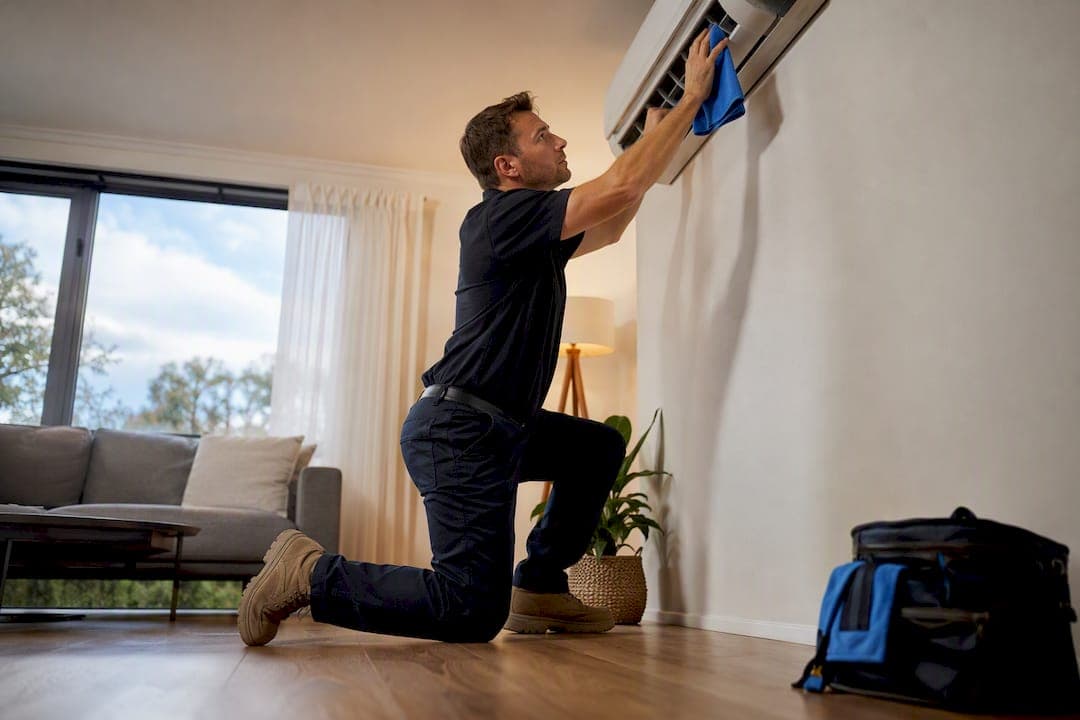
Google Ads works for Australian air‑con cleaning businesses when campaigns are built around phone calls, split by search intent, and measured at the booked‑job level rather than the click. Start with separate campaigns for emergency repairs, routine servicing, and branded search, each running call extensions and a landing page built for immediate booking. Without job‑level tracking, you cannot tell which spend actually turned into revenue.
TL;DR:
- Campaigns should be split by search intent, such as emergency repairs, routine servicing, and branded search, for more effective targeting and bid management.
- Small operators should allocate at least $30 to $50 daily, focusing budget on emergency and servicing campaigns to gather sufficient conversion data for optimization.
- Keywords should be grouped into emergency, service-type, and suburb-modified categories, with negative keywords preventing wasteful spend on irrelevant searches.
- Phone calls remain the main conversion channel, so ad copy and extensions should emphasize immediate booking, fast response, and local relevance to drive calls.
- Using dedicated landing pages with real-time booking and auto-reminders improves booked-job conversion rates, especially when paired with precise call and job-level tracking.
Table of Contents
- How should you structure Google Ads campaigns for aircon cleaning?
- Which keywords and negative keywords matter for local aircon searches?
- What bidding strategy and budget suit small aircon operators?
- What ad copy and extensions actually drive phone calls?
- How do you build a landing page that turns clicks into bookings?
- How do you measure which ads actually produce booked jobs?
- Do Local Services Ads and Google Business Profile matter alongside Search?
- How should you adjust Google Ads for Australian seasons and weather?
- What can Australian aircon cleaners realistically expect from Google Ads?
- How does booking software improve results from Google Ads leads?
- Priorities and trade‑offs for small Australian teams
- Turn every ad click into a confirmed job, not a missed call
- Sources
- FAQ
How should you structure Google Ads campaigns for aircon cleaning?
Split campaigns by intent, not by service area or generic keyword theme. A customer searching "aircon not cooling emergency" wants a different message, and a different bid, from someone searching "annual aircon service Brisbane."
Most Australian operators need four campaign types running at once:
- Branded search — captures people already searching your business name; cheap, high‑converting, and worth protecting from competitors bidding on it.
- Emergency and repair — urgent, high‑intent queries ("aircon repair today," "no cooling emergency") that deserve your highest bids and call‑only ad formats.
- Routine servicing — scheduled cleans, filter replacement, and maintenance plans; lower urgency, so it tolerates Maximise Conversions bidding once you have data.
- Seasonal upsell and remarketing — retarget past enquirers and website visitors ahead of summer, pushing deep cleans or service contracts.
Budget allocation should follow the money, not equal splits. A single‑van operator typically needs a minimum daily budget that gives Google's algorithm enough signal to optimise properly; below that, Smart Bidding stalls and you end up manually adjusting bids anyway. A two‑ or three‑van team can usually justify $80 to $150 a day, weighted toward emergency and servicing campaigns.
Performance Max suits operators chasing volume and comfortable with less granular control, since it blends Search, Display, and YouTube inventory automatically. Search and Call‑Only campaigns give you tighter control over keywords, negatives, and ad scheduling. Most small operators get better early results running dedicated Search and Call‑Only campaigns first, then layering in Performance Max once conversion data is solid.
Which keywords and negative keywords matter for local aircon searches?
Keyword selection for local air‑con cleaning comes down to three tight clusters, each in its own ad group so you can bid and write copy specifically for that intent.
- Emergency and repair terms — "aircon repair near me," "air conditioner not working," "urgent aircon service" — these convert faster than any other group and justify your highest cost‑per‑click.
- Service‑type terms — "aircon cleaning," "split system clean," "ducted aircon service," "coil clean" — bundle these by service, not by suburb, so ad copy stays specific.
- Suburb‑modified terms — combine service terms with the suburbs you actually service, such as "aircon cleaning Southside Brisbane" or "aircon service Sunshine Coast," to sharpen local relevance.
Keep branded and non‑branded keywords in entirely separate campaigns. Branded traffic often produces a much lower cost per lead than non‑branded search, so blending the two hides how much you're really paying for new customers.
Negative keywords stop budget leaking to searches that will never book a job. Add "DIY," "how to clean myself," "parts," "wholesale," "careers," "jobs," and "course" as a baseline negative list, then review the search terms report weekly for the first month to catch anything specific to your area.
What bidding strategy and budget suit small aircon operators?
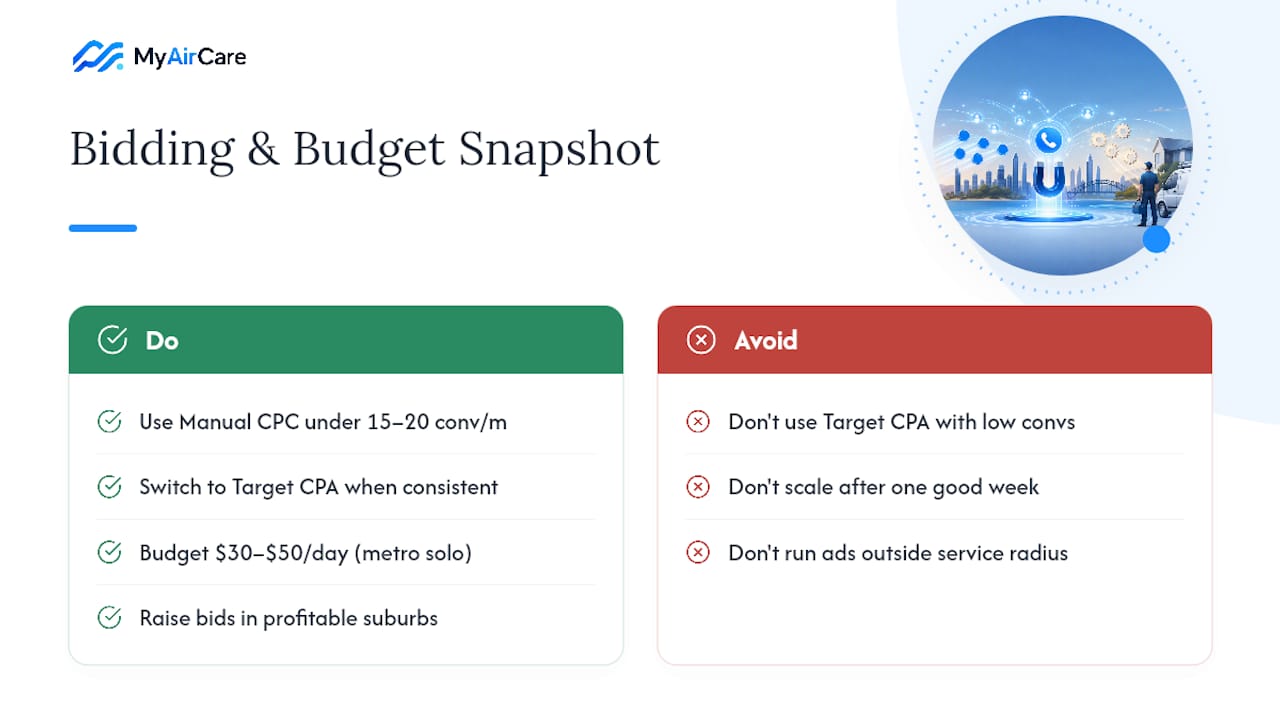
Bid strategy should track your conversion volume, not your ambition. Below roughly 15 to 20 conversions a month, manual CPC or Maximise Clicks gives you more control while Google gathers data. Once you're consistently generating conversions each month, Target CPA or Maximise Conversions usually outperforms manual bidding because the algorithm has enough signal to bid intelligently by time of day and device.
For budget floors, a solo operator needs enough daily spend to generate at least one or two clicks per hour during business hours in their service area, which in most Australian metro markets means a daily minimum around $30 to $50. Scale up only after cost per booked job stabilises, not after a single good week.
Location bid adjustments let you bid higher in suburbs where jobs are more profitable or drive time is shorter, and lower or exclude postcodes outside your realistic service radius. Radius targeting and excluding unprofitable locations is one of the simplest ways to cut wasted spend for a geographically bound service. Ad scheduling matters just as much: if you don't answer calls after 6pm, don't pay for clicks after 6pm.
What ad copy and extensions actually drive phone calls?
Phone calls remain the primary revenue driver for air‑con and HVAC services, so every asset in the ad should push toward a call, not just a click.
Headlines and descriptions that consistently perform well include:
- Same‑day or next‑day availability ("Book Today, Clean Tomorrow")
- Fast response promises ("Answered in Under 2 Rings")
- Price cues where you're comfortable quoting a starting figure
- Credentials and licensing mentions where relevant
Use call extensions on every Search campaign and run dedicated Call‑Only ads for the emergency campaign specifically, since those searchers want to talk to someone immediately, not browse a website. Add sitelinks to individual service pages (split system clean, ducted clean, deep sanitisation) and structured snippets listing service types. Run at least three responsive search ad variations per ad group and pin your strongest emergency phrase to the first headline position so it always shows for urgent searches.
Pro Tip: Pin your phone number and "same‑day service" phrase to the top headline position on emergency ad groups only — pinning everywhere flattens Google's ability to test which combinations convert best.
How do you build a landing page that turns clicks into bookings?
Send paid traffic to a page built around one offer, never your homepage. Landing pages that mirror ad intent, load fast, and present a single call to action convert markedly better than generic homepages, and this holds especially true for air‑con cleaning, where the customer wants an answer, not a menu.
Every paid landing page needs a visible phone number above the fold, a short booking form or a real‑time calendar widget, and clear price bands so the visitor isn't left guessing. If your emergency ad promises same‑day service, the landing page headline needs to say the same thing in the first few words, not three scrolls down.
Mobile load speed is non‑negotiable. Most mobile searchers abandon a slow page within a few seconds, and an emergency searcher on a phone in a hot house has even less patience than average. Test your page on a real phone connection, not just desktop Wi‑Fi.
A well‑designed booking page reduces the friction between "I clicked an ad" and "I have a confirmed job in the diary," which is the entire point of running paid search in the first place.
How do you measure which ads actually produce booked jobs?
Set up three conversion actions at minimum: phone calls of a minimum duration, form bookings, and completed jobs. Tracking at the job level rather than at the click or form‑fill level is what separates accounts that scale profitably from accounts that guess.
- Use Google's call forwarding numbers or a third‑party call‑tracking service to record and tag every inbound call by campaign and keyword.
- Import offline conversions back into Google Ads once a lead becomes a confirmed job, so Smart Bidding learns from revenue, not just enquiries.
- Tie call‑tracking data into your CRM or booking system so you can see cost per booked job, not just cost per lead.
- Report on booking rate from calls (what percentage of calls actually become jobs) alongside CPL, since a cheap lead that never books is worse than an expensive one that does.
Reviewing lead‑to‑booking conversion weekly in the first month lets you catch a bad keyword or a broken form before it burns through a month's budget.
Do Local Services Ads and Google Business Profile matter alongside Search?
Local Services Ads place verified providers at the very top of results on a pay‑per‑lead basis, which often produces a lower cost per lead than standard Search for straightforward, immediate‑need calls. Google verifies your business background before you can run LSAs, which builds trust faster than a standard text ad.
Google Business Profile signals, including review volume and photos, materially support how well your local ads perform, so treat GBP maintenance as part of your ad strategy, not a separate task. Keep service categories accurate and prioritise a steady flow of reviews.
Running LSAs and Search together captures different moments in the buying decision: LSAs grab the immediate, ready‑to‑book caller, while Search covers broader research queries, remarketing, and branded protection.
How should you adjust Google Ads for Australian seasons and weather?
Seasonal and weather‑driven adjustments matter significantly in Australia, where a single heatwave can spike emergency search volume overnight. Raise bids and daily budgets in the days before and during heatwaves, and push same‑day and emergency messaging harder in ad copy during those windows.
The quieter months, typically autumn and early spring, suit a different message entirely. Redirect budget toward deep cleans, service plans, and maintenance packages, which carry better margins than reactive emergency callouts. Ad scheduling rules and manual bid adjustments tied to forecast weather let you automate most of this shift without checking the account daily.
What can Australian aircon cleaners realistically expect from Google Ads?
Expect branded search to produce your cheapest leads by a wide margin, since branded campaigns frequently deliver much lower cost‑per‑lead than non‑branded campaigns. Non‑branded emergency and servicing campaigns cost more per lead but generally convert to booked jobs at a higher rate because the searcher already has an urgent, specific need.
Phone calls will dominate conversions over form fills for most operators, consistent with the pattern seen across HVAC and air‑con services generally. Booking close rates from qualified calls tend to run well above close rates from generic web enquiries, simply because a phone conversation lets you confirm the job on the spot.
Give a new campaign at least two to three weeks of real spend before judging cost per booked job. Early data is noisy. Scale budget once you see a stable pattern across multiple weeks, not a single strong day.
How does booking software improve results from Google Ads leads?
An ad campaign that generates calls still loses money if those calls turn into missed bookings, double‑ups, or no‑shows. MyAirCare's online booking pages let a caller or click‑through visitor book directly into a live calendar, cutting the gap between ad click and confirmed job.
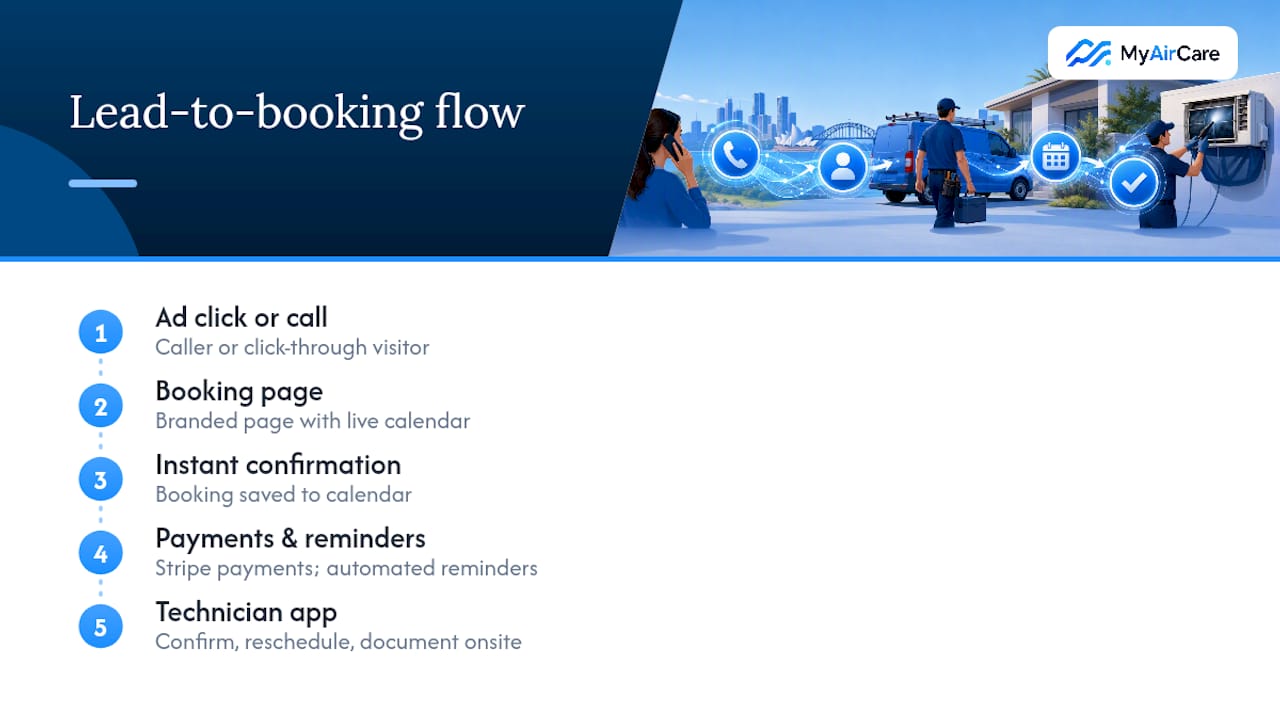
Automated reminders reduce no‑shows, which directly lowers your real cost per booked job even when cost per lead stays the same. Secure payments through Stripe let a customer pay on booking or on completion without a manual invoice chase, and the mobile job app lets a technician confirm, reschedule, or document a job on site. An ad click that lands on a branded booking page, confirms instantly, and reminds the customer automatically closes more of the loop than a click that ends in a missed call.
Priorities and trade‑offs for small Australian teams
Do three things in week one: build call‑optimised Search campaigns split by intent, launch a single‑offer landing page, and enable call tracking before spending a dollar more. Hand campaigns to an agency only if you're scaling fast or genuinely have no spare hours; otherwise, run it in‑house with a simple weekly review.
— Lewis
Turn every ad click into a confirmed job, not a missed call
Google Ads gets the phone ringing; what happens in the next sixty seconds decides whether that call becomes revenue. MyAirCare is a platform designed to provide aircon cleaning businesses with a live booking calendar instead of voicemail, streamlining appointment management.

Set up a branded booking page that mirrors your ad messaging, so a click on "same‑day aircon clean" lands on a page offering exactly that, with real‑time availability instead of a contact form someone has to follow up manually. Automated reminders cut no‑shows, Stripe handles payment on the spot, and the mobile app lets your technician confirm or reschedule from the job site without a callback to the office. If you run tenders or manage multiple service pages, the aircon cleaning tenders tool shows how a structured booking flow scales across jobs without extra admin. Head to MyAirCare and set up a booking page before your next campaign goes live.
Sources
- Google Ads for HVAC Companies Australia ('Near Me' ...)
- Business
- HVAC Google Ads Guide
- Google Ads for Air Conditioning Cleaning Services: A Comprehensive Setup Guide | Sona
FAQ
How much do Google Ads cost in Australia for aircon cleaning?
Costs vary by campaign type and competition in your area, but most single‑van operators need a combined daily budget of roughly $30 to $50 across all campaigns to give Google's bidding algorithm enough data to optimise properly.
Is $500 a month enough for Google Ads?
A solo operator running a tightly targeted emergency and branded campaign needs a daily minimum budget that gives Google's algorithm enough signal to optimise properly, but this leaves little room to also test servicing and seasonal campaigns at the same time.
Is $10 a day enough for Google Ads?
A budget below the daily minimum needed to generate at least one or two clicks per hour during business hours in most Australian metro markets is generally too thin for a competitive local service like aircon cleaning, since it rarely gives Smart Bidding enough conversion data to learn effectively.
Is $20 a day good for Google Ads for aircon cleaning?
$20 a day can work for a narrowly targeted branded or single‑suburb emergency campaign, but most operators need closer to $30 to $50 a day once they add servicing and seasonal campaigns alongside it.
Should I run Local Services Ads or Search ads first?
Run Local Services Ads first if you need immediate calls and want Google's verification badge, since LSAs often produce a lower cost per lead for home services; add Search once you also want broader keyword coverage and remarketing.