
The fastest route to more aircon cleaning leads is to combine three high-intent local channels — Google Business Profile, paid search, and referral partnerships — with a 24/7 online booking page that accepts secure payments via Stripe. Set this up through MyAirCare and you can convert web visitors into booked, paid jobs without answering a single phone call.
Two actions you can complete in under 24 hours:
- Add an online booking page with live availability so customers can self-schedule at any hour.
- Enable automated SMS booking confirmations so every new appointment is acknowledged instantly.
Table of Contents
- Where do aircon cleaning leads come from?
- How do you capture and convert leads faster?
- What features should booking software have for aircon cleaners?
- Step-by-step: from enquiry to booked, paid job
- What do leads cost and when should you expect results?
- How do you measure whether your lead strategy is working?
- How to follow up after a job to generate repeat business
- How do customer reviews help attract more aircon cleaning leads?
- How to optimise your Google Business Profile for aircon cleaning in Australia
- Key takeaways
- The case for treating response time as a business asset
- MyAirCare gives aircon cleaners a complete lead-to-payment system
- Useful sources and further reading
Where do aircon cleaning leads come from?
Local search campaigns and a frictionless landing page are the highest-converting combination for air conditioning cleaning services. The table below maps each channel to its primary strength and the best short-term tactic for Australian operators.
| Channel | Strength | Best short-term tactic |
|---|---|---|
| Google Business Profile | Free, high-intent local visibility | Add before/after photos and request reviews weekly |
| Google Search Ads | Immediate volume, intent-matched | Target suburb-level keywords with a booking-page destination |
| Website + booking widget | 24/7 self-serve conversion | Embed a live-availability booking widget above the fold |
| Referrals and trade partnerships | Low cost, high trust | Partner with property managers and real estate agencies |
| Local lead vendors | Immediate job supply | Trial a postcode-exclusive subscription during peak season |
| Social ads | Seasonal demand capture | Run targeted campaigns in October–November and February–March |
Sole traders should activate Google Business Profile and the booking widget first — both are low cost and generate inbound enquiries without ongoing ad spend. Small teams can layer paid search on top once the booking workflow is confirmed and the calendar is synced.
Seasonal triggers matter in Australia. Late spring (October–November) and late summer (February–March) see the highest search volumes for air conditioning cleaning services, driven by allergy season and end-of-tenancy rental turnovers. Scheduling ad campaigns and promotional emails around these windows improves cost per booked job.
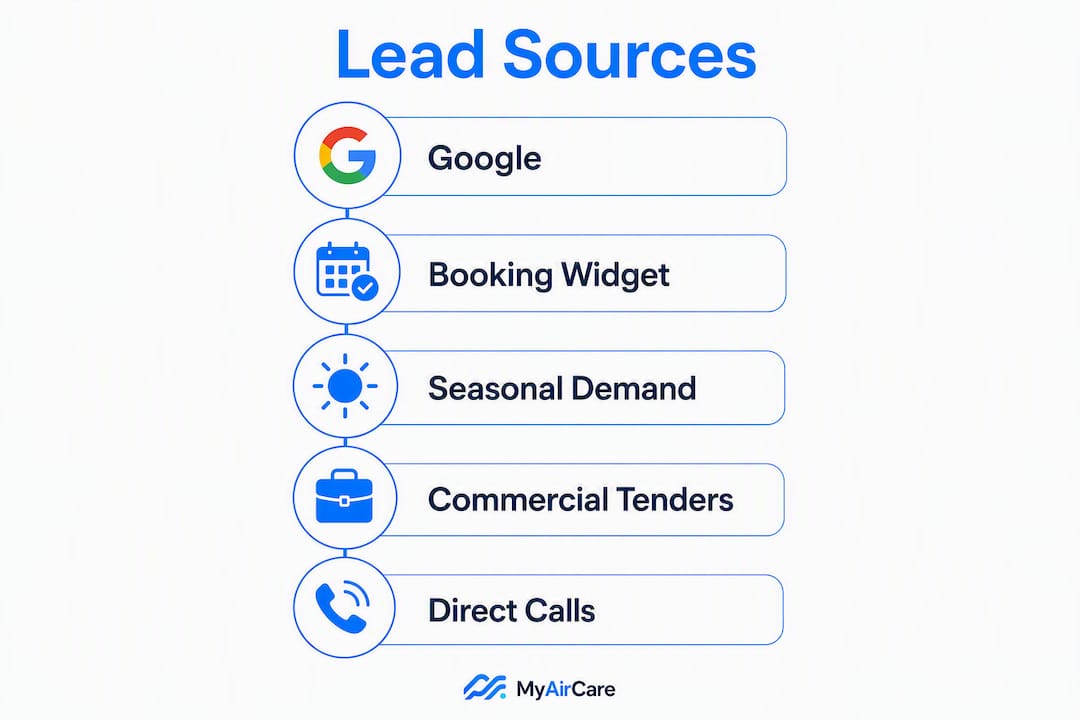
For operators pursuing larger contract work, MyAirCare's tenders page provides a route to commercial opportunities beyond residential one-off cleans.
How do you capture and convert leads faster?
After-hours lead capture converts late enquiries into scheduled morning appointments, turning previously lost contacts into reliable revenue. Three immediate actions make the biggest difference:
- Embed an always-on booking widget that surfaces next-available slots in real time.
- Enable an automated responder that qualifies urgency (repair vs. scheduled clean) before routing the enquiry.
- Require a paid deposit via Stripe at the time of booking to reduce no-shows.
Example automated after-hours reply: "Thanks for contacting us. For urgent repairs, reply URGENT and we'll call you first thing tomorrow. To book a scheduled clean, select a time here: [booking link]. A deposit secures your slot."
This workflow handles the enquiry without disrupting a technician on-site. Responding in seconds rather than hours materially improves review ratings and increases contract conversion rates. A live booking page demonstrates exactly how this frictionless path works in practice.

Pro Tip: Set up two automated routing paths: one for "urgent repair" (flags the lead for a morning callback) and one for "scheduled clean" (sends a booking link immediately). This keeps your field team undisturbed while capturing both lead types.
What features should booking software have for aircon cleaners?
Each feature below maps directly to a business outcome for air conditioning cleaning operators.
- Online booking page: Converts web traffic into confirmed appointments without phone calls.
- Calendar sync and anti-double-booking: Prevents scheduling conflicts across multiple technicians.
- Mobile job management app: Technicians can view job details, reschedule, and take on-site payments from the field.
- Automated SMS and email reminders: Reduces no-shows and same-day cancellations.
- Secure payments via Stripe: Collects deposits or full payment at booking, improving cash flow.
- Quote and invoice generation: Speeds up the billing cycle and reduces admin time.
- Job notes and before/after photos: Documents work quality and supports warranty or dispute resolution.
- Recurring customer reminders: Automated recall messages (e.g. 11 months post-clean) convert one-off jobs into annual recurring clients.
MyAirCare is built specifically for air-con cleaners in Australia and includes all of the above. When trialling any platform, ask: How long does setup take? Does the mobile app work offline? What are the payment processing fees? Does it integrate with your existing website?
Step-by-step: from enquiry to booked, paid job
- Lead capture (0–30 seconds) — Customer submits an enquiry via booking widget, phone, or social message.
- Automated qualification (30 seconds) — System identifies urgent repair vs. scheduled clean and routes accordingly.
- Real-time availability (1 minute) — Customer sees next-available slots and selects a time.
- Deposit or full payment (2 minutes) — Stripe processes payment; booking is confirmed automatically.
- Calendar assignment (Instant) — Job appears on the assigned technician's calendar with job notes.
- Technician prep (Day before) — Automated reminder sent to technician with address, service type, and customer notes.
- Job completion notes and photos (On-site) — Technician logs before/after photos and marks the job complete via the mobile app.
- Automated review request (Within 1 hour of completion) — Customer receives an SMS requesting a Google review.
- Recall reminder (11 months later) — Automated message invites the customer to rebook, converting a one-off clean into a recurring air conditioning service lead.
Steps 1–5 and 8–9 should be fully automated. Steps 6 and 7 require a human touch — technician preparation and on-site documentation cannot be replaced by automation without risking service quality.
What do leads cost and when should you expect results?
Lead costs and timelines vary significantly by channel. Broad guidance for Australian operators:
- Google Search Ads: Cost per lead depends on local competition and suburb. Paid search campaigns typically begin generating enquiries within 10–14 days of launch.
- Local lead vendors: Postcode-exclusive subscriptions supply verified enquiries for a recurring fee, useful for filling gaps during slower periods.
- Booking widget (organic/direct): Near-zero marginal cost per lead once the widget is live; time-to-book is effectively instant.
- Referrals and partnerships: No direct cost, but 1–4 weeks to establish and 1–7 days per lead to convert.
Time-to-book benchmarks: booking widget (instant), phone with automation (same day), email enquiry (1–3 days), partnership or contract lead (1–4 weeks).
Seasonality in Australia creates predictable demand peaks. October through February is high season for residential aircon cleaning services. March through August is quieter, making it the right time to focus on listing optimisation, referral partnerships, and commercial contract leads rather than paid search.
For a sole trader starting out, listing optimisation and the booking widget deliver the best return before committing to paid ad spend. Review MyAirCare pricing to understand the subscription and booking-fee structure before budgeting.
How do you measure whether your lead strategy is working?
Six metrics cover the performance of any air conditioning service lead strategy:
- Response time: Target under 5 minutes for inbound enquiries. Response times above 15 minutes are a trigger to enable automation.
- Lead-to-book conversion rate: The percentage of enquiries that result in a confirmed booking.
- Cost per booked job: Total ad spend divided by confirmed bookings for each channel.
- Average job value: Tracks whether upselling (e.g. multi-unit cleans, sanitisation add-ons) is working.
- Recurring customer rate: Measures how effectively recall reminders convert one-off cleans into repeat business.
- No-show rate: A high rate indicates weak deposit or confirmation processes.
For tracking, add UTM parameters to every ad link and use a separate call tracking number for each paid channel. Connect your booking platform to your ad account for closed-loop reporting — this shows which campaigns produce booked jobs, not just clicks. Review these metrics monthly; if response time consistently exceeds 15 minutes, automate the first-contact reply immediately.
How to follow up after a job to generate repeat business
A structured post-job communication sequence turns a single clean into a long-term customer relationship. The sequence has three stages:
Immediately after job completion: Send an automated SMS thanking the customer and requesting a Google review. Keep the message short and include a direct link.
Two to four weeks later: Send a brief follow-up checking satisfaction and noting any seasonal maintenance tips relevant to their system type. This message reinforces professionalism without being promotional.
Eleven months later: Send an automated recall reminder noting that their system is due for its annual clean. Include a direct booking link. This single touchpoint is the most cost-effective way to generate repeat aircon maintenance leads from an existing customer base.
Automated recall messaging, built into platforms like MyAirCare, removes the manual effort from this sequence entirely. The goal is consistent, timely contact that feels helpful rather than intrusive.
How do customer reviews help attract more aircon cleaning leads?
Reviews are a direct ranking factor in Google's local pack and a primary trust signal for customers choosing between air conditioning cleaning services. Operators who request reviews systematically after every job build a review volume that compounds over time.
Practical steps to build review volume:
- Send an automated review request within one hour of job completion, while the experience is fresh.
- Link directly to your Google Business Profile review page in every request.
- Respond to every review — positive and negative — within 24 hours. A professional response to a negative review often reassures prospective customers more than the review itself.
- Display recent reviews on your booking page and website to reinforce trust at the point of conversion.
Before/after photos posted to your Google Business Profile alongside reviews give prospective customers visual evidence of service quality, which is particularly effective for aircon cleaning where the transformation is visible.
How to optimise your Google Business Profile for aircon cleaning in Australia
A complete and active Google Business Profile is the single highest-return free action for local aircon cleaning operators. Key optimisation steps:
- Set your primary category to "Air Conditioning Contractor" and add secondary categories for cleaning and maintenance services.
- Add your service area by suburb and postcode, not just your business address.
- Upload before/after photos of completed cleans regularly — at least two new images per month.
- Post weekly updates using Google Posts to promote seasonal offers or maintenance reminders.
- List every service with a description and price range where possible, so your profile appears for specific searches like "split system clean Brisbane."
- Enable messaging so customers can contact you directly from the profile.
Consistent NAP (name, address, phone number) details across your Google Business Profile, website, and local directories improve local search rankings. Mismatched details reduce trust signals and can suppress your listing in local pack results.
Key takeaways
Combining a 24/7 online booking page, automated follow-up sequences, and an optimised Google Business Profile gives Australian aircon cleaning operators the most reliable foundation for consistent lead generation and repeat business.
| Point | Details |
|---|---|
| Activate high-intent channels first | Google Business Profile and a booking widget deliver leads at the lowest cost before paid ads are needed. |
| Automate after-hours capture | An automated qualification and booking flow converts late enquiries into confirmed morning appointments. |
| Use recall reminders at 11 months | A single automated message 11 months post-clean is the most cost-effective way to generate repeat bookings. |
| Track six core metrics | Monitor response time, conversion rate, cost per booked job, average job value, recurring rate, and no-show rate monthly. |
| MyAirCare for end-to-end management | MyAirCare covers online booking, Stripe payments, automated reminders, mobile job management, and recall sequences in one platform. |
The case for treating response time as a business asset
The conventional advice for growing an aircon cleaning business focuses on advertising spend and listing optimisation. Both matter. What tends to be underestimated is how much revenue is lost not from a lack of leads, but from slow responses to the leads that already exist.
An enquiry that arrives at 9 PM and receives a reply at 9 AM the next day has a materially lower chance of converting than one answered within minutes. Customers searching for air conditioning cleaning services at night are often motivated by a specific trigger — a rental inspection, an allergy flare-up, a system that smells. That urgency fades by morning, and so does the likelihood of booking.
Automation does not replace the human element of running a service business. It handles the gap between when a customer decides to act and when a person is available to respond. The operators who grow recurring revenue most reliably are those who treat that gap as a controllable variable, not an unavoidable limitation. Automated recall reminders at 11 months are a direct example: the customer does not need a sales pitch, they need a timely prompt. The prompt does the work.
MyAirCare gives aircon cleaners a complete lead-to-payment system
Fewer missed calls, no double-bookings, and payment collected before the technician arrives — that is the practical outcome of running your air conditioning cleaning business through MyAirCare.

MyAirCare is built specifically for Australian aircon cleaners. It includes branded online booking pages with live availability, Stripe payment processing, automated SMS reminders, a mobile app for on-site job management, calendar sync across your team, quote and invoice generation, and automated recall reminders to bring customers back. Operators using the platform report fewer scheduling conflicts and faster payment collection compared to managing bookings manually.
To see the platform in action, view a live booking page example or go directly to MyAirCare pricing to review plan options and get started.
Useful sources and further reading
- MyAirCare platform overview — Start here to understand the full feature set for booking, payments, and job management.
- MyAirCare pricing — Review subscription tiers and booking fees before budgeting your software costs.
- MyAirCare tenders page — Use this to explore commercial contract opportunities and manage larger bids.
- Google Ads setup guide for air conditioning cleaning — Detailed guidance on structuring search campaigns and landing pages for aircon cleaning services.
- Local lead vendor example (Cairns) — Reference for understanding postcode-exclusive lead subscription models and typical fee structures.