Public holiday surcharges are legal in Australia when a business discloses them clearly and prominently before a customer commits to a purchase. That single condition, set out in the Australian Consumer Law, decides whether a surcharge is a fair reflection of higher wage costs or a misleading price. What follows covers why businesses charge them, what "prominent" actually means, and how to fix or report one that isn't disclosed properly.
TL;DR:
- Public holiday surcharges are lawful in Australia only if businesses clearly disclose them on menus, signage, and at checkout before the customer orders.
- Most Australian cafes and restaurants charge between 10% and 15% on public holidays, with deviations raising customer scrutiny.
- Surcharges should be calculated by estimating extra wage costs and applying a percentage close to industry norms, generally 10% to 15%.
- The surcharge notice must be in four locations: on the menu's first page, at the entrance, on the online menu, and on the final receipt, with consistent prominence.
- If a surcharge isn't properly disclosed, customers can request a refund or report the conduct to authorities; in card-only scenarios, the surcharge must be embedded in the advertised price.
Table of Contents
- What counts as a public holiday surcharge under Australian Consumer Law
- Why businesses charge extra on public holidays
- How to display a public holiday surcharge correctly
- Calculating a fair surcharge rate
- What to do if a surcharge wasn't disclosed properly
- A compliance checklist for business owners
- Getting the balance right between wages and trust
- Keep pricing and receipts consistent with MyAirCare
- Sources
- FAQ
What counts as a public holiday surcharge under Australian Consumer Law
A public holiday surcharge is an added percentage or flat fee applied to a bill on a gazetted public holiday, usually to offset higher staff wages. It's separate from GST, separate from a card processing fee, and it has to be disclosed before the customer orders, not revealed for the first time on the receipt.
The Australian Consumer Law treats an undisclosed or late-disclosed surcharge as a form of misleading or deceptive conduct, because the customer didn't get the full price before agreeing to buy. The ACCC's price display guidance sets a specific test for this: the surcharge notice must be at least as prominent as the most prominent price shown on the menu. A 15% surcharge mentioned in size 6 font at the bottom of page four doesn't meet that bar. A clear line near the top of the menu, in a font size comparable to the dish prices, does.
Typical hospitality surcharges sit in a fairly consistent band. Most Australian cafés and restaurants charge between 10% and 15% on public holidays, according to ACCC guidance. That range has become something like an industry norm, which is partly why a surcharge outside it tends to draw more customer scrutiny.
Compliant disclosure generally means doing all of the following:
- Stating the surcharge on the first page of a physical menu, not buried in fine print.
- Repeating the notice on any digital or QR code menu before the customer selects items.
- Displaying it at the entrance or on a sandwich board if tables aren't pre-set with menus.
- Showing it again at checkout or on the final order screen before payment is confirmed.
Businesses that operate a card-only model face an extra rule. If a fee is unavoidable because customers have no other way to pay, the ACCC requires that fee be built into the advertised price rather than tacked on separately. A café that only accepts card payments can't quietly add a card surcharge at the terminal and call it disclosed.
Why businesses charge extra on public holidays
Surcharges exist because public holiday wages cost more, and that cost isn't set by the Fair Work Act's National Employment Standards. The NES guarantees an employee's right to be absent on a public holiday and be paid for ordinary hours. It doesn't set a universal penalty rate for those who work. That's determined by the relevant modern award or enterprise agreement, and hospitality, retail, and healthcare awards each set their own multipliers.
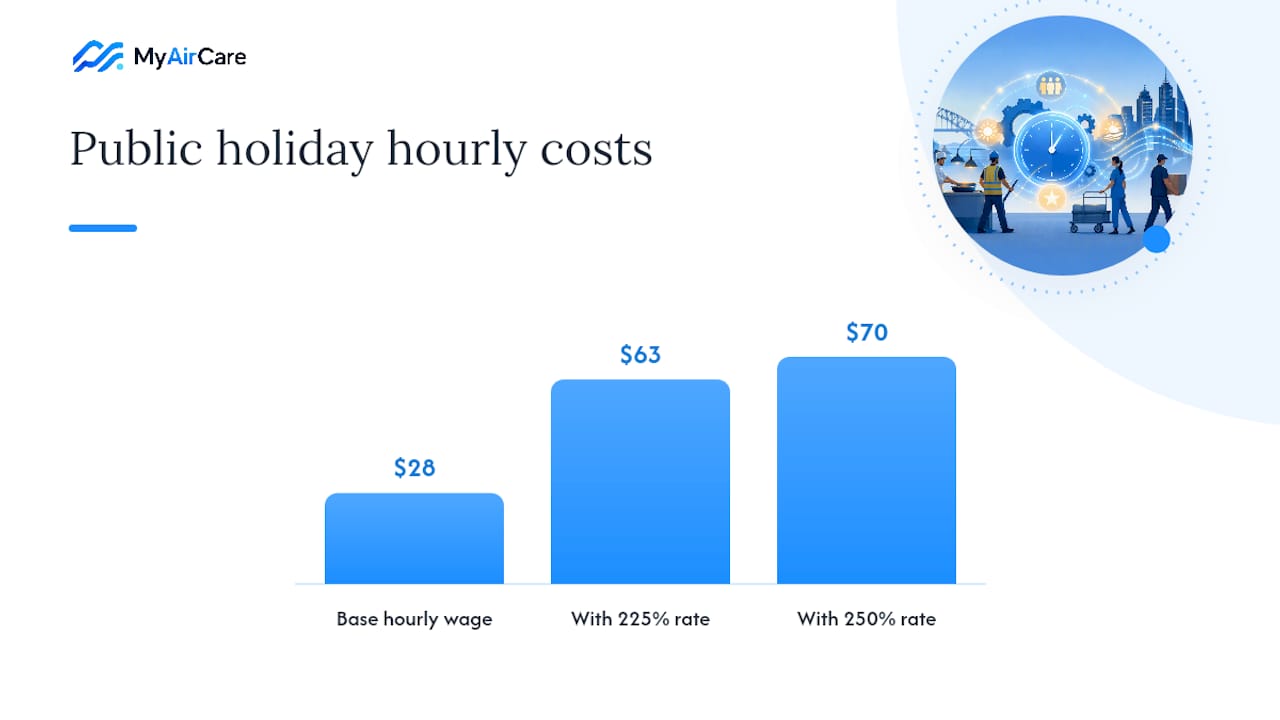
Common hospitality awards typically set public holiday penalty rates somewhere between 225% and 250% of the base wage, according to figures from WorkCalc's public holiday rate calculator. A barista who normally earns $28 an hour can cost a business $63 to $70 an hour once the public holiday multiplier applies. Multiply that across a full floor and kitchen team on a busy Easter Saturday, and the payroll bill for a single trading day can double or more.
Several other pressures compound that wage cost:
- Casual staff availability often drops on public holidays, forcing owners to pay overtime to whoever will come in.
- Utility and supply costs don't fall just because it's a holiday, so fixed overheads stay the same against a smaller staffing pool.
- Closing entirely avoids the wage spike but sacrifices a day of revenue many venues can't afford to lose.
The scale of what customers pay collectively is significant. Media analysis reported by Yahoo Finance AU estimated Australians paid $178.9 million in public holiday surcharges across one April holiday period alone, with other reporting putting a single long weekend at around $49.2 million. Industry groups argue this is what keeps venues trading at all on days when the wage bill would otherwise make opening a loss, a point echoed in ABC News coverage of the issue.
How to display a public holiday surcharge correctly
Getting the wording right matters as much as getting the rate right. Sprintlaw's compliance guidance recommends a direct formula: "A surcharge of [percentage] applies on [the specified day or days]." No vague language about "additional charges may apply," no asterisk chains that send customers hunting for the fine print.
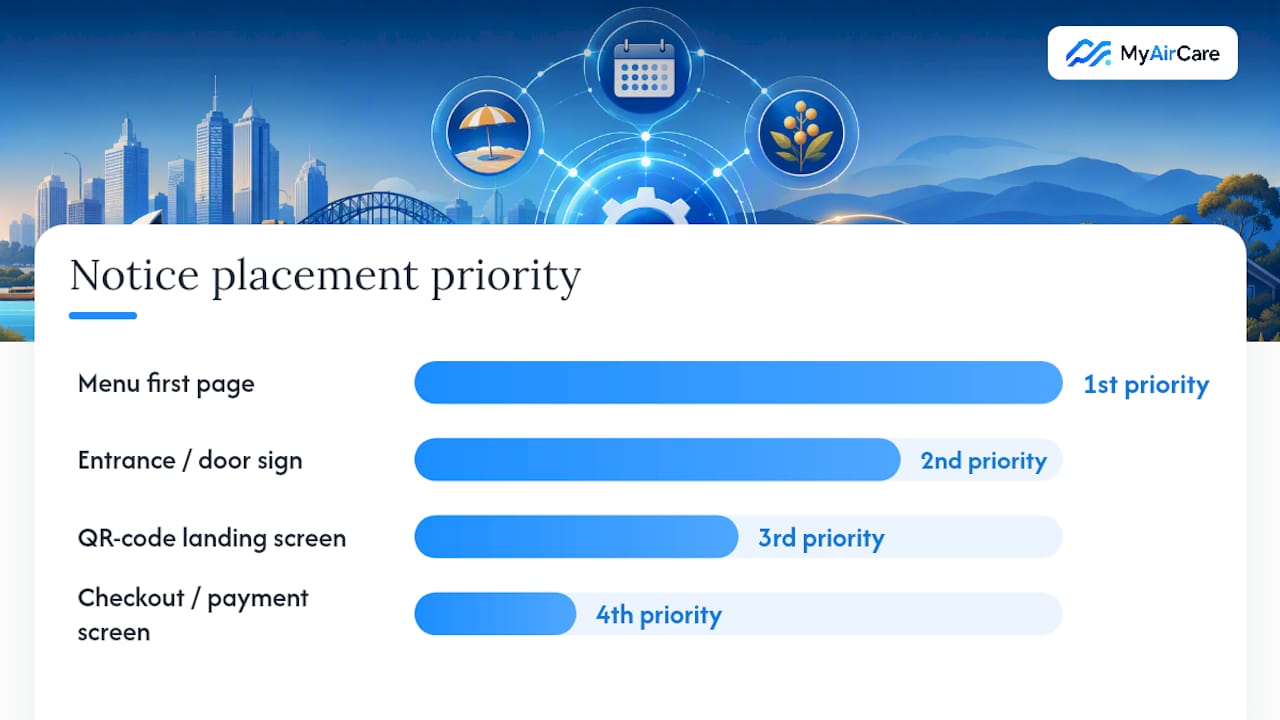
The notice needs to appear in four places, in this order of priority:
- The first page of the menu — physical or digital, wherever a customer looks first.
- An entrance or door sign — especially important for walk-in venues without table menus.
- The main landing screen of any QR code menu — before the customer can browse items, not after.
- The checkout or final payment screen — the last chance to confirm the customer saw it before paying.
Online ordering and third-party delivery apps need the same treatment. If a surcharge applies to click-and-collect orders placed through an app, the notice has to appear before the customer builds their cart, not as a surprise line item at payment. Businesses running their own booking or ordering software should configure the surcharge as a calendar-linked toggle, so it applies automatically on gazetted holidays and shows consistently across the online menu, the point-of-sale system, and the printed or emailed receipt, an approach the ACCC's own guidance implicitly supports by requiring consistent prominence across channels.
Receipts should also list the surcharge as its own line item, not folded into the item prices.
Pro Tip: Set the surcharge as a scheduled rule tied to the public holiday calendar for your state, rather than manually toggling it on each time. Manual toggles are the most common reason a surcharge accidentally applies on the wrong day, or fails to apply at all and costs the business money.
Calculating a fair surcharge rate
A surcharge should track the actual wage cost it's covering, not just match whatever the venue down the road charges. A simple method works for most small operators:
- Estimate total penalty wage cost for the day. Add up the difference between normal and penalty rates for every rostered staff member.
- Estimate average daily revenue or transaction count. Use trading data from a comparable weekend day.
- Divide the wage cost gap by expected revenue to get a percentage, then round to a customer-friendly figure like 10% or 15%.
A café expecting an extra $840 in penalty wages against average holiday trading revenue of $6,000 lands on a 14% surcharge, close to the 10 to 15% range most Australian venues already use.
Fixed fees suit businesses with smaller, more uniform transactions, like a $2 flat surcharge on takeaway coffee, because a percentage surcharge on a $4.50 flat white looks disproportionate next to a $95 dinner tab carrying the same rate. Whichever method a business chooses, keeping records protects it if the calculation is ever questioned. That means payroll extracts showing penalty rates paid, dated copies of menu revisions, photos of updated signage, and notes from any staff briefing on the new pricing.
What to do if a surcharge wasn't disclosed properly
Consumers are entitled to see a surcharge before they order, not after the bill arrives. If a venue didn't disclose it anywhere visible, a customer has a reasonable case to ask for the surcharge to be waived or refunded on the spot.
Before raising a dispute, it helps to gather simple proof:
- A photo of the menu or entrance signage as it appeared at the time.
- A screenshot of any digital or QR menu used to order.
- A copy of the final receipt showing the surcharge line item.
If the venue doesn't resolve it directly, the complaint can go to the ACCC, the relevant state consumer protection agency, or Scamwatch if the conduct looks deliberately deceptive rather than a genuine oversight. Include the date, the venue name, and the evidence gathered above when lodging a report.
One exception is worth remembering: if a business only accepts card payments and that fee is truly unavoidable, the surcharge must already be built into the advertised price. In that case, there's no separate line to dispute, because the price shown is meant to be the price paid in full.
A compliance checklist for business owners
Turning the rules above into a working process doesn't need to be complicated. A short setup sequence covers most of what a small hospitality or trade business needs:
- Decide the rate using the wage-cost method above, rounded to a figure customers already expect.
- Update every price display — physical menu, QR menu, website, and any delivery app listing — before the next public holiday.
- Configure the point-of-sale system to apply the surcharge automatically on gazetted dates, rather than relying on staff to remember.
- Train staff on a short script: "Just a heads up, there's a [X]% public holiday surcharge today to cover higher wages, it's on the menu and the receipt."
- Keep the surcharge and any card payment fee as separate line items on the receipt, so customers can see exactly what each charge covers.
Pro Tip: If your business charges both a public holiday surcharge and a card payment surcharge on the same transaction, list them as two clearly labelled lines rather than one combined percentage. Customers who see one unexplained lump figure are far more likely to complain than those who see both charges named individually.
Save dated screenshots of menu updates and a copy of the payroll calculation each time the rate changes. That record is what turns a customer complaint into a five-minute conversation instead of a formal dispute.
Getting the balance right between wages and trust
Public holiday surcharges are a legitimate way to keep a venue trading on a day that would otherwise cost the business money to open. The wage math is real, and no amount of customer goodwill changes what a modern award requires an employer to pay.
What separates a surcharge customers accept from one that generates complaints usually isn't the rate. It's whether the business said something first. A venue that states the number plainly, on the menu and at the till, rarely gets pushback even at 15%. One that lets the surprise land on the bill invites a dispute regardless of the amount. Testing a rate over a holiday or two and watching for complaints beats guessing at a number and hoping nobody notices.
— Lewis
Keep pricing and receipts consistent with MyAirCare
Everything above applies just as much to an air-con cleaning business trading on a public holiday as it does to a café. If your booking page shows one price, your invoice shows another, and your receipt line items don't match either, that's the exact kind of pricing inconsistency the ACCC flags as misleading, even when it's an honest admin mistake rather than deliberate.

This type of software is designed to handle the mechanics that cause these mistakes in the first place. Branded booking pages show your public holiday rate or surcharge upfront, before a customer confirms a job. Automated invoices through Stripe generate a consistent receipt every time, with any surcharge shown as its own line item rather than buried in a rounded total. The mobile app lets a technician confirm the job and take payment on-site without re-entering prices by hand, which is where manual errors usually creep in.
The Free plan covers the basics for sole traders, while MyAirCare Pro at $199 per month unlocks the full booking, invoicing, and team calendar features for busier operations. Check the pricing page to see which plan fits your business, or book a look at the platform through MyAirCare's booking system to see how automated pricing and receipts work in practice.
Sources
This guide draws on the ACCC's price display rules, Fair Work's penalty rates guidance, and Sprintlaw's compliance guide. Award rates and ACCC guidance can change, so check the ACCC and Fair Work sites directly before setting a new surcharge.
- Price displays — ACCC
- Penalty rates — Fair Work
- Public holiday surcharge shock as huge amount Aussies will fork out on controversial fee revealed — Yahoo Finance AU
FAQ
Is a public holiday surcharge legal in Australia?
Yes, a public holiday surcharge is legal under the Australian Consumer Law as long as it's disclosed clearly and prominently before the customer orders. It becomes a legal problem only when it's hidden, buried in fine print, or revealed for the first time on the bill.
Are public holidays paid at double time in Australia?
There's no single universal rate. Penalty rates for working a public holiday are set by the relevant modern award, and hospitality awards commonly sit between 225% and 250% of the base rate rather than a flat 200%.
What exactly is a holiday surcharge?
A holiday surcharge is a percentage or fixed fee a business adds to a bill on a public holiday, usually to help cover the higher wages required under penalty rate rules. Most Australian hospitality venues charge somewhere between 10% and 15%, based on ACCC guidance.
Is a 10% surcharge legal in Australia?
A 10% surcharge is legal provided it's disclosed prominently before the purchase, on the menu, at the entrance, and again at checkout. The percentage itself isn't restricted by law; what matters is whether the customer saw it before agreeing to pay.
Do I have to pay extra for card payments and public holiday surcharges together?
Yes, a business can legally apply both a card payment surcharge and a public holiday surcharge on the same transaction, provided each is disclosed and shown as a separate line item. If card payment is the only option available, that fee must be built into the advertised price rather than charged separately, as explained in the ACCC's guidance.