The fastest way to reactivate past customers is a segmented, multi-touch win-back flow that pairs personalised messaging with a calibrated incentive. Typical reactivation rates run 5 to 15% depending on how well you segment, according to AI-driven small business reactivation research. Start today by auditing your 100 most recent dormant contacts and grouping them by last purchase date and value.
TL;DR:
- Reactivation efforts are most effective when targeting recent, high-value customers within two to nine months of last purchase, based on their purchase frequency and amount.
- Segmented, multi-touch sequences that reference past interactions and include offers at the right moment significantly improve conversion rates over generic messaging.
- Channel choices matter: SMS for urgent, consented contacts; email for detailed messages; phone or LinkedIn for high-value B2B; and retargeting for ecommerce browsers.
- Using automation like booking reminders and payment follow-ups reduces churn without discounts, turning single visits into ongoing revenue streams.
Table of Contents
- Top tactics to try first for reactivating past customers
- How do you build a customer reactivation campaign?
- Which past customers should you target first?
- What should reactivation messages say and where should you send them?
- How should you time offers and cadence without training customers to wait for discounts?
- What metrics prove a reactivation campaign is working?
- How service businesses use booking automation to reactivate customers
- When should reactivation beat new customer acquisition?
- Running your reactivation flow through one booking platform
- Sources
- FAQ
Top tactics to try first for reactivating past customers
Some tactics recover revenue in weeks. Others take longer to build but pay off at scale. Start with the ones that need the least setup and the most existing data.
Segmented email sequences work because a customer who bought once and vanished needs a different message than one who bought five times and lapsed six months ago. Chargebee's win-back research treats churn reason and segment as the two variables that decide whether an email gets opened or deleted.
The highest-converting moment in the entire customer lifecycle is the cancellation screen itself, not a follow-up email sent weeks later. A pause or downgrade offer presented right there, according to Churnkey's reactivation guide, catches customers before they've mentally moved on.
Beyond email, five tactics consistently deliver results:
- Personalised email sequences segmented by purchase history and churn reason
- Cancellation-moment interventions, including pause options and payment-retry flows for failed billing
- SMS and retargeting ads for consented or high-value contacts who don't open email
- One-click reactivation links that skip login screens and pre-fill checkout details
- Manual phone check-ins reserved for your highest-lifetime-value accounts
Payment-retry automation alone recovers customers who never intended to churn. A failed card, not dissatisfaction, is often the real reason someone goes quiet.
How do you build a customer reactivation campaign?
A reactivation campaign works best as a five-stage process, not a single email blast.
- Audit your CRM and pick a test cohort. Pull 100 to 250 dormant contacts rather than your entire lapsed list, so you can measure results before committing budget.
- Set your lapse window using the repurchase rule. Define "dormant" as roughly two to three times your average repurchase interval, a formula recommended in the 2026 retention playbook. A quarterly service customer becomes a win-back target after six to nine months of silence.
- Write a three to four message escalating sequence. Start with a conversational check-in, move to a value reminder, then introduce an incentive only if earlier messages get no response.
- Set reply-handling rules before you launch. Decide who answers a "yes," who triages a "maybe," and how automation routes each response, an approach detailed in Octavius's CRM reactivation guide.
- Test on the small cohort, measure, then scale to the rest of your dormant list once the sequence proves itself.
Which past customers should you target first?
Not every lapsed customer deserves the same attention. Recency, Frequency, and Monetary value, better known as RFM scoring, ranks contacts by how recently they bought, how often, and how much they spent. A customer who bought six times in two years and lapsed three months ago sits in a different priority tier to someone who bought once, eighteen months ago, for a small amount.
Three cohorts deserve the first wave of outreach:
- Quote-and-ghost leads — requested a quote or booking but never converted
- Recent lapses — inside your defined lapse window with strong historic frequency
- High-value long-tail customers — infrequent buyers whose order size still makes reactivation worthwhile
Chargebee's segmentation research makes the case plainly: the same offer sent to every cohort underperforms because it ignores why each group actually stopped buying. Map churn reasons to campaign types. Price objections need a value message before a discount. Service dissatisfaction needs an apology and a fix, not a coupon.
Pro Tip: Estimate expected return before you set offer depth. If it doesn't, use a non-monetary incentive instead.
What should reactivation messages say and where should you send them?
Messaging works when it references the actual past relationship, not a generic "we miss you" line. Try openers like: "Noticed it's been a while since your last service. Everything holding up okay?" That two-sentence structure invites a reply rather than a purchase, which is exactly the point at this stage.
Channel choice matters as much as wording:
- SMS first for consented lists, since open rates beat email for time-sensitive nudges
- Email as the backup channel and the home for longer value messages
- Phone or LinkedIn outreach for high-value B2B accounts where a human call still outperforms automation
- Retargeting ads to recover ecommerce browsers who never converted
Every message needs a frictionless path back. A one-click reactivation link, a prefilled booking form, or a saved payment method removes the single biggest reason a willing customer doesn't follow through: the effort of starting over.
How should you time offers and cadence without training customers to wait for discounts?
Offer sequencing protects your margin. Lead with value, not a discount. Save the price incentive for your third or fourth message, once a customer has already seen a reason to come back that isn't just cheaper.
- Message one and two: reminder and value, no discount mentioned
- Message three: a modest incentive, sized to the cohort's expected return
- Non-monetary alternatives: early access, priority booking, or free enrolment in a maintenance plan
- A clear sunset rule: stop messaging after the sequence ends if there's no response
Recurly's win-back research warns that over-messaging non-responders damages sender reputation and email deliverability for your entire list, not just the ignored contacts. Set your lapse trigger at two to three times the repurchase cycle, then commit to the sunset policy once the sequence runs its course.
What metrics prove a reactivation campaign is working?
Three numbers tell you whether to scale a campaign or kill it. Reactivation rate is reactivated customers divided by contacts targeted. Reactivated MRR is the recurring revenue those customers now represent. Post-reactivation CLV tracks whether they stick around or churn again within a quarter.
| Metric | What it tells you |
|---|---|
| Reactivation rate | Percentage of targeted contacts who returned |
| Reply rate | Engagement before conversion, an early health signal |
| Cost-per-reactivation | Spend divided by reactivated customers |
| Post-reactivation CLV | Whether the win-back customer is worth keeping |
Track reply rate and booking rate alongside conversion. Octavius's service-business case studies report reply rates of 15 to 30% and booking rates of 5 to 12% from well-triaged CRM sequences. A/B test subject lines, channel combinations, and offer depth against each other, not against a gut feeling.
How service businesses use booking automation to reactivate customers
Service businesses have a reactivation lever that retail doesn't: the booking and reminder system itself. Automated appointment reminders and invoice follow-ups reduce no-shows and missed payments, which quietly creates re-engagement touchpoints without a single discount email.
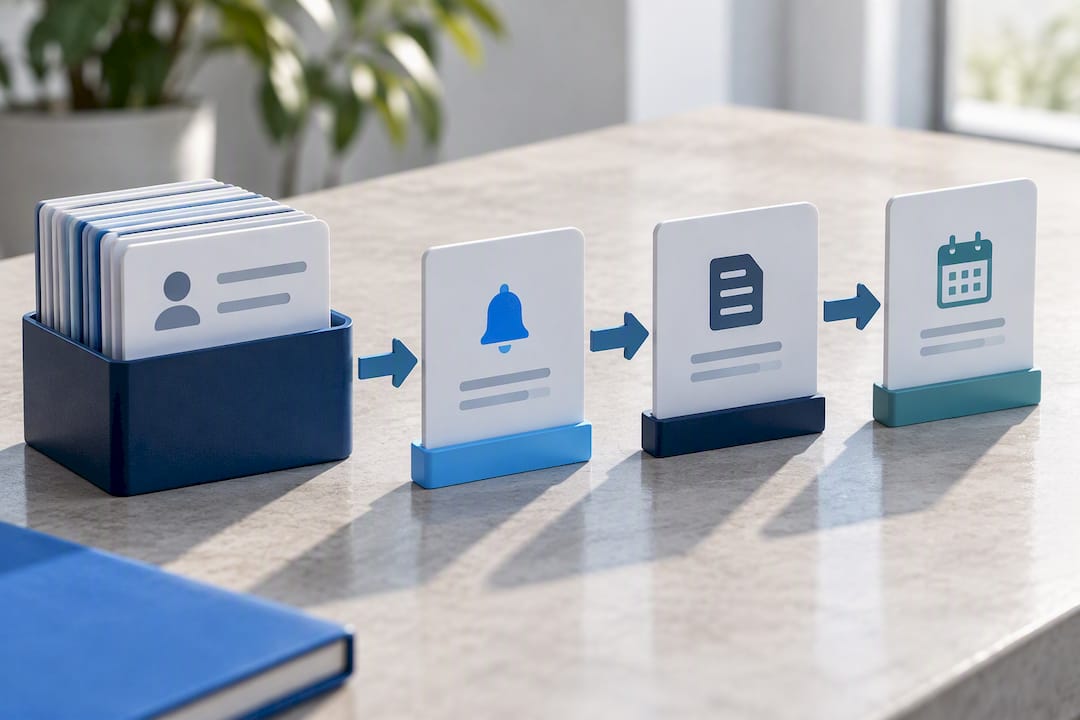
On-site maintenance-plan enrolment is a strong example. Customers already on-site for one job convert into recurring plan members at rates of 20 to 50%, according to MyAirCare's operational data, turning a single visit into ongoing revenue.
Two supporting habits matter just as much as the automation itself:
- Clean duplicate CRM records before launching a campaign, since a fragmented contact list wastes segmentation effort
- Route reply handling through consistent rules, whether automated triage or a dedicated team member, so responses don't sit unanswered
When should reactivation beat new customer acquisition?
Reactivation usually wins when historic customer lifetime value is decent, since HBR's research shows winning back a lapsed customer often costs less than acquiring a new one. If contacts have been dormant more than eighteen months, or CLV was always thin, acquisition is the better bet. Assign clear ownership and reply SLAs either way.
— Lewis
Running your reactivation flow through one booking platform
MyAirCare gives air-con cleaning businesses a cheaper way to run the reactivation tactics covered above than stitching together separate email tools, payment processors, and reminder systems. It combines online booking, automated job reminders, secure payments through Stripe, and customer records in one mobile-friendly system.

That matters directly for reactivation. Automated reminders keep past customers on a repeat schedule without manual follow-up, which is the non-discount lever this article recommends over blanket discounting. Branded booking pages and prefilled forms remove the friction that stops a willing customer from rebooking. If a reactivation campaign generates a spike in replies you can't answer fast enough, a service like 42Voice's HVAC answering support can help triage the overflow.
MyAirCare runs on a Free plan, with MyAirCare Pro available for businesses wanting the full feature set. Check current pricing and plans and set up your first automated reminder sequence today.
Sources
- Winning back lost customers
- 6 strategies for customer winback and reduce churn
- Customer win-back campaigns: 2026 retention playbook
- CRM reactivation campaign guide: templates, timing, results
- Customer reactivation with AI for small business: the 2026 playbook
FAQ
What does customer reactivation actually mean?
Customer reactivation means re-engaging customers who have stopped buying or interacting with your business, typically through targeted outreach that references their past relationship with you. It's distinct from retention, which focuses on customers who haven't yet lapsed.
What are some examples of effective re-engagement emails?
Effective re-engagement emails open with a specific reference to the past purchase or interaction, such as "Noticed it's been a while since your last service." The strongest sequences follow a value message first, then introduce an incentive only in the third or fourth message, per the 2026 retention playbook.
What is a reactivation campaign?
A reactivation campaign is a structured, multi-touch outreach sequence aimed at dormant customers, using segmentation, escalating messaging, and calibrated offers to bring them back. It typically runs three to four messages across email, SMS, or phone depending on customer value.
How do you keep customers coming back again and again?
Consistent post-purchase touchpoints, like automated booking reminders and maintenance-plan enrolment, keep customers engaged without relying on repeated discounting. Platforms like MyAirCare build these reminders directly into the booking process so repeat business happens automatically rather than through manual follow-up.
How much does MyAirCare cost to run reactivation campaigns?
MyAirCare offers a Free plan alongside the paid MyAirCare Pro tier, with full details listed on the pricing page. A booking fee also applies, with current rates available on the same page.