Improving indoor air quality to benefit occupant health and wellbeing starts with three actions that deliver the highest return for the least cost: eliminate or reduce pollutant sources, increase ventilation, and upgrade filtration. The US EPA confirms source control is the most effective and cost-efficient first step, followed by ventilation and air cleaning. Before spending on equipment, measure what you are dealing with using a CO2 monitor, a PM2.5 sensor, and a relative humidity (RH) gauge. Then work through this prioritised checklist:
Immediate actions (low cost, high impact):
- Stop all indoor smoking and prohibit it within the building perimeter
- Use a vented range hood every time you cook, and open a window if the hood recirculates
- Upgrade HVAC filters to MERV-13 or equivalent, which can reduce indoor PM2.5 by 50–85%
- Add a HEPA portable purifier in high-use rooms, sized to the room's floor area
- Control humidity to 40–50% RH to suppress mould and dust mite growth
Near-term operational fixes (weeks to months):
- Seal duct leaks, which commonly cause a substantial proportion of conditioned air loss
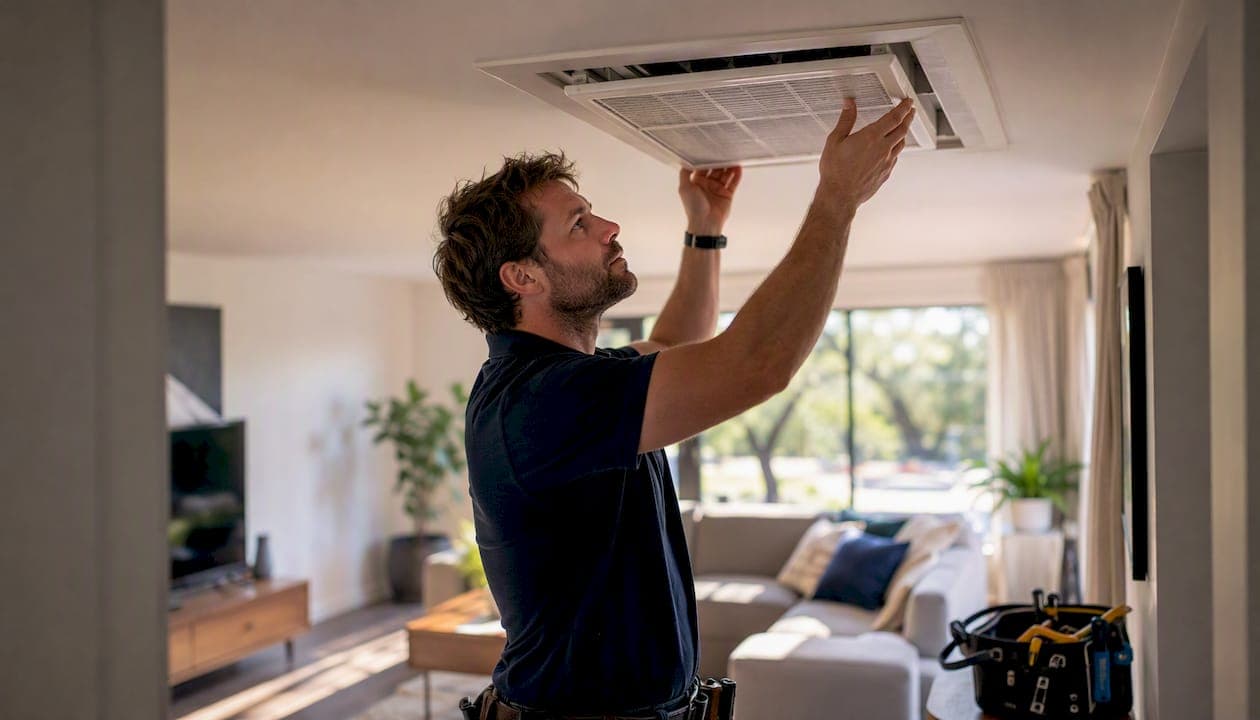
- Schedule HVAC coil cleaning, condensate pan checks, and filter replacement on a fixed cadence
- Install mechanical ventilation with heat or energy recovery (HRV/ERV) where natural ventilation is insufficient
Strategic upgrades (capital investment):
- Whole-building filtration integrated into the HVAC system
- Energy-recovery ventilation to increase fresh air without proportional energy cost
- Material swaps to low-VOC paints, sealants, and flooring in renovation projects
Pro Tip: Measure first. A CO2 reading above 1,000 ppm in an occupied room signals inadequate ventilation. A PM2.5 reading above 25 µg/m³ (the Australian 24-hour standard) signals a filtration or source-control problem. Tackle whichever is worse before spending on the other.
Key takeaways
Improving indoor air quality and occupant health requires measuring first, eliminating sources second, upgrading filtration and ventilation third, and maintaining those systems on a consistent, documented schedule.
| Point | Details |
|---|---|
| Measure before acting | Use CO2, PM2.5, and RH sensors to identify the worst pollutant before spending on equipment. |
| Source control first | Eliminating or reducing pollutant sources is the most cost-effective first step, per US EPA guidance. |
| MERV-13 filtration | Upgrading to MERV-13 filters can reduce indoor PM2.5 by 50–85% at low cost. |
| Ventilation for CO2 and gases | Filtration alone does not reduce CO2 or VOCs; ERV/HRV ventilation is required for those pollutants. |
| MyAirCare for operators | MyAirCare automates reminders, before/after documentation, and payments to keep maintenance reliable and traceable. |
Table of Contents
- Why indoor air quality matters for occupant health and wellbeing
- Evidence-backed interventions ranked by effectiveness
- What and where to measure for a practical IAQ audit
- Cost-effective maintenance routines that protect occupant health
- Design and material choices for new builds and retrofits
- Australian standards, compliance, and when to get specialist help
- How routine maintenance translates to measurable health outcomes
- Do indoor plants actually improve air quality?
- How occupant behaviour shapes indoor air quality every day
- Occupant health should be a measurable management objective
- MyAirCare gives air-con cleaning businesses the tools to make maintenance reliable
- Sources
Why indoor air quality matters for occupant health and wellbeing
Indoor air quality (IAQ) refers to the chemical, biological, and physical characteristics of air inside a building as they relate to occupant health and comfort. Indoor environmental quality (IEQ) is the broader term, covering IAQ alongside thermal comfort, acoustics, and lighting. Both directly affect how people feel, function, and stay well.
The health evidence is substantial. A broad literature review found that IEQ factors, including ventilation rates, PM2.5 concentrations, and VOC levels, affect physical and mental health outcomes. Higher ventilation rates are associated with reduced respiratory symptoms and measurable productivity gains. In one set of cited studies, sick leave linked to sick building syndrome dropped when ventilation increased from 12 L/s to 24 L/s per person.
Common indoor pollutant sources include:
- Combustion: gas stoves, unflued heaters, candles, and tobacco smoke
- Building materials: VOCs from paints, adhesives, carpets, and composite wood products
- Biologicals: mould, dust mites, pet dander, and pollen tracked indoors
- Particulates: PM2.5 from cooking, printers, and outdoor infiltration
- Occupant activities: cleaning products, personal care sprays, and air fresheners
Statistic: Ventilation rates in offices that doubled from approximately 20 cfm/person to 40 cfm/person were associated with significant improvements in cognitive performance, with estimated economic benefits that far exceeded the per-person energy cost of the additional fresh air.
Australian guidance from Health reinforces these findings and provides practical national advice on protecting occupant health through ventilation and source control.
Evidence-backed interventions ranked by effectiveness
Not all IAQ interventions perform equally across pollutant types. Filtration addresses particulates; ventilation addresses CO2 and gaseous pollutants; source control addresses both. Combining approaches is more effective than relying on any single strategy.
| Intervention | Pollutant reduced | Expected reduction | Typical cost/difficulty |
|---|---|---|---|
| MERV-13 filter upgrade | PM2.5 | 50–85% | Low cost, low difficulty |
| ERV/HRV installation | CO2, humidity | Significant | Moderate cost, moderate difficulty |
| Vented range hood | Cooking PM2.5, VOCs | High during cooking | Low–moderate cost |
| Portable HEPA purifier | PM2.5 (room level) | Moderate–high | Low cost, very low difficulty |
| Source elimination | All pollutants from that source | Complete for that source | Zero cost |
| Humidity control (40–50% RH) | Mould, dust mites | High biological risk reduction | Low–moderate cost |
| Duct sealing | PM2.5, energy loss | High (substantial air loss recovered) | Moderate cost |
Pro Tip: When selecting a MERV-13 filter, check that your HVAC fan can handle the increased static pressure. Some older systems need a fan speed adjustment or a slightly lower MERV rating (MERV-11) to maintain adequate airflow. A filter that restricts airflow too much can reduce system efficiency and shorten equipment life.
UVGI (ultraviolet germicidal irradiation) has a reasonable evidence base for inactivating biologicals, particularly mould and bacteria, within HVAC ducts and coil sections. Photocatalytic oxidation (PCO) has a less consistent performance record and can generate by-products; it is not recommended as a primary strategy until product-specific testing is available.
Portable HEPA purifiers are effective at the room level but do not address whole-building air. The Victorian government's guidance on choosing an air purifier recommends matching the purifier's CADR rating to the room size and selecting models with both HEPA and activated carbon filtration to address particulates and VOCs together.
Filtration alone does not remove CO2 or most gaseous pollutants. Ventilation is the only reliable approach for those, which is why combining MERV-13 filtration with ERV/HRV ventilation delivers the broadest pollutant coverage.
What and where to measure for a practical IAQ audit
Monitoring converts guesswork into a prioritised action list. The core metrics for most buildings are CO2, PM2.5, total VOCs, relative humidity, and temperature.
Target thresholds for occupied spaces:
- CO2: below 800 ppm is good; 800–1,000 ppm indicates marginal ventilation; above 1,000 ppm requires immediate ventilation improvement
- PM2.5: below 25 µg/m³ (24-hour average, aligned with Australian air quality standards)
- Relative humidity: 40–50% RH; below 30% increases viral persistence, above 60% promotes mould
- Temperature: 20–26°C for most occupied spaces; deviations affect both comfort and pollutant behaviour
Sensor placement rules:
- Place sensors in occupied zones at breathing height (approximately 1.0–1.5 m above floor level)
- Keep sensors away from doors, windows, and supply air vents, which distort readings
- Do not use kitchen or bathroom readings as background references; measure in living areas, offices, or bedrooms instead
- For continuous monitoring, one sensor per distinct zone (open-plan floor, bedroom, meeting room) gives usable data
Basic IAQ audit checklist:
- Record baseline CO2, PM2.5, and RH readings during peak occupancy
- Note any obvious pollutant sources (gas appliances, recent painting, visible mould)
- Check filter condition and date of last replacement
- Inspect supply and return vents for blockages or visible contamination
- Measure again after any intervention to confirm improvement
Spot checks are useful for identifying problems. Continuous monitoring is more valuable for validating that interventions are working and for building a data record that supports management decisions. Before-and-after sensor logs attached to job records are a practical way to demonstrate measurable outcomes to building owners and facility managers.
Cost-effective maintenance routines that protect occupant health
Routine HVAC servicing and well-organised maintenance programmes are among the most cost-effective strategies for protecting occupant health and building assets. FacilitiesNet research supports programmed servicing over reactive repairs, noting that automating maintenance cycles increases reliability and client trust.
Recommended maintenance schedule:
- Monthly: Inspect filters; replace MERV-13 filters every 60–90 days or earlier if visibly loaded
- Quarterly: Clean evaporator coils, check condensate drain pans for standing water, and inspect fan motors
- Bi-annually: Full system service including duct inspection, refrigerant check, and coil deep clean
- Annually: Commission a full IAQ audit with sensor measurements before and after servicing
Routine duct cleaning is not warranted unless contamination (mould, vermin, or significant debris) is visible. Unnecessary cleaning can disturb settled particulates and temporarily worsen air quality.
Pro Tip: Attach before-and-after photos and sensor readings directly to job records and invoices. This before/after documentation gives clients tangible evidence of the work performed and is one of the most effective tools for securing recurring service agreements.
Platforms like MyAirCare automate the reminder and scheduling cycle, reducing missed jobs and keeping maintenance on a consistent cadence. Operators can log before-and-after photos, record sensor readings, and issue invoices from the same mobile interface, creating a traceable evidence trail for every service visit.
Design and material choices for new builds and retrofits
Design decisions made at the planning stage have a disproportionate effect on long-term IAQ. Retrofitting ventilation or replacing materials after construction is significantly more expensive than specifying them correctly at the outset.
Ventilation design principles:
- Specify mechanical ventilation with modulation (demand-controlled ventilation using CO2 sensors) rather than fixed-rate systems
- Avoid recirculating range hoods; specify ducted hoods vented to the exterior
- Plan service access to all HVAC components at the design stage; inaccessible coils and filters are rarely cleaned on schedule
Material procurement checklist:
- Specify low-VOC or zero-VOC paints, primers, and sealants for all interior surfaces
- Choose hard flooring (timber, polished concrete, or vinyl plank) over carpet in spaces where allergen control is a priority
- Specify low-emitting composite wood products (E0 or E1 formaldehyde emission class) for cabinetry and joinery
- Use low-VOC adhesives for flooring and wall coverings
Pro Tip: In Australian climates, hybrid ventilation strategies, combining passive cross-ventilation with mechanical backup, can reduce energy costs while maintaining adequate fresh air supply. In tropical and subtropical climates (Queensland, Northern Territory), humidity control is the dominant design challenge; specify dehumidification capacity in addition to cooling.
Passive design benefits vary significantly by Australian climate zone. In temperate southern climates, cross-ventilation through opposing windows is effective for much of the year. In hot-humid northern climates, sealed, well-insulated envelopes with mechanical ventilation and dehumidification perform better. Seasonal considerations matter: winter in southern Australia concentrates indoor allergens and reduces natural ventilation opportunities, making HEPA filtration and periodic airing more important during those months.
Australian standards, compliance, and when to get specialist help
Several Australian authorities publish guidance and set minimum requirements for IAQ and ventilation in buildings.
Key Australian references:
- NCC/ABCB ventilation provisions: sets minimum ventilation requirements for health and amenity in residential and commercial buildings
- Health: national guidance on IAQ best practice and links to state resources
- Safe Work Australia: workplace IAQ obligations and guidance for employers managing occupant health risks
- yourhome.gov.au: passive design and ventilation guidance for Australian residential buildings
- Vic: state-level guidance on selecting air purifiers
AS 1668 (the Australian standard for mechanical ventilation in buildings) sets minimum outdoor air rates for commercial and public buildings. Designers and building operators should reference both AS 1668 and the NCC ventilation clauses when specifying or assessing systems.
Decision triggers for engaging an IAQ specialist or engineer:
- Repeated occupant illness or complaints that persist after basic source control and ventilation improvements
- PM2.5 or VOC readings that remain elevated after filter upgrades and source elimination
- Visible mould covering more than one square metre, or mould in HVAC ductwork
- Post-renovation exposures (new materials, adhesives, or coatings) with persistent odour or symptoms
- Workplace compliance requirements under Safe Work Australia guidance
- Any building where radon testing has not been conducted (particularly in areas with known geological risk)
Specialists can conduct advanced testing (including radon, formaldehyde, and biological sampling), design whole-building mitigation strategies, and manage HVAC remediation. Radon mitigation is cost-effective where testing confirms elevated levels; sub-slab depressurisation is the standard approach for residential buildings.
How routine maintenance translates to measurable health outcomes
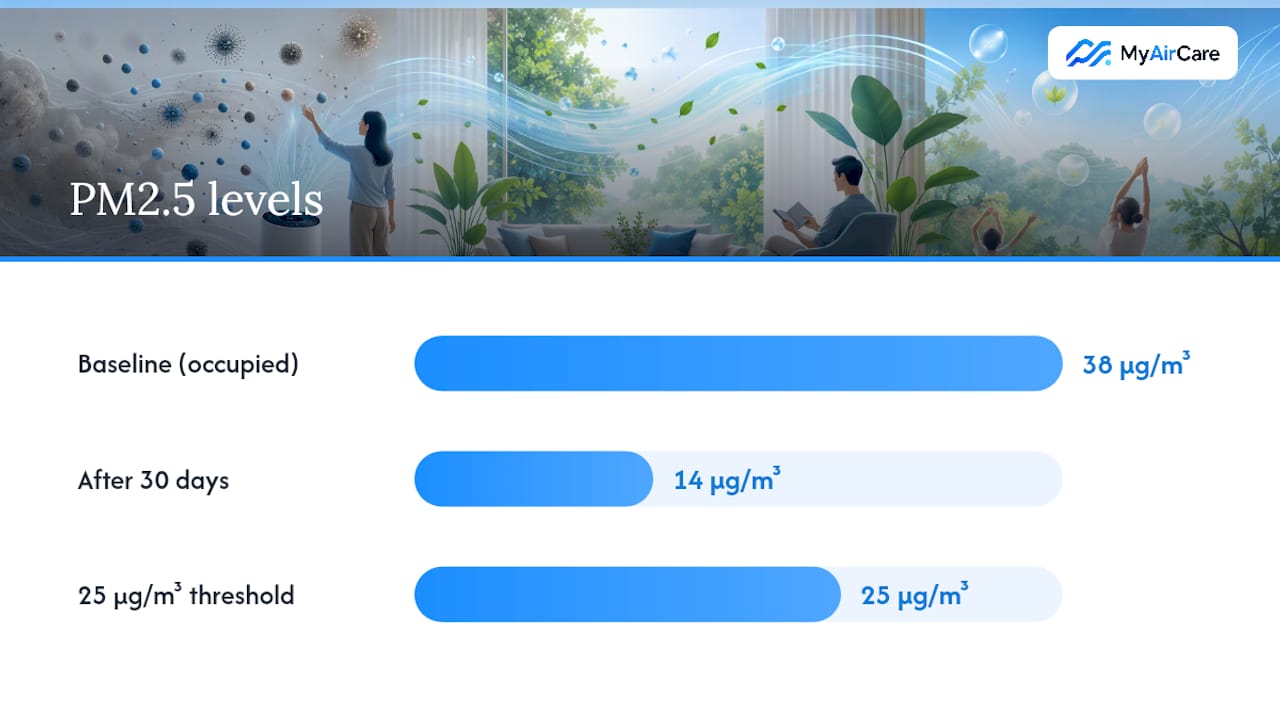
A residential property in Queensland presented with occupant complaints of persistent respiratory irritation and elevated dust levels. Baseline measurements recorded PM2.5 at 38 µg/m³ during normal occupancy and CO2 peaking at 1,150 ppm in the main living area. The HVAC system had not been serviced in over 18 months, and the installed filter was a standard fibreglass panel with no meaningful PM2.5 capture rating.
Interventions performed:
- Filter upgraded to MERV-13
- Evaporator coil and condensate pan cleaned
- Two supply duct joints sealed where visible leakage was confirmed
- Portable HEPA purifier added to the main bedroom
Measured outcomes after 30 days:
- PM2.5 reduced to 14 µg/m³ (below the 25 µg/m³ threshold)
- CO2 peak reduced to 820 ppm following minor window ventilation adjustments
- Occupant-reported respiratory symptoms resolved within two weeks
A follow-up service was scheduled at 90 days using automated reminders. Before-and-after photos and sensor readings were attached to the job record and shared with the client, providing clear evidence of the improvement.
Operational insight: Attaching sensor data and photos to every job record converts a one-off service visit into a documented health outcome. Clients who receive this evidence are significantly more likely to book recurring maintenance, and operators who provide it build a defensible record for compliance and warranty purposes.
Platforms like MyAirCare support this workflow directly: operators can log before-and-after photos, record job notes, and issue invoices from a mobile app, with automated reminders sent to clients ahead of the next scheduled service.
Pro Tip: Schedule the follow-up service at the point of completing the first job, not after the client calls back. Automated reminders sent 7–10 days before the due date reduce no-shows and keep the maintenance cadence on track without manual follow-up.
Do indoor plants actually improve air quality?
The short answer is: modestly, and not in the way most people expect. NASA's 1989 clean air study, which is widely cited as evidence that houseplants remove VOCs, was conducted in sealed chambers with conditions that bear little resemblance to a ventilated room. In a typical occupied space, the number of plants needed to produce a meaningful reduction in VOC concentration would be impractical.
What plants do reliably provide is a measurable wellbeing benefit. Studies consistently find that the presence of plants in workplaces and homes is associated with reduced stress, improved mood, and higher reported satisfaction with the indoor environment. These are genuine IEQ outcomes, even if the air chemistry effect is small.
For occupant wellbeing, a few well-maintained plants in visible locations are a low-cost, evidence-supported addition to any indoor space. For air quality, they are a supplement to, not a substitute for, ventilation, filtration, and source control. Overwatered plants can also contribute to mould and elevated humidity, which works against IAQ goals.
How occupant behaviour shapes indoor air quality every day
Building systems set the ceiling for IAQ performance, but occupant behaviour determines whether that ceiling is reached. The most well-specified ventilation system delivers no benefit if occupants block supply vents with furniture, disable exhaust fans, or prop fire doors open.
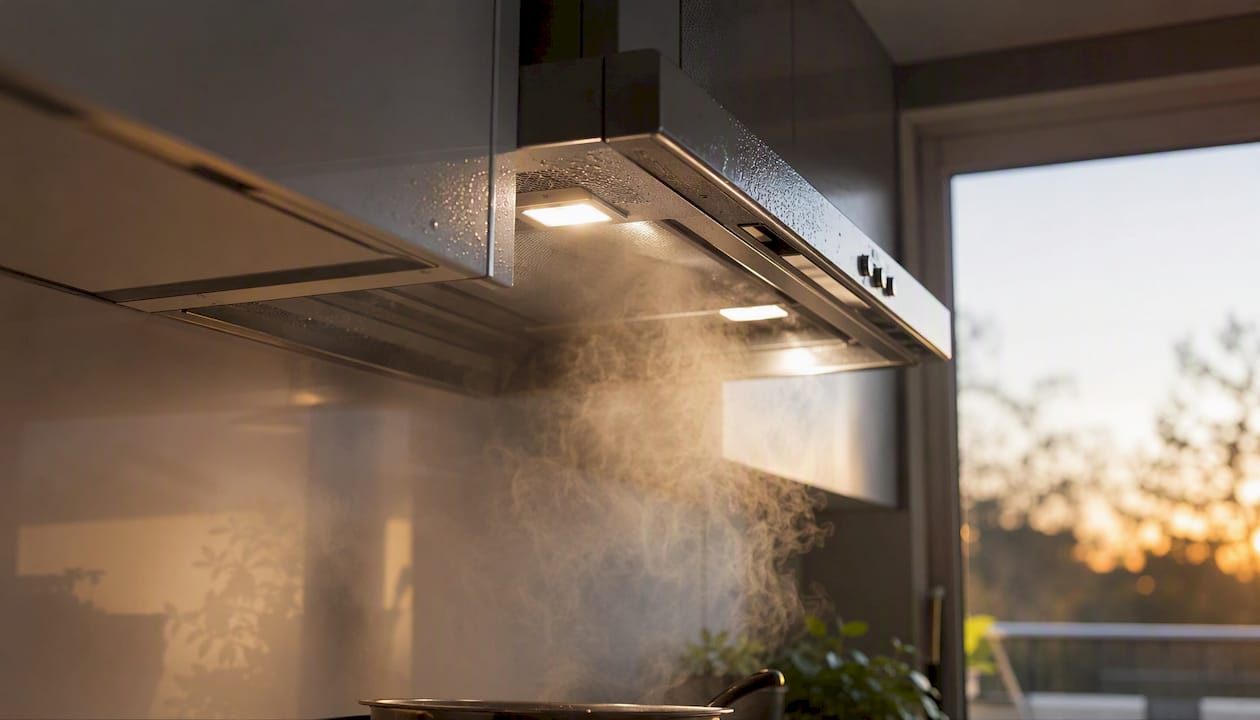
Practical behaviours that consistently improve IAQ include opening windows for short periods during mild weather, using exhaust fans during and after cooking and showering, and avoiding aerosol sprays and strongly scented cleaning products indoors. Keeping entry mats clean and removing shoes at the door reduces particulate load from outdoor sources, which is particularly relevant in Australian urban areas during bushfire season or high-pollen periods.
Occupant education is an underused lever. Building managers who brief occupants on why ventilation matters and what specific behaviours help tend to see better IAQ outcomes than those who rely on systems alone. A one-page guide posted near HVAC controls or distributed at tenancy start is a low-effort, high-return communication tool.
Seasonal behaviour matters too. In southern Australia during winter, occupants tend to seal buildings tightly to retain heat, which concentrates indoor pollutants. Brief daily airing, even for 10–15 minutes, significantly reduces CO2 and VOC accumulation without meaningful heat loss in a well-insulated building.
Occupant health should be a measurable management objective
The conventional framing of IAQ as a compliance checkbox misses the economic case entirely. Research modelling office buildings found that the productivity gains from doubling ventilation rates far exceeded the per-person energy cost of the additional fresh air, particularly when energy recovery ventilators were used to reduce the thermal penalty.
Building managers who treat IAQ as a measurable outcome, rather than a background condition, tend to make better decisions. Measuring before and after an intervention, documenting the results, and reporting them to stakeholders converts maintenance from a cost centre into a demonstrable asset. The operational mindset is straightforward: measure, fix the worst source, standardise the maintenance cycle, and monitor results. Repeating that cycle consistently delivers compounding health and productivity benefits that a single capital upgrade rarely matches.
The gap between what most buildings achieve and what is technically possible with existing systems and low-cost interventions is large. Operators and managers who close that gap through disciplined maintenance and monitoring create environments where occupants are healthier, more productive, and more satisfied, outcomes that are measurable and defensible to any stakeholder.
MyAirCare gives air-con cleaning businesses the tools to make maintenance reliable
Air-con cleaning operators who want to turn one-off jobs into consistent, evidence-backed maintenance programmes need more than a good service. They need a system that keeps jobs on schedule, captures the evidence clients expect, and handles the administrative side without manual effort.

MyAirCare is built specifically for Australian air-con cleaning businesses. The platform handles online booking, automated client reminders, before-and-after photo records, Stripe-secured payments, and mobile job management from a single interface. Operators can schedule follow-up services at the point of completing a job, attach sensor readings and photos to the job record, and issue invoices without returning to the office.
For building managers, the result is a traceable maintenance history that supports compliance reporting and demonstrates measurable IAQ outcomes. For operators, it means fewer missed jobs, less time on administration, and a stronger case for recurring service agreements. Myaircare to see how it fits your operation.
Sources
- Improving Indoor Air Quality | US EPA
- Impact of indoor environmental quality on occupant well‑being and comfort: A review of the literature
- How to Improve Indoor Air Quality: 10 Proven Methods Ranked by Effectiveness (2026) | HVAC Base
- Economic, Environmental and Health Implications of Enhanced Ventilation in Office Buildings
- Health
- Ncc