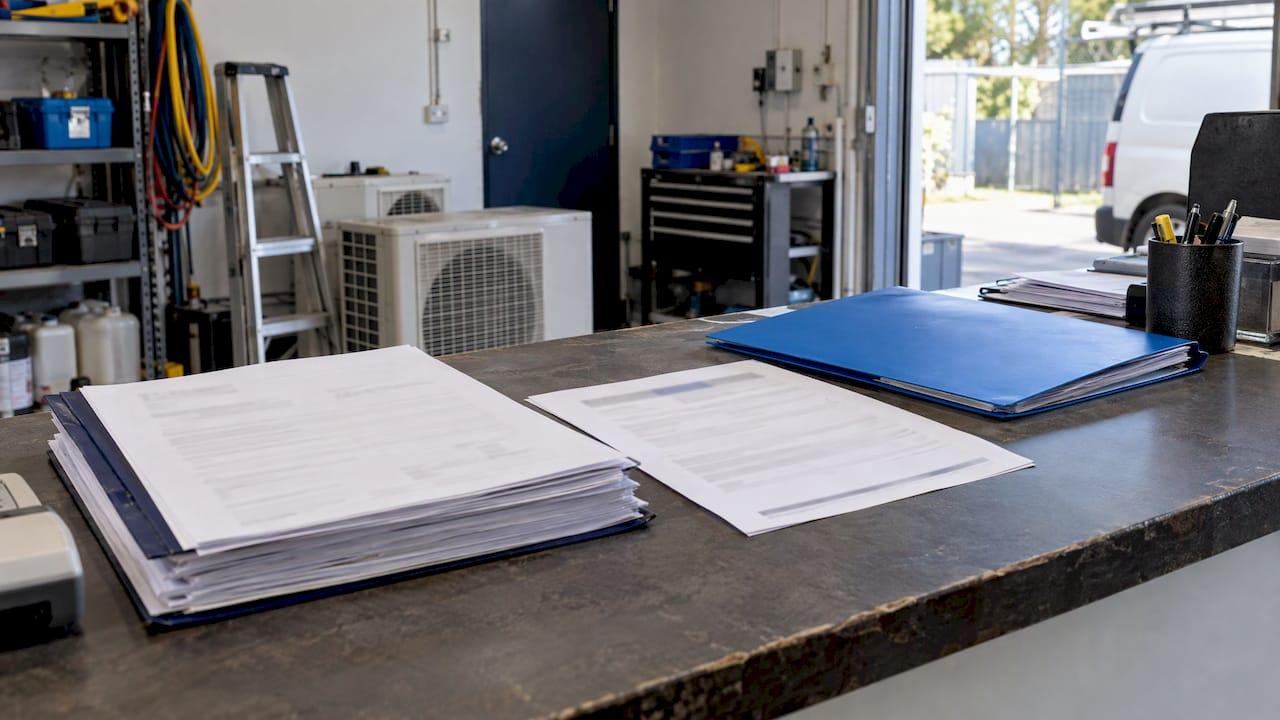
An air-conditioning cleaning business in Australia is usually insured through public liability cover as the core policy, with workers compensation added once staff or deemed workers are engaged, and tools and vehicle cover added for equipment. The type and level of cover is set by the work performed, the customers served and the state or territory. Clear job records, quotes and invoices support every policy, and MyAirCare's software keeps those records in one place alongside bookings and payments.
TL;DR
- Public liability is the central policy for aircon cleaners: it responds when a customer or member of the public is injured or their property is damaged because of the operator's negligence.
- Workers compensation is mandatory in every state and territory once a business has employees, and contractors can be treated as workers even with their own ABN.
- Public liability for cleaners typically costs about $455 to $842 a year, with the limit ($5m, $10m or $20m) often set by the client type.
- The policy should record the actual services performed (split systems, coil treatment, duct cleaning), because an occupation label does not guarantee every task is covered.
- Dated before and after photos, quotes and invoices make incidents easier to resolve and are kept in the job record in MyAirCare.
Table of Contents
- Why insurance matters in this trade
- The main policies for an aircon cleaning business
- Sole traders, employees and subcontractors
- What public liability costs
- How much cover customers expect
- Policy wording to check before signing
- Records that support a claim
- Insurance in the wider business plan
- Starting and running the business with MyAirCare
- Perspective
- FAQ
- Sources
Why insurance matters in this trade
Aircon cleaning takes place inside customers' homes, offices and strata buildings. The work involves water, cleaning chemicals, ladders and electrical components. A chemical or water leak into an indoor unit can damage electronics, and a fall or a damaged ceiling can lead to a claim much larger than a job's fee.
No single Australian law requires every HVAC business to hold insurance. According to a 2026 cost guide from an insurer, clients, sites and contracts commonly require it instead. In practice, that makes cover a condition of winning work, particularly with strata managers and commercial sites. business.gov.au notes that some states and territories require public liability insurance for certain occupations, so the rule for a particular business depends on location and activity.
The main policies for an aircon cleaning business
Public liability
business.gov.au describes public liability insurance as cover for when someone dies, is injured or has property damaged because of the business's negligence. That includes injury or death, emotional distress or a recognised psychiatric illness, property damage such as causing a fire, and consequential loss where negligence causes another business to lose expected revenue.
Allianz Australia explains that the policy pays compensation the business is legally liable for, up to the policy limit, plus reasonable legal fees. For an aircon cleaner, typical scenarios include water damage to a floor from a blocked drain line, a customer tripping over equipment, or damage to a customer's indoor unit.
Workers compensation
Workers compensation covers injury or illness to people working for the business. business.gov.au states that it is required if a business has employees. Allianz adds that it is mandatory in all states and territories for businesses with employees, and that it is bought as a separate policy rather than being part of its Business Insurance Pack.
Tools, equipment and vehicles
Public liability does not pay for the operator's own losses. Upcover's guide says the policy does not pay for tools, a van, the operator's own injury or rework. Pumps, pressure washers, steam equipment and a van are the core assets of a mobile cleaning business, so tools and motor cover are separate items to price. business.gov.au also notes that third party personal injury insurance applies if a business uses motor vehicles, and is often part of the vehicle registration fee.
Professional indemnity
Professional indemnity responds to advice claims rather than physical damage. Upcover says it matters for those who design, size or specify systems, and that install-only work is mainly a public liability exposure. A cleaner who also recommends equipment, or who works under a commercial contract that calls for it, can ask the insurer whether this cover is needed.
Sole traders, employees and subcontractors
The workers compensation position is where most new operators are caught out. The rules differ by state, and the label on an arrangement does not decide the outcome.
Sole traders working alone. WorkSafe Victoria states that sole traders and individual partners or trustees who do not employ other workers do not need to register for WorkCover. WorkCover Queensland says a sole trader is not covered by an employer's accident insurance policy, but optional workplace personal injury insurance is available to self-employed people, contractors, partners, directors and trustees. A solo operator who wants income protection after an injury can look at that kind of cover.
Employees. SIRA in NSW states that most employers must hold a workers compensation policy, covering all workers and listed deemed workers, with total wages and worker numbers declared to a licensed insurer. In Queensland, WorkCover says an employer must insure workers with an accident insurance policy. Victoria has an exemption where an employer has no apprentices and pays no more than $7,500 in remuneration in a financial year, according to WorkSafe Victoria, and unregistered employers can face severe penalties.
Subcontractors. SIRA explains that whether a person is a contractor or an employee depends on the nature of the relationship, not on what it is called, and that an ABN alone is not a definite indicator. WorkCover Queensland's wages manual states that sole traders and individual contractors can be deemed workers even with their own ABN or business name, and names cleaners among the trades this may apply to. Allianz also warns that subcontracted cleaners may not be covered by the workers compensation policy of the person engaging them, and that a subcontractor's work may not be covered for liability by the primary contractor.
For an operator growing from solo work to a small team, the practical sequence is to confirm each person's status with the state regulator and insurer before the first additional person starts, then declare wages accurately.
State and territory regulators
Each jurisdiction has its own scheme and regulator. A business insurance summary of the eight schemes sets out the differing triggers: in Queensland, employing a worker is the whole trigger with no threshold; in South Australia, cover must be registered within 14 days of employing; in Victoria, registration must reach WorkSafe within 60 days of becoming eligible. Operators working across borders, such as in the Northern Territory and Queensland, check the rules in each place where workers are engaged.

What public liability costs
Premiums vary with turnover, client type, staff, subcontractors and whether tools are included. ASBG's guide for cleaners, drawing on policy data from 2022 to 2026, reports that most cleaners pay $455 to $842 a year for public liability, from about $24 a month. Its illustrative bands are:
| Cleaner profile | Approximate monthly cost |
|---|---|
| Solo domestic cleaner, $5m cover, no tools | $24 to $38 |
| Domestic cleaner, $10m cover, with tools | $50 to $70 |
| Cleaning business, $20m cover, with tools | From about $70 |
These are published 2026 figures for general cleaners, not quotes for aircon work. Aircon cleaning that includes duct work or access above ceilings is rated on the activities declared, so the insurer's own quote is the figure that applies.
Excess is the amount paid on each claim before the insurer contributes. A higher excess often lowers the premium, but it raises the cash needed after an incident. Selecting an excess the business can pay from a normal week's takings keeps a small claim from becoming a cash-flow problem.
How much cover customers expect
The level of cover is often set by who is hiring. ASBG's client-requirements table sets out typical expectations:
| Client type | Typical public liability expectation |
|---|---|
| Private homeowners | Often nothing in writing; $5m is the usual entry level |
| Strata companies, body corporate common areas | $10m, sometimes $20m |
| Offices, medical practices, commercial sites | $10m minimum, often $20m |
| Government contracts, shopping centres, hospitals, large commercial premises | $20m |
The same guide notes that Victorian government schools must engage cleaning providers with at least $10 million of public liability and obtain copies of public liability and WorkCover certificates of currency, per the Department of Education's cleaning policy updated in March 2026.
A certificate of currency is the insurer's document confirming that a policy is active and stating its limit. Strata managers and tender panels ask for it routinely. Operators aiming at those clients usually set the limit to the higher bracket from the start. MyAirCare's guide to winning strata contracts covers how that work is approached, and its tenders page is aimed at the same segment.
Policy wording to check before signing
Two policies with the same limit can respond very differently. The checks below come from insurer and broker guidance.
- List the actual services. Cockatoo's guide for air-conditioning cleaners advises starting with the work performed, such as split-system cleaning, coil treatment, duct cleaning and work in occupied premises, and having the insurer record the accepted activities rather than assuming the occupation name includes every service.
- Test a realistic scenario. The same guide suggests running a case such as cleaning fluid entering an indoor unit and damaging electronics, asking about property being worked on, chemical use and subsequent water damage separately.
- Read the exclusions. Upcover lists wording points: faulty workmanship and rework, asbestos in older ceiling spaces and plant rooms, ammonia or industrial refrigerant plant, subcontractors, consequential loss and overseas work. It also notes that height caps and hot-work conditions differ between insurers.
- Know the general exclusions. Marsh Australia lists intentional damage, wear and tear and illegal activities as matters many policies typically do not cover, with specifics varying by policy.
- Match the limit to the target customer. Use the table above and the written requirements of the strata manager or tender.
Licensing sits beside insurance
Insurance does not replace licences. According to upcover, handling fluorocarbon refrigerant requires a refrigerant handling licence, a business acquiring or disposing of regulated refrigerant needs a Refrigerant Trading Authorisation (both administered by the Australian Refrigeration Council), and hard-wiring a condenser is electrical work requiring a state licence. A cleaner who adds repairs or installation to the service list tells the insurer, because the activity changes the cover required.
Records that support a claim
When a customer alleges damage, the outcome often depends on what the business can show: the condition of the unit before the job, what was done, what the customer agreed to and when. Insurers and customers both look for that record.

MyAirCare's mobile app supports before and after service documentation and job tracking, and quotes, invoices and customer details sit in the same system as the booking. Service terms can be customised, so the scope of each job is written into the booking page. The aircon service checklist covers the compliance and proof steps technicians can record on each visit, and the options-based quoting guide shows how to state what is and is not included in a quote. Correct tax documents matter as well, and the invoice and receipt rules are set out for Australian operators.
Communication records have the same role. Tools that handle automated lead response for HVAC businesses keep a log of calls, texts and follow-ups, which helps establish what a customer was told and when.
Insurance in the wider business plan
Insurance is one fixed cost among several. A new operator sets it against software, equipment, training and marketing when pricing jobs. MyAirCare publishes its plans on its pricing page: a Free plan at $0 per month, MyAirCare Pro at $199 per month, and an AI phone agent at $29 per month. A comparison of the subscription and booking-fee models is in the pricing guide for aircon software. Operators who are still deciding whether to start can read about going live in Brisbane with GST invoices.
Starting and running the business with MyAirCare
For people entering the trade, MyAirCare Training is a one-off $2,990 and covers structured air conditioning hygiene training. MyAirCare Business in a Box is a one-off $24,990 and combines equipment, training, software, business setup and launch support. Both are for operators building a business under their own brand, without franchise royalties. Booking, scheduling by service area and travel time, reminders, quotes, invoices and Stripe payments are handled in the MyAirCare software, so that records and admin are in order from the first job.
Details of every plan and package are on the MyAirCare site.
Perspective
We built MyAirCare out of experience running an air-con cleaning business, and the pattern is consistent: the operators who handle insurance well are the ones who treat it as part of how the business is organised, not as a form filled in once.
The scope of each job should be written down before the work starts, the condition of the unit should be photographed, and the invoice should match what was agreed. That is the same information an insurer, a strata manager or a tender panel asks for. Our software and training are designed around that routine, so that a booking, a quote, a photo record and a payment sit together for every customer.
Starting under an own brand also means choosing policy limits that match the customers wanted. An operator who targets strata and commercial work sets the limit for those clients from the beginning, and builds the systems to evidence it.
Lewis
FAQ
Is public liability insurance compulsory for aircon cleaners?
No single national law requires it for every HVAC business. business.gov.au says some states and territories require it for certain occupations. Most strata managers, commercial sites and tenders require it in writing, so it is treated as essential in practice.
How much public liability cover does an aircon cleaner need?
The level depends on the customer. Domestic work often starts at $5m, while strata and commercial sites commonly ask for $10m and large or government premises for $20m, according to ASBG. The written requirement in the contract or tender is the figure to follow.
Does a sole trader need workers compensation?
In Victoria, sole traders who employ no other workers do not need to register. Once someone else is engaged, the position changes, and contractors with their own ABN can still be treated as workers. The state regulator and the insurer confirm the position for each arrangement.
Does public liability cover the cleaner's tools and van?
No. Public liability responds to harm to other people and their property. Upcover notes that tools, a van and the operator's own injury are separate. Tools and motor cover are arranged as their own items.
Sources
- Types of business insurance, business.gov.au
- Insurance for Cleaners, Allianz Australia
- Insurance for air conditioning cleaning, Cockatoo
- Workplace personal injury insurance, WorkCover Queensland
- Who should I cover?, WorkCover Queensland
- Wages definition manual, WorkCover Queensland
- Construction and workers compensation, SIRA
- How to get workers compensation insurance, SIRA
- Do I need to register for WorkCover insurance?, WorkSafe Victoria
- Air conditioning and HVAC insurance cost guide, upcover
- Public liability insurance for cleaners, ASBG
- Cleaners' insurance cover, Marsh Australia
- Business insurance in Australia, OpenStream
- Automated lead response for HVAC businesses